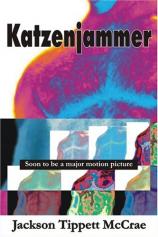
Katzenjammer
Soon to be a major motion picture
by Jackson Tippett McCrae
List Price: $23.00
Pages: 359
Format: Paperback
ISBN: 0971553637
Publisher: Enolam Group Inc

Katzenjammer is the story of a first-time novelist struggling in New York. The book's main character, Max Perkins, feels cursed by having the same name as that of the famous editor to Hemingway, Wolfe, and Fitzgerald. Max's attempts to get recognized finally land him in the readers' department of Bandomday Books where the plot to get his book published takes on mind-bending twists and turns, eventually becoming a Faustian comical journey. Encompassing everything from Russian pianists, male prostitution, and insane bosses, to the Mormon religion, the New York arts scene, hermaphrodites, dwarfs, and the inner workings of corporate America, Katzenjammer is a scathing, hilarious, and quixotic look at what it takes to get published today.
A scathing, quixotic, and Faustian look at the Publishing Industry, Jackson McCrae's new novel Katzenjammer takes us into the mind of Max Perkins-a first-time movie-obsessed novelist attempting to get his work published in New York. In this, his third book, McCrae strips away the media-created and hyped veneer of being a published author and shows us what it really takes to get your book on the bestseller list. The result is not always pretty but it is highly informative, hilarious, and above all, entertaining. Encompassing everything from Russian pianists, male prostitution, and insane bosses, to the Mormon religion, the New York arts scene, hermaphrodites, dwarfs, and the inner workings of corporate America, Katzenjammer is a ribald and adventurous romp through New York, publishing, and the world of books.
top of the page

1. How many references to the past can you find in the book? How do many of the references tie in with movies mentioned in the novel?
2. The original Max Perkins was fond of saying “The book belongs to the author.” Why is this ironic given the experience of Max Perkins in Katzenjammer and his experience with publishing?
3. The original Max Perkins was of a New England temperament and possessed many dichotomies. How is he similar to the Max Perkins in Katzenjammer?
4. The original Max Perkins once said, “When a man does you a favor, he owns a little piece of you.” How does this compare to the favors that Robert does for Katzenjammer’s Max Perkins?
5. How do music, art, dance, and film figure into this novel?
6. Compare how Katzenjammer gets published and whose name gets attached to it, with the story of Robert and his attempted entry into a piano competition (chapter one).
7. What part do the epigrams play at the beginning of the different sections in the novel?
8. Discuss the “What you hate, you become” theme.
9. For all the discussion and themes of sex, there is no actual traditional sex act in the novel. Why do you think this is?
10. What do you notice about the number of chapters in this novel (excluding the prologue and epilogue)? How is the number significant? What sexual connotation does it have?
11. What do you notice about the climactic chapter in the novel? Why is its chapter number significant?
12. Discuss the different writing styles used in the novel. Contrast the “Scene” sections with the rest of the writing. Also, discuss the author’s style when describing music (New York Philharmonic concert and the jazz in the night club). How are the styles related to the music the characters are listening to?
13. Discuss the style of writing whenever movies are mentioned.
14. Even though Max is aware that people are using him at times, he nevertheless continues associating with them (Reeda Rot, Robert, certain bosses). How does this figure in with the epigram(s) at the beginning of the epilogue?
15. Discuss how the author ties together the idea of movies with fantasy, the story editor, and the general theme of the book.
16. What is the significance of the quote from the The Rubaiyat of Omar Khayyam? How does it fit in with the novel and the movie The Picture of Dorian Gray?
17. What is the significance of mentioning the “pothos vine” in the book? What is the common name for this vine?
18. How many references to movies can you find in the novel?
19. Discuss the idea of “What you say about other people is usually a reflection of yourself” and how it figures into the text.
20. How many references to the devil can you find in the text?
21. Compare this story to that of Faust. What are the similarities --- the differences?
22. At one point in the relationship between Thomas Wolfe and the original Max Perkins, Wolfe --- who was known for using his life and those around him in his writings --- decided to write about Scribners, Max, and things that Mr. Perkins had said to him in confidence. Contrast this with Katzenjammer’s “Max” and how he writes about the publishing world. In this particular article that Wolfe wrote --- “No More Rivers” --- he eventually changes the main character’s profession to be a concert pianist. How is this similar to what happens to Max in Katzenjammer?
23. Discuss the idea of paranoia. How does this relate to the book and movie Rosemary’s Baby?
24. Discuss the similarities between the magazine focus groups that Max attends and a group therapy session.
25. At the beginning of the novel, and then later on, the movie Midnight Cowboy is mentioned. Compare what happens in that movie to what happens in Katzenjammer. How many similarities can you find?
26. Where does the title of the book come from?
top of the page

"A modern day Faustian tale of madness, with the city of New York as a main character itself, Katzenjammer does just what books are supposed to do --- enlighten and entertain."
Jason McCuller, BookReads