IndieBound Independent Bookstores BRC Facebook Fan Page
Coming Soon
Reading Group Guide
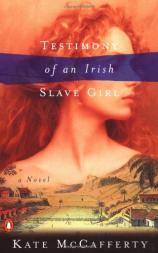
Testimony of an Irish Slave Girl
by Kate McCafferty

List Price: $13.00
Pages: 240
Format: Paperback
ISBN: 014200183X
Publisher: Penguin Books

Click here to buy this book from Amazon.com.
Click here to buy this book from Amazon.ca.


About This Book


Kate McCafferty's searing first novel explores a little-known episode of seventeenth-century history when colonial England forced thousands of Irish to labor in the sugarcane fields of Barbados. McCafferty delves into this rich historical terrain through the eyes and voice and memory of Cot Daley, kidnapped by the English when she was ten and shipped to the West Indies. Cot's testimony to Peter Coote, the ambitious apothecary sent to discover why Irish servants joined forces with African slaves to rebel against their English masters, takes the form of a rambling narrative, filled with digressions and self-reflections. Still defiant even though she has just been flogged, Cot insists on telling the facts of the uprising her way, and her way turns out to be not so much an unraveling of the plot to rebel as a moving and wide-ranging personal history.

The difference between what Peter Coote wants to hear and what Cot Daley wants to say lies at the very heart of the novel. Coote wants to know how and why the rebellion occurred and why Cot joined it. But Cot wants to express the evolution of her emotional life during the many years she has spent on the island. Peter wants facts he can deliver to his own masters to use for their purposes, but Cot wants him to know not just facts but how it feels to be a slave, to have one's child taken away, to suffer the brutality and indignity of being treated like an animal. Thus, Coote gets more than he bargains for, as Cot's story stretches out far beyond his comfort level into areas of human experience he'd rather not hear about. Coote is a doctor and at moments his natural human empathy emerges, allowing him to feel connected to Cot on a deeper level than interrogator to witness. After all, he too feels pressure from above, as those of higher military and aristocratic rank treat him with barely concealed contempt and order him to do their bidding, much in the same way as he issues orders to his servant Lucy and to Cot herself. Like Cot, Coote is also familiar with sadness and disappointment. His dreams of owning land in the colonies, of having a wife and family, of bringing honor to the British Empire and to himself have thus far been unfulfilled. At one point, a senator's wife even says to him, "His Excellency says you're up and coming. Cot, is it? Peter Cot?" (p. 109). This momentary confusion of names reveals an underlying similarity between Cot and Coote that has significant consequences for how we read the novel. For it is really a novel about connection, about who we identify with, who we see as being like us and who we cast out as different.

Initially, Cot identifies with her masters. She longs for the captain of the ship that brings her to Barbados to keep her. Once on the island, she falls in love with her first master, Henry Plackler, dreaming that he might take her away with him. Cot even betrays her fellow slaves and servants when she warns Plackler of their plot against him. She learns to hate herself, because others despise her, but she says "the one thing I never thought to hate was my master or my mistress. For those who harmed me were also the only ones who could redeem me from worse harm" (p. 94). But for this betrayal she feels a lasting remorse, and when she marries the African slave Quashey and begins to see all that the Africans and Irish have in common, she shifts her allegiance from the oppressors to the oppressed. Peter Coote, who hears her story, who indeed transcribes it for us, is not yet able to make such a leap. But Testimony of an Irish Slave Girl offers us a rich testament to why such a leap is so important.

top of the page


rgg_discuss.gif (1294 bytes)


1. How surprising was it to learn that in the seventeenth century the British Empire captured thousands of Irish men, women, and young boys—"tinkers, jugglers, peddlers, wanderings, idle laborers, loiterers, beggars, and such as could not give a good account of themselves" (p. vii)—and shipped them to work as slaves in the Indies? How does this historical episode alter your understanding of more recent conflicts between the British and the Irish?

2. Why does Kate McCafferty choose to tell this story in the voice of Cot Daley? Why has she structured her narrative around Cot's forced testimony to Peter Coote? What affects does McCafferty achieve through letting us see slave life in Barbados and the failed rebellion of 1675 through Cot's recollection of them?

3. Cot comes from a long line of seanachies, storytellers who "traveled the world in all its strangeness and brought back its songs, its tales and poetry and wisdom" (p. 5). In what ways is Cot herself a kind of poet? Why does she insist on telling her story the way she wants to tell it, filled with digressions of all kinds, instead of simply giving Coote the information he's after?

4. What kind of man is Peter Coote? What were his ambitions in coming to Barbados? In what ways is he like Cot Daley? At what points in the novel does he feel empathy and connection with her?

5. When Coote asks Cot if she "reported Mary Dove's plot because she had borne false witness against you?" Cot replies: "No! None of us had the right to tell the truth....The truth was the creation of our masters" (p. 70). In what sense do masters create the truth? How does Testimony of an Irish Slave Girl itself attempt to subvert the truth such masters have created?

6. Why does Cot betray the first slave rebellion against Sir Henry Plackler? Why does she so willingly participate in the Coromantee uprising of 1675? How has she changed in the intervening years?

7. What experiences lead Cot to stop identifying with her masters and begin to see the connections between herself and the African slaves? What does she find she has in common with the Africans? Why are the masters so worried about just such connections?

8. Testimony of an Irish Slave Girl is a historical novel about Barbados in the seventeenth century, but how is the story it tells relevant to our own time and place? What larger truths does it reveal about human motivations and human relationships? In what sense does Quashey's spirit live on?

9. Cot tells Coote that "every tribe of people think themselves the yardstick of Creation, and feel fear and distaste and suspicion of outsiders. But still, I tell you this is learned....In right circumstances, things like that melt away like morning haze" (p. 45). Do you agree with Cot's assessment of the origins of prejudice in the above passage? How does the novel dramatize this idea?

10. At the very end of the novel, when Peter Coote's son sends the manuscript of Cot's testimony to Betty, the narrator tells us that "he hears God laughing. But that's another tale: a tale not recorded here" (p. 204). Why would God laugh at the transmission of this story? How would the tale of that laughter unfold? Why has McCafferty chosen to end her novel in this way?

top of the page

Critical Praise

"Strange. Compelling. Unexpected. Just when the reviewer believes that there are no truly original first novels, along comes Kate McCafferty's Testimony of an Irish Slave Girl."
USA Today


"[McCafferty] creates a formidable heroine, and recovers, through the alchemy of research and imagination, a voice that history has tended to silence."
The Boston Sunday Globe


THE GIRLS FROM AMES


Become a Fan of ReadingGroupGuides.com on Facebook!


Bookreporter.com Bets On...: Books We're Betting You'll Love

Add Your Guide to ReadingGroupGuides.com!


Privacy Policy | Contact Us | Advertising | About Us

© Copyright 2001-2010, ReadingGroupGuides.com. All rights reserved.
The Book Report, Inc. • 250 West 57th Street • Suite 1228 • New York, NY • 10107
Ph: 212-246-3100 • Fax: 212-246-4640

Bookreporter.comReadingGroupGuides.comGraphicNovelReporter.comFaithfulReader.com
Teenreads.comKidsreads.comAuthorsOnTheWeb.comAuthorYellowPages.com