Reading Group Guide
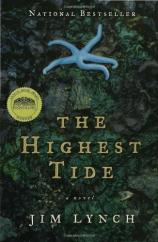
The Highest Tide
by Jim Lynch

List Price: $13.95
Pages: 272
Format: Paperback
ISBN: 1582346291
Publisher: Bloomsbury USA

Click here to buy this book from Amazon.com.
Click here to buy this book from Amazon.ca.


About This Book


One moonlit night, thirteen-year-old Miles O'Malley slips out of his house, packs up his kayak and goes exploring on the flats of Puget Sound. But what begins as an ordinary hunt for starfish, snails, and clams is soon transformed by an astonishing sight: a beached giant squid. As the first person to ever see a giant squid alive, the speed-reading Rachel Carson- obsessed insomniac instantly becomes a local curiosity. When he later finds a rare deepwater fish in the tidal waters by his home, and saves a dog from drowning, he is hailed as a prophet. The media hovers and everyone wants to hear what Miles has to say.

But Miles is really just a teenager on the verge of growing up, infatuated with the girl next door, worried that his bickering parents will divorce, and fearful that everything, even the bay he loves, is shifting away from him. While the sea continues to offer up discoveries from its mysterious depths, Miles struggles to deal with the difficulties that attend the equally mysterious process of growing up. In this mesmerizing, beautifully wrought first novel, we witness the dramatic sea change for both Miles and the coastline that he adores over the course of a summer --- one that will culminate with the highest tide in fifty years.

top of the page


rgg_discuss.gif (1294 bytes)


1. Miles narrates his own story of the summer he was 13, a summer in which he was "ambushed by science, fame and suggestions of the divine" (1). What is the effect of Miles' narration, and his occasional direct address to the reader, throughout the novel? How does Miles' voice contribute to the reader's sense of his character as "real"? How likeable is he as a narrator?

2. Miles says, "most people realize the sea covers two thirds of the planet, but few take the time to understand even a gallon of it. … Most people don't want to invest a moment contemplating something like that unless they happen to stroll low tide alone at night with a flashlight and watch life bubble, skitter and spit in the shallows. Then they'll have a hard time not thinking about the beginnings of life itself and of an earth without pavement, plastic or Man" (1,2). In creating a character like Miles, does Lynch seek to make his readers think more like Miles, and less like "most people"?

3. Is Florence like a surrogate mother to Miles? If not, how would you describe the relationship between them? What does Florence offer that Miles' parents don't? What does Miles offer Florence?

4. When Miles tells Phelps all about Rachel Carson, including the fact that she was "brave and brilliant," Phelps tells him that he's in love with a spinster who's been dead for decades" (31). Phelps also tells Miles, "You're a freak. . . . Why don't you use all your homo-reading to study something of value to us" . . . "like the G-spot?" (30). What is the basis of the friendship between Miles and Phelps, and why are such conversations between the two (about sex and sea life, mainly) so funny?

5. Miles has overheard that his parents didn't really want to be parents (44) and that he was a mistake. Why are his parents so incompatible with each other? Why are they so oblivious to Miles and his interests? How does Miles cope with his parents?

6. When asked by a TV reporter why the giant squid might have ended up in the cove, Miles responds, "‘Maybe the earth is trying to tell us something.'" He then comments, "They liked that a lot. A kid says something like that, and people go ahhh. Offer a plausible explanation and they yawn. Dip into the mystical, especially if you appear to be an unsullied, clearheaded child, and they want to write a song about you" (16). What do these very different insights --- one about the earth, and one about people --- tell us about Miles?

7. Considering the sea life Miles observes on any given day --- a giant squid (8), an organ-vomiting sea cucumber (56), horny phosphorescent worms (59), a scarred and battered ragfish (59-61), a giant sunflower star (75), moon jellies (131) --- does it seem true that we miss something exciting if we don't pay attention to the natural world? If there is an relationship between "science and suggestions of the divine" (1) in the novel, how do they come together, or diverge?

8. Miles has a knack for rescuing people and creatures: he tries to save the giant squid; he resuscitates Lizzie, a half-drowned retriever; he rescues Phelps when he is stuck in the mud during an incoming tide; he rescues Florence daily with his visits, and he wants nothing more than to rescue Angie from her unhappiness. He also wants to rescue his parents' marriage, but that doesn't seem likely. And, he says "I want to keep my bay, as I knew it, intact" (50). What does this aspect of his character suggest about Miles' future?

9. Channel 7's story about "the remarkable Olympia boy" makes much of Miles' extraordinary gift for seeing what others don't see, like the invasive Chinese mitten crabs and invasive seaweed Caulerpa (104-08). Florence, too, is able to know what other people can't know, as with her predictions of the earthquake and the tide. What does the novel seem to say about this ability to see or to know what other people can't? Is it a gift, or a particular kind of attention?

10. According to Miles' mother, Angie Stegner has "gone public" with her craziness (18), which her father later tells Miles is bipolar disorder (111). This knowledge doesn't change Miles' feelings for Angie at all. What do his memories of Angie as his babysitter tell us about the basis of their bond (79-80)? What is most interesting, or funny, about Miles' conversation with Angie in Chapter 12?

11. In what ways does Miles seem older than his years? What particular observations or actions demonstrate his unusual level of maturity?

12. Some of the explanations given for the strange events occurring in the Sound that summer are winds, weather, global warming and human actions. Miles says, "People lost interest once the explanations rolled in. Some even got angry, as if scientists were determined to squeeze the magic out of everything" (243). Given people's desire to fix on the mystical explanations for environmental events rather than the rational ones, how likely does it seem that people will take responsibility for actions that have an environmental impact? How do the media, in the novel, feed this irrational response?

13. In his conversation with Carolyn, in front of a large audience, Miles quotes from Rachel Carson: "If there is poetry in my book about the sea it is not because I deliberately put it there but because no one could write truthfully about the sea and leave out poetry" (163). Is Miles a poet as well, when he talks about the sea? Is he a natural teacher?

14. Near the end of his story Miles says, "in the space of a summer I'd learned that everything was changing, including me. I grew six inches during the next ten months, then my voice dropped and tiny Miles O'Malley slipped away" (242). How has Miles changed during the summer, and why? How well has he dealt with such painful events has his parents' separation and Florence's death? How optimistic is Miles about his future?

15. In the novel's final scene, Miles and Angie are in her canoe on the flood tide, and Miles again quotes from Rachel Carson: "For all at last return to the sea --- to Oceanus, the ocean river, like the ever-flowing stream of time, the beginning and the end" (245). Angie tells Miles that she and the sea will wait for him. In what ways is this scene symbolic? What possible interpretations does it suggest?

top of the page

Critical Praise

"The Highest Tide is a plunge into sustained and intelligent wonder. Jim Lynch creates a richly tumultuous world on a microcosmic stage. His characters and events are as complex and surprising as the sea that surrounds them. He's got me re-reading Rachel Carson and itching for tide pools of my own."
—Katherine Dunn, author of Geek Love


"In The Highest Tide, Jim Lynch has written a masterful first novel, gracefully weaving together the wonders of the sea and the wonders of our humanity. Seeing the world through the eyes of his narrator, Miles O'Malley, is to see the world with a rapturous freshness that is, it seems to me, the essence of a fine book. This is an exciting debut. I can't wait to see what Jim Lynch does next."
—Robert Olen Butler, Pulitzer Prize --- winning author of A Good Scent from a Strange Mountain


"Jim Lynch has written a breathtakingly beautiful first novel. At its core is a fabulous metaphor, rising from the ocean to wrap around his painful story with all the brilliance and mystery of life. That is a big statement. Lynch can carry its weight and then some."
—Martha McPhee, author of Gorgeous Lies

 
Back to top.   


Privacy Policy | Contact Us | Advertising | About Us

© Copyright 2001-2009, ReadingGroupGuides.com. All rights reserved.
The Book Report, Inc. • 250 West 57th Street • Suite 1228 • New York, NY • 10107
Ph: 212-246-3100 • Fax: 212-246-4640

Bookreporter.comReadingGroupGuides.comGraphicNovelReporter.comFaithfulReader.com
Teenreads.comKidsreads.comAuthorsOnTheWeb.comAuthorYellowPages.com