Reading Group Guide
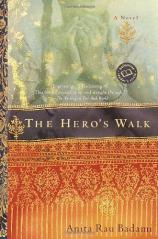
The Hero's Walk
by Anita Rau Badami

List Price: $14.00
Pages: 384
Format: Paperback
ISBN: 0345450922
Publisher: Ballantine

Click here to buy this book from Amazon.com.
Click here to buy this book from Amazon.ca.


About This Book


n a small town in India, Sripathi Rao struggles to support his unappreciative family. His wife, though subservient, blames him for refusing to communicate with their daughter Maya, who defied tradition by breaking her engagement to a well-to-do Brahmin and marrying a Caucasian she met in Canada. Then a phone call brings tragedy: Maya and her husband have been killed in an accident leaving Sripathi to be their daughter's guardian. Sripathi travels to Vancouver to bring the child back to India. Nandana has not spoken since she heard about her parents' death. Terrified, she resists her distant grandfather. Filled with guilt about his daughter, Sripathi finds everything in his life falling apart. But circumstances soon change as Nandana unexpectedly begins to bring hope into all their lives.

top of the page


rgg_discuss.gif (1294 bytes)


1. Which of the seven main characters--Maya; Sripathi; Nirmala, his wife; Ammayya, the grandmother; Putti, the sister; Nandana, the orphaned girl; and Arun, the son--was your favorite, and why?

2. Sripathi keeps his passion for writing letters to the editor a se-cret from his wife. Why do you think he does this? What does this secrecy reveal about his character?

3. What was your opinion of Ammayya, the widowed mother of Sripathi? Did you feel that her unkind husband--and his public rejection of her for his mistress--justified her bitterness? Why do you think Ammayya stole things from her own family?

4. After her daughter Maya dies, Nirmala has a terrible argument with her husband, during which she exclaims: "I am tired of behaving myself!" By the end of the book, has Nirmala stopped behaving herself? If so, how?

5. At Sripathi's youthful initiation ceremony, he escorts his mistress out of the hall, and leaves Ammayya and Sripathi in the celebration hall. Afterward, Sripathi says to himself: "Never would he fail in his duty to his family or subject them to such shame." Has he succeeded? To what does Sripathi feel a sense of duty?

6. Maya is engaged to Prakash, a young Indian man, when she leaves for Canada. But in Canada, she meets and falls in love with Alan, and she breaks the engagement--"I cannot help the way I feel about Alan," she writes by way of explanation. How does her family react to this? Did you feel her argument that she was truly in love with Alan, not Prakash, meant much much to Sripathi and Nirmala? Did "love" justify Maya's change of heart?

7. From Sripathi's balky scooter, to the garbage on the streets, to the showy policemen directing traffic, the reader is given a precisely textured vision of life in the imaginary town of Toturpuram. Why do you think Badami took so much time and care over the details of everyday life? What does this add to your sense of the characters, and to the way they move through life?

8. Women take many different roles in The Hero's Walk--from traditional wife to homebound spinster to political leader to career girl on the rise. Did this diversity surprise you? What were your conceptions of women's roles in India before you read this book? What are they now?

9. Throughout most of the book, Sripathi shows disdain for his son, Arun. But in the end, it is Arun who shows Sripathi the sea turtles returning to lay their eggs on the Toturpuram beach, an event that awes Sripathi. How does Arun's knowledge about the sea turtles help to shift Sripathi's opinion of him? What has Sripathi been overlooking about Arun?

10. "The whole business of living, I think, is an act of heroism," says Anita Rau Badami, the book's author. By this definition, there are many acts of heroism in The Hero's Walk. Which acts, for you, stand out? Nirmala's helping Putti to marry Gopala, the milkman's son? Arun's social activism? Maya's marriage to a non-Indian? Putti's dutiful behavior to her mother?

top of the page

Critical Praise

"Engrossing . . . Fascinating . . . This book demands to be read straight through."
The Washington Post Book World


"DEFT AND KNOWING . . . Badami’s prose is lovely, almost poetic, and her ear for dialogue and the idiosyncrasies of her characters’ speech rings true. . . . An intimate look into the hearts and minds of a complicated, quarrelsome, yet deeply loving family."
Richmond Times-Dispatch


"COMPELLING . . .[A] LUSH EVOCATION OF INDIAN LIFE . . . [with] often laugh-out-loud funny dialogue."
salon.com


"A WONDERFULLY TEXTURED TALE whose poignant events are imbued with truthfulness . . . Badami joins the ranks of such internationally celebrated authors as Michael Ondaaje."
The London Free Press

 
Back to top.   


Privacy Policy | Contact Us | Advertising | About Us

© Copyright 2001-2008, ReadingGroupGuides.com. All rights reserved.