IndieBound Independent Bookstores

Barnes & Noble

Loading
Reading Group Guide
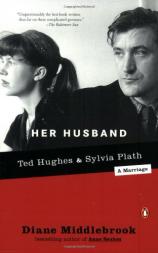
Her Husband
Ted Hughes and Sylvia Plath: A Marriage
by Diane Middlebrook

List Price: $15.00
Pages: 304
Format: Paperback
ISBN: 0142004871
Publisher: Penguin

Click here to buy this book from Amazon.com.
Click here to buy this book from Amazon.ca.


About This Book


In 1955, the young American writer Sylvia Plath arrived in England on a Fulbright scholarship, where she soon met the struggling poet and Cambridge graduate Ted Hughes. They plunged into a marriage that would last just over six years, produce two children, and become one of the most sensationalized and scrutinized domestic partnerships of our time. Plath has since been acknowledged as one of the most important American poets of the last century. After her suicide, Hughes continued to write for more than forty years and, in spite of the enduring infamy of his scandalous personal life, became a lauded poet laureate of England. In Her Husband, Diane Middlebrook tracks the development of these two distinctive poetic voices. She uses an innovative approach, writing a balanced biography not just of the two individuals but of the enduring impact of the marriage itself, particularly on the writing life of the surviving partner, Ted Hughes.

Hughes and Plath were strong-willed, eminently creative, and brilliant individuals struggling to balance writing and love, family and new fame. In their years together they were emerging as writers, and the tension between working and family life was the central axis of their life together. In Plath, Middlebrook reveals a contemporary woman, fighting against tradition, seeking to conduct a fulfilling home life in the context of an engulfing artistic ambition. Plath's poetry, conventional in her youth, came to embrace anger and cultural taboos even as it reveled in motherhood and the feminine. Plath ingeniously used her own struggles, such as the psychiatric breakdown she suffered in college, as subjects rather than mere inspiration. Middlebrook reveals a complicated Plath, "a woman poet conscious of her status as a mother, ambitious to be the voice of her generation."

Hughes's poetic self emerged over many more years, as he struggled to realize the themes of his poetry, themes that had first emerged during his partnership with Plath. It was with Plath that he first realized the primal importance of the landscape of his childhood to his own personal and poetic mythology. That landscape, along with his interest in the occult and astrology, animals and their symbols, and his father's-and nation's-experience of war, would provide the subject matter of most of his writing, including work for the theater, for radio, and for children. Middlebrook shows how ideas about women as muses-influenced by Robert Graves's book The White Goddess-were reflected in his relationship with Plath and the many other women in his life. Hughes's journey as an individual culminated in his ultimate embrace of his autobiography-and of Plath's importance to his identity-in his final works, especially the bestselling Birthday Letters.

As a portrait of a marriage, Her Husband is necessarily focused on Hughes as he struggles with the enduring effects of those brief six and a half years. Middlebrook carefully draws out the links between life and work to explicate the intertwining of personal experience with creative expression. Hughes and Plath's marriage is one of the iconic collaborations of the twentieth century. Its tragic end, Plath's suicide, has resulted in their alliance often seeming like a story "forever simplifying itself into a tragedy and rushing towards its horrible ending." Middlebrook slows down that rush to the end, spending time on the intimate details of this famous marriage, and stressing the artistic exchange that led to work by both poets that has endured long past the moment of Plath's death. This brief coming together in love and work between Hughes and Plath became a dynamic literary inspiration, the fount of two important poetic oeuvres. In Her Husband, Middlebrook demonstrates that the poems of these great artists were to them not just works of literature, but also prophecies, cathartic performances, modes of resolution, and statements of fate.

top of the page


rgg_discuss.gif (1294 bytes)


1. Hughes and Plath's marriage is famous for many reasons, among them because it is an early model of the type of marriage that is common now but was just emerging then: two working parents struggling to balance home and career. Think about some of the ways that their partnership was traditional and some of the ways it broke with convention. Do you think it might have ended differently if they had been living now? Or were they two headstrong personalities doomed to failure in the compromises that marriage demands?

2. How did knowing Sylvia Plath, being married to her, and being engaged in a lifelong dialogue with her writing change Ted Hughes? Think about his poetry, his subject matter, and the long struggles of his personal life. When did her influence emerge? Conversely, how do you think being married to Hughes influenced Plath's choices, particularly her writing?

3. The persona that Middlebrook identifies in Hughes, that of being Sylvia Plath's husband, is unusual. In the past, women were defined through their relationships to men, rarely vice versa. How does it influence your impression of Ted Hughes to think of him this way? Is it enriching, demeaning, or otherwise?

4. Middlebrook provides some wonderful close reading of poems by Plath and Hughes, uncovering related images and symbols, and revealing how much they wrote in response to each other's work. Look again at the discussion of the poems "Morning Song" and "Lines to a Newborn Baby / For F.R. at Six Months" (p.153). To what do you attribute the difference in the way they reacted to their daughter? Are those differences related to gender, or to something else-perhaps just individuality? What linguistic and emotional strategies do they use in these poems to convey their personalities?

5. Plath tried to fulfill herself with the competing demands of motherhood and poetry in a way that is still recognizable to women today. Middlebrook spends a lot of time interrogating "the struggle at the center of their life together, the tension between the desire for an ordinary family life, and the necessity of protecting that inner wilderness in each other." How are things different now for women who are mothers and have careers?

6. Plath's suicide and her writing about her psychological breakdown are the more sensationalized aspects of her biography. Middlebrook notes that depression is an illness, and even posits the possibility that Plath's taking of a misprescribed medication might have facilitated her downfall. Consider the way that definitions of depression have changed since Plath's death; now, for example, we tend to think of mental illness as a chemical imbalance. Middlebrook goes as far as to state that depression killed Sylvia Plath, rather than the emotional consequences of a man's deceit. Does this change the way you think about the marriage and about Hughes's culpability?

7. Middlebrook writes that Hughes "would crave a place in the sun alongside the great English poets of his personal pantheon. But he would hate to be dragged out of his proper element, his inwardness. And he would hate being scrutinized." The competing desires for fame and solitude would plague Hughes for most of his life. How do you explain such a contradiction in his character? Do you think he ever resolved it for himself, perhaps in his late incarnation as poet laureate? What effect did his hatred of scrutinization have on his marriage with Plath and his response to her death?

8. Hughes's history with women was enormously complicated, often tragic, and far from conventional. Hughes seemed to need a muse, and he did appear to conflate Plath and all of the women who followed her with an archetypal female spirit. How much of this tendency towards women seems stereotypical, even sexist? How much seems a genuine exploration of his primal (male) impulses?

9. Hughes was deeply attached to nature. As a child, he adored hunting animals with his revered older brother Gerald, but as an adult he chose to express that attachment in words. Think about animals and nature, his connection to place, and their relationship to Hughes's poetic voice. What kind of animals appear most often in the works that Middlebrook discusses? What do you think these poems reveal about his inner preoccupations?

10. As "her husband," Hughes became the owner of Plath's legacy. He oversaw the publication of much of her work posthumously, including Ariel, her journals, and collections of her letters. He has been accused of mismanaging that legacy, in part because of contradictory information about some of Plath's missing journals, and because of editing decisions such as the reorganization of the order of poems in Ariel. What do you think about how he executed this responsibility? Consider the enormous amount of time he spent with her work, along with the gains to both his finances and his own well of artistic inspiration.

11. Middlebrook states that Ariel "conveys an instantly recognizable subjectivity," as Plath realizes her true poetic voice. Hughes, on the other hand, spent his life resisting the identifiably autobiographical in his work, insisting on myth and symbol as his vehicles. Yet at the end of his life, he stunned the literary world with a tremendously personal book of poems about Plath, Birthday Letters. Think over his life and the evolution of his writing; why do you think he came to autobiographical work so close to the end of his life?

12. Hughes believed, as Middlebrook discusses, that "the greatest poets . . . are those in whom the deepest spiritual issues of their time find pathways into complex psychological representations, or images." Was Hughes such a poet? Was Plath? Think back to their subjects-landscape, suicide, war, gender-and try to identify which might express important aspects of twentieth-century culture.

top of the page

Critical Praise

"Diane Middlebrook's shrewd and compelling biography . . . is a book of mysteries, delicately revealed."
O Magazine


"A deep, rich, and satisfying biography of a marriage --- harrowing and ironic, playful and grave."
The Washington Post Book World


"Unquestionably the best book written thus far on these complicated geniuses."
The Baltimore Sun

 
Facebook Fan Page  Follow us on Twitter


Add Your Guide to ReadingGroupGuides.com!

Bookreporter.com Bets On...: Books We're Betting You'll Love


Privacy Policy | Contact Us | Advertising | About Us

© Copyright 2001-2012, ReadingGroupGuides.com. All rights reserved.
The Book Report, Inc. • 250 West 57th Street • Suite 1228 • New York, NY • 10107
Ph: 212-246-3100 • Fax: 212-246-4640

Bookreporter.comReadingGroupGuides.comGraphicNovelReporter.comFaithfulReader.com
Teenreads.comKidsreads.comAuthorsOnTheWeb.com