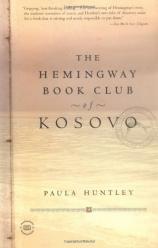
The Hemingway Book Club of Kosovo
by Paula Huntley
List Price: $13.95
Pages: 255
Format: Paperback
ISBN: 1585422932
Publisher: J. P. Tarcher
In August 2000, Paula Huntley's husband took a leave of absence from his teaching post at a law school, and she resigned from her marketing job of thirteen years. Huntley's husband had signed on with the American Bar Association to help rebuild Kosovo's legal system. Not quite sure how she could be of any service in a country that had suffered so much, Huntley found a position at a private school teaching English to a group of Kosovo Albanians. In this inspiring diary of her experiences in Kosovo, Huntley describes the deep friendships she formed with her students and the remarkable book club that they created . . .
One day in a bookstore in Prishtina, Huntley stumbled upon a copy of Hemingway's Old Man and the Sea and-judging that it was just the right reading level and length--she made copies of it for the group. Despite lingering concerns that this quintessential American writer so notorious for his machismo might not resonate, the story of the old man's struggle to bring in his big fish touched them deeply. So deeply in fact that, though the group went on to read other great American writers, a name for their club was born: The Hemingway Book Club of Kosovo.
This book reveals both the fragility and strength of the human spirit. Neither a journalist nor a historian, Huntley describes her students' experiences during the war and the intimacy of the bond that she formed with them with a rare purity and directness. A vision of great hope, The Hemingway Book Club of Kosovo reveals the power of human connection to bring about healing in even the most war-torn circumstances.
top of the page

1. The Old Man and the Sea really touched Huntley's students and enabled them to talk about deeply personal and painful subjects. Did you ever read a book (with one or more other people) that became a vehicle for conversation about very personal and painful subjects? What was the book?
2. Leonard, the Professor, and Huntley's other students demonstrated incredible hope and optimism despite terrible adversity. What in their lives or in their personalities made this possible? Can you imagine yourself, in the same circumstances, demonstrating such hope and optimism?
3. Huntley tries to teach her students about the perils of stereotypingto avoid saying, "All Americans are this," "all Serbs are that," and so forth. Do you ever find yourself stereotyping? Why is it so easy or appealing to stereotype?
4. In her interview, Huntley talks about the notion of "clean hands, dirty hands," as well as collective guilt and collective innocence. Do you feel that the Albanians who unequivocally hate Serbs are justified in their hatred? Do you feel that they can, and should, overcome their hatred for the sake of rebuilding their country?
5. If this happened to you personallyif your country were at war, and someone from "the other side" burned down your house or killed members of your familywould you be able to overcome your feelings about that person and about his/her people for the sake of moving on?
6. Although much progress has been made, Albanian women are at times treated as second-class citizens. In fact, echoes of the ancient Albanian Code of Conduct, the Kanun of Lek Dukagjin, still resonate, especially in the remote rural areas; women are often mistreated, and in extreme cases are ostracized from their families or brutally punished if they dishonor the family by being raped or by not being a virgin upon marriage, for instance. How can the U.S. and other countries help modernize or democratize Kosovo while respecting their history and their differences from other western countries? Or should we be insisting on 100 percent equal rights for women in exchange for our aid?
7. Do you think that journals, in general, translate into good books? Did you like the fact that The Hemingway Book Club of Kosovo was never intended to be a book, and is in fact a series of spontaneous, uncensored journal entries by a "ordinary" womani.e., not a journalist or historian? Do you think it would have been a very different book if it had been written by a journalist or historian? Do you keep a journal? Can you imagine turning it into a book? When does something that is meaningful to you personally become something that might be meaningful for a wider audience?
8. Huntley says that the most important thing she gave her students and other Kosovars was love and encouragement. Did you ever offer love and encouragement to someone you didn't know well, even briefly, and realized that you had touched their lives? How did it feel? Did anyone ever do that for you?
9. Have you ever fantasized about dropping everything and seeing the world? Have you ever fantasized about dropping everything, seeing the world, and also doing volunteer work in another country? Where do you imagine going? What kind of volunteer work do you imagine doing?
10. Are there lessons we can take from this bookpersonally, spiritually, politically, and otherwisethat can help us deal with the turmoil of our postSeptember 11 world? If you would like to help provide educational opportunities for young Kosovars, please send a check or money order to:
SUNY New Paltz Foundation for the Paula Huntley Kosovar Student Scholarship Fund State University of New York at New Paltz
75 S. Manheim Boulevard, Suite 9
New Paltz, NY 12561
A portion of the proceeds of this book will be donated to this fund. For information about other ways to help the people of Kosovo, visit:
www.hemingwaybookclubofkosovo.com.