IndieBound Independent Bookstores

Barnes & Noble


Loading
Reading Group Guide
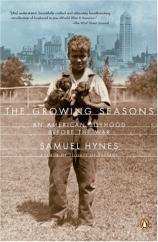
The Growing Seasons
An American Boyhood Before the War
by Samuel Hynes

List Price: $14.00
Pages: 304
Format: Paperback
ISBN: 0142003964
Publisher: Penguin

Click here to buy this book from Amazon.com.
Click here to buy this book from Amazon.ca.


About This Book


Long before microwave ovens and TV dinners, before tract homes and sprawling subdivisions, before America became a drive-through society wedded to the information superhighway, life went on—though many today can't imagine how. It is during this seemingly quiet time that we meet a young Sam Hynes and, through his eyes, glimpse a bygone way of life that—as the specter of World War II begins to infiltrate a nation through newspaper headlines, radio broadcasts, and telegrams—was already receding into history.

As Hynes pieces together his "scrapbook memories"—photographs, smells, old letters, fleeting glimpses of the past—an extraordinary living, breathing testament to how things used to be unfolds before our eyes. We see Sam spend a summer on a farm, exploring the mysteries of sex and death vis-á-vis the rituals of farm life. Then, a snapshot reveals a newly formed family standing on a Minneapolis street corner—a family led by his proud and private father, whose ethics and morals are rooted in self-sacrificing Christianity, and by a stepmother who can never replace the mother Sam lost.

We see the daily goings-on in a typical less-than-affluent American home as Sam grows up in a modest house provided by his father who never had one of his own. There is frugality and a sense of belonging while happy memories of Christmases and Easters intermingle with less cheerful memories—a father running through the streets to escape a striking mob, a schoolmate's father gunned down in his driveway.

Along with the danger of mobsters, his father's struggling, and the perils of childhood itself, Sam begins to see a new danger: a war is heating up. For a while, life goes on as usual. But as we see the wide-eyed excitement of young boys expectantly awaiting for their first glimpse of a naked woman in the movies, light dancing across their faces as they sit in a darkened theater, a shadow falls over America. All the neighborhood boys begin leaving for war and a way of life fades into history.

But through it all, we see a truly American boy. One who, as he stands on the tallest building in Minneapolis and looks out over the country of his youth, prepares to go to war and make his mark on the world—just as he did when scrawling his name on a sidewalk years before.

top of the page


rgg_discuss.gif (1294 bytes)


1. Hynes mentions the tendency of adults to keep secrets and shelter children from what they might not understand. Have you kept secrets from children that, in hindsight, should have been explained to them? Is there anything your parents kept from you growing up that you wish had been discussed?

2. Life in Minneapolis and across America went on as usual—but also subtly, crucially different—in the months leading up to World War II. Do you see any similarities with the current state of affairs in America? Is our determination to go on as usual a result of denial?

3. Hynes is masterful at evoking smells, which many argue are inextricably linked to memory, and using them to tell a story. Are there any smells that remind you of an event or time in your life? Are there any smells that, though most people find them pleasant, are ruined for you by their attachment to a particular event?

4. Hynes and his friends had to go out of their way to see sexual imagery. How has mass media changed how American youth discover sex? What are the advantages and disadvantages?

5. Looking back through his family, Hynes sees a pattern of marrying out of necessity. With today's debates over the nature and importance of the institution, how does marriage as a business transaction affect the argument? Should such marriages be considered less valid than those rooted in true love?

6. Hynes's first experiences with death, other than that of his mother, were on a farm. Do you think witnessing the killing of animals on a farm for food, clothing, and population control is healthy for a child? Do you think the modern American way of handling death is more healthy?

7. Americans of Asian descent were rounded up and interred during World War II—Hynes sees the buses being boarded in Seattle. Protestants, Catholics, Jews, and even Lutherans were pigeonholed and separated. Is the nation, in your opinion, now more inclusive? Or have different cultures, nationalities, and religions had to assimilate to the point of being generic in order to gain acceptance?

8. At what point in the book, if any, do you think Hynes truly becomes an adult? Is it a result of having his first sexual experience or is adulthood more elusive and difficult to pin down?

top of the page

Critical Praise

"An understated, beautifully crafted and ultimately heartbreaking recollection of boyhood in pre–World War II America."
The Wall Street Journal

 
Facebook Fan Page  Follow us on Twitter


Add Your Guide to ReadingGroupGuides.com!

Bookreporter.com Bets On...: Books We're Betting You'll Love


Privacy Policy | Contact Us | Advertising | About Us

© Copyright 2001-2013, ReadingGroupGuides.com. All rights reserved.
The Book Report, Inc. • 250 West 57th Street • Suite 1228 • New York, NY • 10107
Ph: 212-246-3100 • Fax: 212-246-4640

Bookreporter.comReadingGroupGuides.comGraphicNovelReporter.comFaithfulReader.com
Teenreads.comKidsreads.comAuthorsOnTheWeb.com