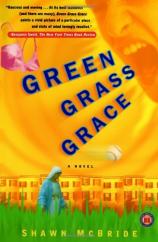
Green Grass Grace
A Novel
by Shawn McBride
List Price: $13.00
Pages: 304
Format: Paperback
ISBN: 074322311X
Publisher: Touchstone
Henry "Hank" Toohey, a thirteen-year-old altar boy, is an incessant smart-ass with a deep love of life...and other four-letter words. But with his foul mouth comes a heart of gold, and he's going to need it to get through the last weekend of summer 1984.
Everyone up and down St. Patrick Street, Henry's claustrophobic Irish-Catholic block in Philadelphia -- with its seventy-eight row homes, seventy-eight skinny mile-high lawns, seventy-eight statues of saints, and seventy-eight Mondale-Ferraro signs -- knows that the Toohey family is falling apart. Henry's mailman father is having an affair with a neighbor lady right under his mother's nose. His big brother has been a drunken mess since his girlfriend died. And his little sister is counting on him to keep her laughing through it all. But Henry has a plan to pull the family back together: He'll propose to his chain-smoking fourteen-year-old girlfriend, Grace McClain, at a neighborhood wedding. To prepare, he and his ragtag group of friends pinball around the streets, making elaborate plans for his proposal, riding bikes, rating breasts, bothering the local merchants, talking trash about Mike Schmidt and Bob Seger, and kissing behind the seafood-store dumpster.
Gritty, giddy, and bursting with Henry's boundless energy, Green Grass Grace is a heart-thumping rocket ride back to adolescence that is riotously funny and tragic at the same time.
top of the page

1. In a rapid staccato style salted with curses and slang, Henry Toohey brings his own story to life in Green Grass Grace. How would you describe the book's tone and language -- and, by association, Henry? Did the writing style or Henry remind you of any other books or characters?
2. Why do you think the author chose to set the novel in 1984? How does this time period shape these characters and their outlook? How might this neighborhood have been different if the story had been set in the present day?
3. In what ways could this Philadelphia neighborhood be seen as a character in its own right? What's the personality of the neighborhood? How are the troubles that Henry's family is experiencing characteristic of -- or distinct from -- the problems facing the entire community?
4. Even more than most teenagers, Henry is very concerned about his personal style. Describe the image he's crafted for himself. Do you think other characters see him the same way he sees himself?
5. While Henry presents himself as wise beyond his thirteen years, his romantic and idealistic take on the world doesn't always match reality. In what instances does he accidentally reveal his naivete? How has he changed by the story's end? Do you think he'll lose his romantic optimism as he grows up?
6. How does the author use humor -- especially in describing Henry and his friends' boys-will-be-boys exploits -- to lighten the more serious elements of the story?
7. When his father denies point-blank the question about whether he's having an affair, Henry thinks, "For the first time in my life...I watch him with sadness and something less than complete love. He lied right to my face, and the whole year of him letting me down, letting us down, hits me at once" (169). Why does this incident have such an impact on Henry?
8. Why do you think Francis Jr. is having such a hard time being a good husband and father? What expectations did he have for his life, and how have things turned out differently? Why has Stephen's depression hit him so hard?
9. Each time Henry and his friends visit a shop in their neighborhood, they are treated to the shop's brand new TV commercial. What do these commercials add to the color of the novel?
10. All of the action of the story is set in just a few days' time -- the last few days of summer vacation. Why is this time frame especially appropriate and meaningful?
11. What role does the Catholic Church play in the story? Does the irreverence with which it is sometimes portrayed -- the character of Father S. Thomas Alminde, for instance -- undermine its influence, or is the church actually a positive force in these characters' lives?
12. Henry reflects that it "could as easily be 1963" (58) in his neighborhood. He later explains, "People let themselves get frozen in a bad place, lost in space, until they get used to it and can't change. They bury the best of their love beneath a pile of stubborn bullshit, losing chances, wasting time, missing life" (249). For which characters is this description most fitting? How did this neighborhood become so depressed, so trapped in the past? What makes Henry the right person to shake things up?
13. Why do you think the author chose Green Grass Grace as the book's title?
14. All of Henry's idealism and optimism coalesces in his plan to propose to Grace, pull Stephen from his blues, and save his parents' marriage. Were you surprised when his elaborate designs fell apart? What was wrong with his plan?
15. Although the events of the wedding reception transpire far differently from the way Henry had imagined, they do point the way to real change for the Toohey family. What challenges does this family still face, and how do you think things might be different for them in the future?
top of the page

"The last time I had this much fun in the company of an adolescent was when Ferris Bueller took a day off. Shawn McBride is a hoot and a half."
Richard Russo, author of Empire Falls
"Shawn McBride fills the pages of his novel with dizzying verbal slapstick and inspired silliness while also making us care about his feather-haired, motor-mouth protagonist and his fractured family."
Dwight Allen, author of The Green Suit and Judge