Reading Group Guide
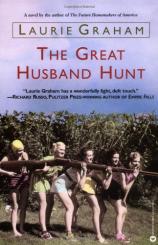
The Great Husband Hunt
by Laurie Graham

List Price: $14.00
Pages: 400
Format: Paperback
ISBN: 0446691321
Publisher: Warner Books

Click here to buy this book from Amazon.com.
Click here to buy this book from Amazon.ca.


About This Book


From the author of The Future Homemakers of America comes the hilarious and moving story of one unstoppable woman's unforgettable ride through an ever-changing century.…

What hope is there for Poppy Minkel? She has kinky hair, big ears, skin that's too sallow, and an appetite for fun. Poppy's mother, Dora, despairs of ever finding her a husband, despite the lure of the family fortune offered by Minkel's Mighty Fine Mustard. Correctness, duty, and Dora Minkel Ear Correcting Bandages are the weapons in this husband hunt-and they serve as torture to a girl who has her own hazy ideas about beauty, love, and marriage. After the sudden death of her father, Poppy's rebelliousness bursts into full bloom. From one World War to the next, from New York to Paris, she'll invent her own extraordinary life with never a moment of self-doubt…as acclaimed author Laurie Graham treats us to a rollicking, exhilarating celebration of passion over prudence.

top of the page


rgg_discuss.gif (1294 bytes)


1. The book opens with a genealogy, "Poppy Minkel and the British Royal Family." Besides the humor of this tenuous connection, what is the point of including it? Does it relate to Mortie's statement: "A person who knows where he came from need never feel lost. Roots are a blessing. If you know where you came from you know who you are and you can decide where you're going" (p. 330)?

2. Poppy is the narrator and the central character-and what a character she is. What about her is particularly outrageous? Do you feel she is naïve, or is that a pose? What do you think about her rejection of her daughters? Her lack of recognition of the German threat? Her belief that money can fix anything? What is it that you think she needs above all else?

3. Are all the women characters in this book focused on "The Great Husband Hunt"? Is marriage a recipe for happiness for the women in this book? Emerald says, "Mom, I have a life. The best kind" (p. 306). Does she truly have "the best kind"? Is it the best kind for every woman?

4. We have a number of women characters being left without their fathers in this novel. What impact do you feel the loss of a father has on each of them? Do you feel their reactions are authentic and true in your experience?

5. The twentieth century is viewed through Poppy's particular point of view. How would you describe her "voice"? What colors the way she perceives events? Choose another character and discuss how he or she might have seen an event. You might want to consider a classic philosophical question: Is there an objective "reality" that is true and universal, or is reality a slippery concept, wholly dependent on the viewer?

6. Poppy says of her daughter Sapphy: "It wasn't me who ruined her life, of course." But did she? If not, what contributed to Sapphy's fate? What do you think the author is saying about free will? Do we make our life choices, or are our choices made for us?

7. The great mythologist Joseph Campbell calls Judaism an "ethnic religion." He contrasts it with Christianity by pointing out that one must be born a Jew to be a Jew, whereas anyone can become a Christian by adopting Christianity's beliefs. Popppy and her family are non-practicing Jews; in fact, they try to escape their Jewishness. What steps do they take to assimilate into American culture and lose their ethnicity? Are they successful? Can one stop being a Jew by renouncing Judaism? What about other ethnic groups such as Italians, or, as depicted in this book, "The Irish"?

8. The "outsiders" from mainstream culture in this book include homosexuals. Who are the homosexual characters? Is Reggie gay? How is this outsider status depicted? Why do you think these characters play such a big part in Poppy's life?

9. Art, artists, and the art world also have a major role in Poppy's life. She particularly champions avant garde artists. Is the author poking fun at art created from macaroni or pubic hair? At trend-setting galleries? Or is Laurie Graham, by making Poppy its champion, indicating that this art is legitimate? What does "innovative" art contribute to society? What does it say about it?

10. Is Poppy a woman ahead of her time? Contrast her with Vera Farber, Sherman's wife. The book also touches on the rise of the women's movement. Who would you say is more a feminist, Poppy or Vera?

11. Overall, do you think the book advocates that a person's background and family are factors to be escaped from or embraced? Can they be oppressive and harmful? If so, is the wiser course to recreate oneself? Is that possible?

12. What is the purpose of the haikus in the book? Pick out a few and discuss them, particularly the book's final haiku on the last page.

13. How do you feel about the book's ending? Why do you think these three characters end up together? Would you call them survivors?

top of the page

Critical Praise

"Laurie Graham has a wonderfully light, deft touch."

—Richard Russo, Pulitzer Prize-winning author of Empire Falls


"Wildly funny…you can't help being charmed."
The Sunday Times (London)


"Fantastic, engrossing…Graham injects Poppy with the same eccentric humor all her protagonists share, making it impossible not to love her. 'A Glamour Must Read.'"
Glamour


"A delight…Graham's style is riveting, hilarious one-liners falling in quick succession."
The Times (London)


"Fresh, funny, and smart."
Observer (London)


"An irrepressible adventurer, Poppy is a comic combination of innocence and pluck, but although this is a brisk, breezy read, it's also a novel with serious bite."
Daily Mail


"A combination of stealthy nostalgia and tender comedy…she writes with pathos-a quality that is rarely taken seriously nowadays, perhaps because it usually relies on a quality of innocence for its effect."
Times Literary Supplement


"It's the insight it offers into changing personal attitudes and family life during this turbulent period that makes it such a fascinating read. The central character is delightful and the characters she encounters are both accurate and colorful."
Irish News


"Compelling…doesn't disappoint."
Hello!


"Laurie Graham is a writer with a remarkably malleable comic voice."
Guardian


Back to top.   


Privacy Policy | Contact Us | Advertising | About Us

© Copyright 2001-2008, ReadingGroupGuides.com. All rights reserved.