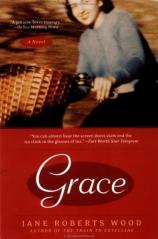
Grace
by Jane Roberts Wood
List Price: $13.00
Pages: 256
Format: Paperback
ISBN: 0452283396
Publisher: Plume
In the east Texas town of Cold Springs in 1944, the community holds their breath, waiting for the war to end. In a time when the emotions of families, consumed by the war, swung wildly between hope and despair, and in a place where certain boundaries were not breachedwhere people revealed little about themselves, their problems, and their passionsGrace takes readers into the lives of four families on the 900 block of Pine Street. Bound together by their neighborhood and their Southern culture, yet separated by class, money, and family, the people inhabiting Grace are an unforgettable cast of characters, vibrantly brought to life by bestselling author Jane Roberts Wood.
Grace Gillian, abandoned by her husband, thinks of herself in mundane termsbut she is an extraordinarily passionate and impulsive woman whose "wild Irish streak" will soon either land her trouble, bring her happiness, or both. As Grace, the heart of the novel, works toward closure with her past, her story intertwines with those of her neighbors, the Moores, Applebys, Balderidges, and othersall waiting to learn what the future holds.
As the war come to a much-anticipated end, daily reports of battle, victory, and death are the catalysts that drive the inhabitants of Cold Springs across the boundaries that had once divided them, taking them to places both chaotic and astonishingplaces where, as Grace Gillian says, "so many kinds of love" abide.
top of the page

1. The word "grace" is both nebulous and powerful. What does it mean to you? Does the character Grace embody any of your definitions of the word, and if so, in what ways?
2. Could an argument be made that the town of Cold Springs is itself a character in the novel, Grace?
3. Does Grace Gillian live her life by the motto Bucy painted on her kitchen ceiling ("Cooking is like love. It should be entered into with abandon or not at all.")? If so, does this saying serve her well? If not, would it have helped or hurt Grace to have lived by those words? Does the motto hold a clue to the real reason for Bucy's departure?
4. Is Grace's love for John Appleby indicative of true love, wishful thinking, or loneliness?
5. What does Bobby Moore learn from what he witnesses in the Sandflat's yard? Are Mr. Sandflat's efforts to give the moon to his daughter comic, tragic, or some combination of both? How does Mr. Sandflat's evident love and devotion to Maxine compare to Robert Moore's affections toward Bobby?
6. How does Willie B.'s arrival in the Moore residence loosen constraints and encourage happiness at home and hearth? Why, then, is Robert Moore so resilient to helping pay for her surgery? Why does he later pay her funeral expenses, and what does he learn from her funeral?
7. During her long train ride to New York, Grace has a dream that she is bandaging wounds and offering soldiers the comfort of her body"taking care of. . . of everybody," as she later explains to Sergeant Dan Manning. Is her dream indicative of her need to comfort, or to be comforted?
8. On the train, Sergeant Manning is overcome by the realization that he loves Grace, a woman he has just met, and wants to marry her. Similarly, Grace is astonished to find herself imagining caressing his nude body. Do you believe in love at first sight? Why does Grace never reply to any of Sergeant Manning's letters?
9. Bobby memorizes a poem that reminds him of Dixie Balderidgeparticularly the second line "What tune the enchantress plays"; Bobby's literal interpretation imagines Dixie at her piano. Is Dixie truly an enchantressplaying Bobby for a foolor is she also confused about love?
10. Does Barbara Moore make the right choice when she leaves her family?
11. Author Jane Roberts Wood touches upon dark issues of spousal abuse in the Balderidge home. How has the community of Cold Springs turned their backs on Mrs. Balderidge? Do you think that, in this Texas town of 1944, Mrs. Balderidge would ever leave her husbandas Barbara, neglected by her husband and an outsider in the community, later does?
12. How are Barbara Moore, Grace Gillian, and Maryanne Balderidge similar? In what ways are they different?
13. Though some members of the Moore family would strenuously disagree with the notion, are there points of similarity between the Moores and the Balderidges? What about between Barbara Moore and Grace Gillian?
14. At the outset of Grace, two of the major characters, Grace Gillian and Bobby Moore, both have clear ideas of what should happen for themselves (of lasting love with John Appleby and of joining the navy, respectively) that have passed by the wayside as the novel ends. Are Grace and Bobby better off without their original notions? Why or why not?
15. As in fairytales and the movies, Sergeant Manning rides into Cold Springs on a white steed to ask Grace to marry him. How is Grace different from the fair maidens of film and fantasy? Do you think she needs rescuing?
16. Impulsively, Grace left Cold Springs with both Bucy and Dan Manning, trying to find love. Although her first marriage failed, do you think Grace will be happy in New Mexico?
17. To overcome insecurities about his poor eyesight, Bobby had dreamed of joining the navy and becoming a hero in the war. In the epilogue, we learn that he has become a legend as a fearless Shakespeare-quoting, mine-dodging heroic Red Cross ambulance driver; why does Bobby modestly deny his heroism?
18. What parallels can be drawn between the resolution of the novel and the poem "The Lady of Shalott" that Grace reads to her class?
top of the page

"Grace exhibits literary heroism at its very best. Ms. Wood is a genuine Texas treasure
and we can only hope she doesn't make us wait so long for her next novel."
The Dallas
Morning News
"Woods' novel is an absolute charmer. Sometimes it's poignant, sometimes it is funny.
With a palpable languid Southern air, Grace moves calmly toward an ending that is not just
happy, but also satisfying."
Fort Worth Star-Telegram
"Jane Roberts Wood's Grace is as gentle and lovely as the name suggests."
Houston
Chronicle