IndieBound Independent Bookstores BRC Facebook Fan Page
Coming Soon
Reading Group Guide
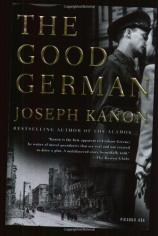
The Good German
by Joseph Kanon

List Price: $14.00
Pages: 496
Format: Paperback
ISBN: 0312421265
Publisher: Picador

Click here to buy this book from Amazon.com.
Click here to buy this book from Amazon.ca.


About This Book


The Good German, set in Berlin during the summer of 1945, is an equally fast-moving and thought-provoking novel of suspense, and of history, that concerns the end of one war and the beginning of another. Jake Geismar, the former Berlin correspondent for CBS, has been sent back to his old beat to write magazine pieces about the Potsdam Conference, at which America, Britain, and Russia will divide the spoils and determine the future of a recently conquered Germany, a nation of dark secrets and unfathomable atrocities. But as World War II draws to a close, has the Cold War already begun? Moreover, what Jake sees floating in a lake right outside the Potsdam Conference turns out to be (for his purposes, at least) a far more interesting story-and a more personal and more dangerous one, as well. A murder mystery, a love story, and a panoramic depiction of a wholly ravished European metropolis at a unique moment in history, Joseph Kanon's novel is, as Neil Gordon observed in The New York Times Book Review, a "provocative, fully realized [work of] fiction that explores, as only fiction can, the reality of history as it is lived by individual men and women."

top of the page


rgg_discuss.gif (1294 bytes)


1. What do we learn about Jake Geismar in the opening pages of The Good German? What are his personal and professional reasons for returning to Berlin, now that the war in Europe has ended? And what does he hope to find after his big discovery at the Potsdam Conference? Also, explain how Jake's personal history-as a somewhat heroic yet exiled American, a cynical but honest journalist, a former citizen of Berlin, and so forth-influences the novel's tone, atmosphere, narrative focus, and plot.

2. Explain the meaning of the novel's title, giving special attention to the ironic connotations of the word "good." How-and where, specifically-does this novel address the difficult issue of morality? Cite several passages from the book that highlight Kanon's thematic engagement with questions of good and evil.

3. Revisit the scene in Chapter 9 where Jake takes Lena to the cinema. After the feature, they see a newsreel. What is it about this newsreel that prompts Jake to whisper "It didn't happen that way" to Lena? Where else in the novel do we see representatives of the press tinkering with-or else blatantly reworking-the stories they are reporting? As a group, explore The Good German's ongoing suggestion that history is ultimately the product of media spin. Does this suggestion echo the old dictum that history is written by the winners? Explain why or why not.

4. The guilt of the Holocaust, the bureaucratic and moral perplexities of denazification, the shame of losing the war, the geographic and spiritual wasteland of Berlin itself-the Berliners in Kanon's novel are depraved souls with serious problems that are personal and political, individual and social. Identify these characters and specify the problems each of them is facing. Also, discuss how each character confronts or denies these problems. More broadly, what links can you establish between the historical realities and the emotional truths depicted in The Good German?

5. Who is Renate? How does Jake know her? Why has she been put on trial by the Russians? And what is the outcome of this trial? How does Renate's story-her particular background and fate-typify the novel's key theme of survival?

6. In Chapter 12, Jake and Lena visit Frau Hinkel, the fortune teller. What does she tell them about their past(s) and future(s)? What does she get right, what does she misread, and how do Jake and Lena receive her pronouncements? Also, discuss the presence (or absence) of luck as a theme in this narrative-as well as that of destiny.

7. Early in Chapter 17, when Sikorsky and Jake briefly discuss the imminent surrender of Japan and the coming of the war's end, Sikorsky asks, "Does it feel over to you?" What does he mean by this? And later, in Chapter 18, Jake spots a newspaper item entitled, "WWIII BEGINS? WHO FIRED FIRST?" Discuss this and other events in this novel-both historical and imaginary-that might also be seen as preludes to the Cold War.

8. Late in the novel, in Chapter 20, Jake confers with one of his closest investigative allies, Bernie Teitel, a former DA who works in the Army's denazification department. As they discuss the horrific enormity of the Holocaust, Bernie says, "There isn't any punishment, you know. How do you punish this?" Jake, as a friend and as a journalist, counters with: "Then why bother?" How does Bernie respond to him? As a group, try to elaborate on Bernie's answer and discuss your own responses to this issue.

9. In terms of its literary genre, The Good German is a thriller, a novel of intrigue meant to engage its readers by way of a plot full of questions, clues, riddles, leads, red herrings, and so forth. Identify the many separate and related mysteries that Jake confronts over the course of this narrative. Which, if any, go unsolved-and why? Were there any particular questions raised in the pages of this novel that weren't answered or addressed to your satisfaction (as a reader)? If so, explain.

10. "What Carol Reed's film, 'The Third Man,' did for Vienna immediately after World War II," one reviewer (Bill Ott, writing in Booklist) has laudably noted, "Kanon's thriller does for Berlin during the same period." Compare and contrast The Good German with any other novels or movies you can think of that take place in Europe just after World War II.

top of the page

Critical Praise

"The Good German is thoroughly captivating, a novel that brings to life the ambiguities at the heart of our country's moral legacy. It also offers the promise of a writer who is fast approaching the complexity and relevance not just of John Le Carre and Graham Greene but even of George Orwell."
The New York Times Book Review


"Gripping…A tale about the untenable choices war entails, and about the moral dangers of demonization. For American readers, the book cuts to the bone, coming at a time when we have become the demonized and are doing our best to avoid becoming the demonizers."
Newsday


"As he did in Los Alamos, Kanon demonstrates an eerie mastery of the evocative historical detail…. You can feel the shattered glass crunching beneath your feet as you read. You can smell the smoke-scorched broken bricks….Kanon is as ambitious a novelist as he is a gifted one."
The Washington Post


"A terrific book…[Kanon] writes of moral quandaries that are real and not created to drive a plot…A multilayered story, beautifully told."
The Boston Globe


Privacy Policy | Contact Us | Advertising | About Us

© Copyright 2001-2010, ReadingGroupGuides.com. All rights reserved.
The Book Report, Inc. • 250 West 57th Street • Suite 1228 • New York, NY • 10107
Ph: 212-246-3100 • Fax: 212-246-4640

Bookreporter.comReadingGroupGuides.comGraphicNovelReporter.comFaithfulReader.com
Teenreads.comKidsreads.comAuthorsOnTheWeb.comAuthorYellowPages.com