Reading Group Guide
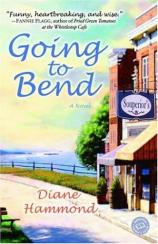
Going to Bend
A Novel
by Diane Hammond

List Price: $13.95
Pages: 336
Format: Paperback
ISBN: 0345460987
Publisher: Ballantine Books

Click here to buy this book from Amazon.com.
Click here to buy this book from Amazon.ca.


About This Book


In the small coastal town of Hubbard, Oregon, your man may let you down, your boss may let you down, life may let you down . . . but your best friend never will.

Welcome to Hubbard, where Petie Coolbaugh and Rose Bundy have been best friends since childhood. Now in their early thirties, both are grappling to come to terms with their age and station in life. As they struggle to make ends meet and provide for their children and the good-hearted but unreliable men in their lives, they take jobs cooking for a brand-new upscale restaurant, Souperior's Cafe, starting from scratch every morning to produce gallons of fresh soup from local recipes. The proprietors of the cafe, Nadine and Gordon, are fraternal twins from Los Angeles with adjustments of their own to make, but Rose's warmth and the quality of the women's soups quickly make them indispensable despite Petie's abrupt manner and prickly ways.

The strains of daily life are never far, however, and the past takes its toll on the women. Petie's childhood as the daughter of the town drunk --- a subject she won't talk about --- keeps her at a distance from even her best friend, until an unexpected romance threatens to crack her tough exterior. And despite Rose's loving personality, the only man in her life is a loner fisherman who spends only a few months of the year in town.

In this fishing village, friends are for life and love comes in the most unexpected ways. As the novel draws together lovers, husbands, employers, friends, and family, each woman finds possibilities for love and even grace that she had never imagined.

top of the page


rgg_discuss.gif (1294 bytes)


1. Much of the action in Going to Bend happens over food preparation. What does soup represent in the lives of Petie and Rose? How is that different than its significance for Nadine and Gordon?

2. Kitchens are also centers for discussion, revelations, and turning points. What key scenes take place in kitchens?

3. As a young man, Schiff meets a redheaded girl at a carnival and, early in the book, vividly remembers the few hours they spent together. Later, he will associate her with Petie. Why? What characteristics and quirks do these characters hold in common --- and why does Schiff find them appealing?

4. When Petie is young, she and Paula seek refuge in a gift shop from Old Man's drinking. When a fragile teacup is broken, the shopkeeper gives it and a matching saucer to Petie. What is the significance of these objects to Petie?

5. Old Man Tyler and Petie live in a camp trailer in the woods behind Hubbard. Later, Jim Christie discovers the trailer and uses it for his own purposes. What role does the trailer play in Petie's past and in later causing a disastrous rift between her and Rose?

6. Going to Bend explores the different kinds of love that can exist between husbands and wives, fathers and sons, mothers and daughters, and friends. How did those different kinds of love manifest themselves between the characters in Going to Bend?

7. Rose and Gordon become good friends. Why --- what do they have in common?

8. In some sense, Going to Bend is a story about the effects of isolation --- geographical isolation, psychic isolation, and isolation based on shame and secrecy. What are some examples of isolation and its effect on the characters and on their unfolding stories?

9. In the course of the book there is an unfolding tension between Jim Christie and Carissa that will ultimately have tragic results. What's really going on between these two characters?

10. Eula Coolbaugh is one of the most important people in Petie's life. Does Eula's love for Petie differ from Paula Tyler's? If so, how?

11. In a childhood visit to Camp Twelve, Petie is badly burned in a fire, and Old Man applies a poultice of ashes. What do these ashes signify, both then and at the book's end? What role do they play in helping Petie to resolve grief?

12. Eula Coolbaugh may be Going to Bend's only truly wise character. What wisdom does she impart to Petie that has a lasting effect on her life and decisions? Why?

13. The title Going to Bend has both a metaphorical and literal meaning. What are they, and how do they relate to the book's main characters?

14. At several key moments in Petie's life, she buries objects beneath a tree. What are the objects, what do they represent, and why does she bury them?

15. Petie and Schiff, both of whom are married, carry on a clandestine relationship through much of the book. What's missing in their respective marriages, and how does this play a role in their unfolding relationship?

16. Jim Christie is an inarticulate man with a severely limited ability to communicate his feelings. How does Rose deal with this throughout the book, and what role does it play in the book's climactic outcome?

17. Work creates tensions throughout the book, and everyone except for Paula Tyler and Eula Coolbaugh has a job. How do the characters regard their respective jobs at the start of the book? At the end? How do they suit each character?

18. Were any of the characters in Going to Bend reminiscent of people you've known in your own lives? If so, what were the resemblances?

19. Were there universal truths about people and relationships that were revealed in Going to Bend? If so, what were they, and how might they relate to, say, white-collar people living and working in an urban environment?

20. What do you think will happen to Petie and Rose after the book's end? What would you like to see happen?

top of the page

Critical Praise

"Diane Hammond is a fabulous storyteller. Her portrait of small town life is full of humor and detail, and in her characters Petie and Rose, a relationship so original and real, you root for them from page one. I loved this heartfelt story and I am sure you will too."
—Adriana Trigiani, author of the Big Stone Gap trilogy and Lucia, Lucia


"In this remarkable first novel, Diane Hammond brilliantly captures the subtle nuances of everyday life in a small Oregon town and the friendship between two extraordinary women. Funny, heartbreaking and wise."
—Fannie Flagg, author of Fried Green Tomatoes

 
Back to top.   


Privacy Policy | Contact Us | Advertising | About Us

© Copyright 2001-2008, ReadingGroupGuides.com. All rights reserved.