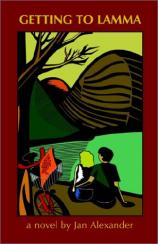
Getting to Lamma
by Jan Alexander
List Price: $17.70
Pages: 244
Format: Paperback
ISBN: 1591131448
Publisher: Booklocker.com
Madeleine Fox, a 35-year-old New Yorker, has dreamed of exotic escapes all her life, a fantasy fueled by her off-the-wall upbringing at the hands of a roving-eyed father and a Southern belle leftist mother. Now in serious need of flight from her cocaine-crazed ex-husband, Madeleine decides to follow the married foreign correspondent who has cajoled her for years to "come run away with me," but after a disastrous rendezvous in Hong Kong she goes on by herself to spend a year teaching English in Shanghai.
Alone in a threadbare hotel room, Madeleine plots revenge against men who cheat. Then, in a bicycle accident, she meets brash Shanghai dissident David Li, who wants to defect from China and leans on her. Though helping David means dipping into her life savings, letting him wound her ego, and, ultimately, embarking on a dangerous sailing trip, Madeleine finds herself propelled into a series of adventures that change her life in some highly unconventional but satisfying ways.
NOTE TO READING GROUPS
The author has offered to chat by speakerphone with any reading group that chooses Getting to Lamma. Interested reading group members should contact the author at www.janalexander.com. Leave your email address on
the TalkBack link and the author will contact them to set up a mutually convenient time for a chat.
top of the page

1. Since we observe all of the action through Madeleine's point of view, and see her the way she sees herself. Do you think she has sabotaged her own chances for happiness in the past? To what extent does her description of herself as a "disillusioned Westerner, not a believer in any opium-clouded myths of the Orient, seeking nonetheless to discover what' on the other side," reflect what she's really looking for?
2. If you were traveling to China with Madeleine, would you find her an enjoyable travel companion? Why or why not?
3. What do you make of the various tales Madeleine has heard about Asia from her father, her mother, and her married boyfriend Steve? What do these stories tell you about these particular characters and what they really want from life?
4. Madeleine finds that in China, David grew up hearing some rather skewed stories about how all-knowing the communist government was. "'The party says you are bad, you are bad. My father was bad, they said. I believed,'" he says. What kind of impact do you think this had on his personality development? What sort of parallels do you see between the irrational authoritarian government in China and Madeleine's own upbringing?
5. By the time David was a teenager, the Chinese government was telling him that it was good for the country to get rich. Did the novel make you think about the impact of politics and economics on peoples' lives? Are there some ways in which someone such as David, whose life is tied to the political winds of his country, might be better off than Madeleine, who as a middle-class American grew up wallowing in her own personal concerns? What do you think of her parents' efforts to embrace causes? Were they just trying to give their own lives meaning, or were they sincere?
6. The novel begins with a Chinese philosophical observation that says: "Just as the seasons cancel one another, justice cancels corruption and corruption cancels justice." How does the story from there reflect the idea that "there is no final resolution, but there is always a new season" in terms of power plays, happiness, and love?
7. "Traveling should be an adrenaline rush. Love should keep you on a sort of even level of contentment," says Madeleine when she is thinking about whether to take Steve up on his offer to move in and finally see where their relationship can go. What do you think of this view of an ideal life? How do she and Steve each contribute to the demise of their love affair? Do you think it might have worked if they'd started out when they were younger, or if they had met when they were older and each more content already?
8. The other relationship that doesn't work, the one between David and Alison, is partly an "adrenaline rush" but there are other reasons David and Alison are attracted to each other, including his need for an American wife. Do you think the novel's cynical view of love is appropriate, given the characters and the setting?
9. Which characters do you think are the most morally ambiguous? Among them are Steve who has had visions of saving the world but treats women badly, Alison who does David a big favor but then backs out, Oscar Wong who will do anything to make money but is also capable of using his fortune to do good deeds, and of course Madeleine and David, who find themselves helping each other in the most unexpected and not always legal ways.
10. In her new job at the news magazine in Hong Kong, Madeleine is at times in a position to pursue stories that might attempt to right wrongs. Do you think she'll be any better at this than Steve was? She might work very hard and do some award-winning stories, she might decide competing with Steve doesn't matter any more, she might decide she has other priorities besides her work, or that good deeds begin at home. How do you think her experiences in the novel change her values?
11. Does the last chapter, with Madeleine on Lamma Island and embroiled in many other people's lives, seem like a satisfying way to end an adventure? Is she playing around with too many other people's lives to achieve a semblance of contentment herself? What do you think might ultimately happen to Madeleine, to David, to David's mother Wang Ming, to Madeleine's new boyfriend, and to her baby?
top of the page

"Jan Alexander exposes the realities behind the glamorous facade of Hong Kong ex-pat life in a lively and richly realized novel of West meets East. Her spunky protagonist Madeleine Fox (journalist, teacher, and latter-day
Marco Polo) trains a highly observant gaze on the fascinating hybrid nature of Asia in the nineties. With the reversion to China fast approaching, Hong Kong Chinese and ex-pats struggle to find their cultural compass in a tilting, careening world even as Madeleine Fox seeks to find herself."
Patricia Eakins, The Marvelous Adventures of Pierre Baptiste, The Hungry Girls and Other Stories
"Getting to Lammais a novel about a woman's journey, both outward and inward. Journalist Madeline Fox travels to China and on to Hong Kong to eventually settle on an offshore island away from the fray. But she travels much further within herself. Madeline's search for independence, compassion, and real love offers a powerful vision for all women of the new millennium."
Maudy Benz, Oh Jackie
"Jan Alexander balances many themes and characters with consummate grace
family, lovers, politics, Hong Kong, Shanghai, New York in one compelling story.
It's a delight."
Robert Abel, Flannery O'Connor Short Fiction Award winner