|
|
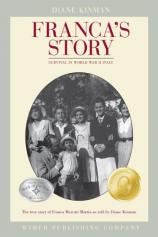
Franca's Story
Survival in World War II Italy
by Diane Kinman
List Price: $16.95
Pages: 204
Format: Paperback
ISBN: 9780976392927
Publisher: Wimer Publishing Company
This memoir of life in wartime Italy is based on the true story of a young girl, Franca Mercati Martin, as told by Diane Kinman. It provides a window into a fascinating time and an intriguing family determined to endure amidst increasing devastation and loss. Rich, compelling details of the story are told through the eyes of a teenager and accompanied by warmhearted, powerful sepia images of Franca's art, which introduce each chapter.
Franca’s Story chronicles the adventures of a remarkable young girl determined to help her family survive the trauma of World War II. Set in Florence, Italy, and on the Mediterranean Coast in the cities of Viareggio, La Spezia, and Capezzano, the memoir spans the era from 1937 to 1945.
Franca is a young girl of 11 as the growth of the Fascist movement in Italy becomes increasingly divisive and destructive. She is the youngest of seven children of wealthy but aging parents. The family’s close connections and affluent lifestyle deteriorate with the onset of war. Mussolini’s uneasy alliance with Hitler against the Coalition soon takes a lethal turn.
Franca’s life changes on June 10, 1940 when Mussolini announces that Italy is going to war; everyone in her family seems distracted and tense from that day on. When Florence becomes a bombing target, Franca’s father Ugo moves his family to their beach house at Viareggio. She accidentally overhears her father and the local priest planning to help Jewish children get out of Italy; she is frightened for him but proud, and vows to keep his secret. She rescues a British pilot shot down by enemy planes, survives direct hits of bombs at a train station, and an air raid on her sister Maria’s home and store.
Franca’s family suffers losses: the war claims her brother Luigi. Her oldest brother, Krimer, a famous journalist and author who ran with Hemingway and Picasso, is maimed while serving as a war correspondent. When her youngest brother Eddie is reported missing in action, Franca and her father are granted a private audience with Pope Pius, arranged by the Pope's secretary her father’s second cousin and receive immediate help in finding him.
Franca's surprising strength and resolution helps her aging parents survive the explosive destruction of their beach home and find refuge with 300 other older people at “Aunt” Elena’s palace at Pianore. Elena is a childhood friend of Franca’s mother and a distant relative. Franca is one of four youths who scavenge for food each day to feed all of the refugees. Elena knew the Germans would take over the old Bourbon palace if it sat empty, so she invited everyone she knew to come stay there when the cities were no longer safe. The Germans set up camp on the vast grounds, closely monitoring movement in and out of the palace.
The teenage Franca maintains a happy facade as she faces the obstacles and losses of war. Her body is in turmoil; death, destruction, lack of food, and constant stress cause jaundice and pancreatitis. Franca longs to have her large family together again, and to be able to do the normal things teenagers do. She doesn’t hate the Germans for what they have done to Italy, but she doesn’t understand their mentality how could they shoot starving people for simply trying to find food? Food is scarce and Franca is forced to trade her favorite gold medallion necklace to a farmwoman in exchange for flour and vegetables to feed the refugees at the palace.
Franca travels to Buggiano, 60 kilometers from Pianore, to help her sister whose innocent husband faces execution by the Fascists. The doctor who provides care to the S.S. officers who took over the house next door befriends her. Herr Doctor tells Franca of his plan to desert the Nazi forces and meet his family in Switzerland; she tells him she is desperate to return to her parents. Escaping in a stolen ambulance at midnight, Franca and Herr Doctor dodge air strikes by planes intent on destroying the road. She sneaks past armed guards to get back into the palace.
By Christmas 1944, many long months of confinement have deflated the spirit of the refugees. Their low morale is lifted as they create gifts for each other made from the heart – and the draperies and pillows. They sing spirited carols in a display of hope for peace to come back to Italy. The sound of bagpipes from the Scottish medical corps signals their rescue and an end to the terror, to sharing food and fear in the palace.
The bagpipes announce that a Scottish medical unit is at the gates to help them. The Germans flee, leaving landmines that endanger the rescuers efforts to deliver food and a little luxury once taken for granted soap. Franca sleeps that night without a worry, savoring the sound and smell of peace and freedom.
top of the page

1. As a dictator, one of Mussolini’s accomplishments was that he “made the trains in Italy run on time.” Later, after the war began, he was considered Hitler’s puppet. Why did Mussolini decide to align Italy with Hitler’s Germany?
2. By her nature, Franca wanted to dance and sing, yet once the war started, she felt that she should hide when she did it because everyone else was so sad. Have you ever been through a situation similar to this one? How did you cope with your feelings?
3. The Facists destroyed paintings by the students in Franca’s art class, but not the masterpieces in the Uffizi. What is Facism about? Why do you think the masterpieces survived?
4. Why did Franca and her family have to go to the Post Office to answer the phone?
5. How do the Mercati family dynamics in 1930-40’s differ from yours?
6. Why were the railroad stations and tracks targets for bombing?
7. When Franca and her father visited the Pope, they were served tea with sugar and milk and cakes. Franca asked her father why the Pope had food when everyone else was hungry. Should the Pope have shared his food? Why or why not?
8. Franca and Lilly found a wounded British pilot in the park and rescued him. Why was this a dangerous thing to do?
9. Hans tells Fosco that he loves him as a brother, yet his training since the age of three was so intense that, if ordered, he would kill him without question. Discuss the early training methods used by the Nazi regime to build a superior race of people.
10. Franca escaped with Herr Doctor to return to Pianore. Do you think the planes were trying to bomb their ambulance, or were they aiming at the road? Why?
11. Why did Elena want everyone to call her “Aunt Elena” instead of Princess Elena? Why did she fill Pianore with so many people?
12. As the family watched, all of their belongings were destroyed in the bombing of the home in Viareggio. If you had just 5 minutes to grab your things, what would you bring with you?
13. In the middle of the war, there were severe shortages of food and things we take for granted such as electricity or gasoline or soap. Without soap, people washed with the water poured over ashes from the fireplace; wore layers of clothing to keep warm; rode bikes without rubber on the rims of the wheels so the Germans wouldn’t take them. The elderly citizens at Pianore spent long cold dark evenings huddled together in one large room for warmth, entertaining each other by singing or telling stories. Franca wore the same pair of Ferragamo loafers for 4 years; her father patched the soles using pieces of leather from Aunt Elena’s desk set. How do you imagine your life might change under these circumstances?
14. Franca felt special, being born so much later than all of her siblings. Her recurrent thought about her aging parents was that she was born late in their life because “God sent me to them to protect them.” Do you think that helped her survive? Why?
15. What happened to Italy in 1944 that made them switch allegiance to the Allies? (p.159)
16. Why did it cause such confusion among the Italian citizens and soldiers?
17. In 1944, the Nazi SS killed 560 Italian villagers at Sant’ Anna, a few miles from Capezzano, and burned the bodies. The massacre was one of the worst in a series of atrocities by Nazi troops in northern Italy. In 2006, 10 of these Nazis were tried in-absentia and convicted for the crime. Although these officers will never be imprisoned, Italian citizens felt justice had been done. Do you feel the trial was an appropriate way to settle the matter?
18. In celebration of Christmas, the residents at Pianore took apart the curtains and pillows to make gifts. Franca and Lilly read recipes to each other to savor the flavors in their imagination. What other things do people do to survive, physically and creatively?
19. How did the farms that Franca visited for food differ from our idea of a farm?
20. How did Franca’s ideal family life change? If there had not been a war, what changes would you have expected to see in the family dynamics?
21. Franca maintains a deep belief that God would protect her throughout the war so that she could help her parents. Have you experienced something similar while going through a difficult situation?
22. How has this book affected your understanding of the role of Italy during World War II?
top of the page

"An inspiring tale of quiet heroism during wartime.
In an Author’s Note, first-time biographer Kinman begins the story of her neighbor with the assertion that “writing a memoir means: what happened happened, there is no fantasy in reality.” However, what results here is a real story, as she seamlessly relates Franca’s experiences in war-torn northern Italy during the years 1937-45. In fact, some of the more captivating moments in the narrative contradict Kinman’s avowal of the real --- Franca’s experiences demonstrate the need for fantasy in reality, particularly when that reality is shattered by war. She and her aged parents end up virtually imprisoned in Villa Pianore, near Capezzano, where hundreds of elderly Italians seek refuge from the occupying Germans. Young Franca shows great bravery and ingenuity as she scavenges nearby fields for food for the villa’s refugees, but an even more poignant scene occurs in the kitchen, where the starving Franca and a friend retreat to read recipes to one another. Reciting the ingredients engages the girls’ imaginations and momentarily staves off their hunger.
Ample yet unassuming, and illustrated with period photos and evocative paintings by Franca, this touching memoir is an enjoyable journey for lovers of Italy and those interested in tales of courage."
Kirkus
"Thank you so much for sending me 'Franca's Story.’ I loved it - your writing has caught absolutely the flavour of real Italian life, and a real person's life story, so that one absolutely believes in, and trusts, the authenticity of what you are saying. I know that sounds obvious and easy as you are telling a true story, but so many biographies try to read like fiction, and as a result end up sounding contrived and untrue. Your great skill is to let the story tell itself, and not to let any authorial tricks or ego get in the way.
Franca herself comes across as a wonderful character --- absolutely indomitable, but also completely of her time and place. I hope very much that she (and you) likes The Wedding Officer, and that I am able to make my own storytelling match up to the reality of lives like hers. Please give her my best regards, and accept my congratulations to you. "
Anthony Capella, author of The Food of Love and The Wedding Officer
"What I loved and admired most about this well-written, fascinating memoir of World War II Italy was Franca’s steadfast faith that ultimately carried her through to survival. The war presented many dangerous situations that tested her character and out of which she got to know herself as a heroic figure. In the end, through Franca’s resilient spirit, what was a devastating experience turned out to be a blessing. Through it Franca learned what her purpose was and how best she could serve her loved ones. Her paintings positioned throughout the story are a delight to the soul."
Rosemary Broccoli, Host/Producer, “Being in Seattle” television show
"This true story of wartime Italy will touch the very deepest part of your heart. Franca is only fourteen when World War II begins, but she is brave in ways that most people can only imagine. Whether she is rescuing a downed British pilot, personally visiting the Pope’s quarters, or risking her life to bring food to her starving family, Franca’s courage rings through this entire book. Her memories will become yours, enriching and uplifting your life."
Peggy King Anderson, author of The Fall of the Red Star
"Franca's Story is a must for school librarians who recommend books to students, second- and third-generation Italian Americans who want to know about life in Italy from 1937 to 1945, and anyone drawn to the stories of unsung heroes of World War II. Kinman shines a light on Franca's journey of determination to save her family in this gripping riches-to-rags tale."
Mary Willix, author, professor, and founder of Hypno-Spanish
"[Franca’s] story make for interesting reading and one wants to read every chapter before putting down the book to complete one’s daily chores.... Chapter by chapter, history will be relived as the tragic events of the war unfold."
Dottie Wienecke, Waco Citizen
"Kinman proves a competent scribe whose writing gets better and better as Franca’s charming and compelling personal history unfolds.
Born the youngest of seven children to a wealthy, aristocratic Italian family, Franca sees her life turned upside down when one brother is killed in the war, another is captured, and yet another is wounded. Forced to flee their home in Florence, Franca and her family settle in their summer home on the coast, only to have it destroyed by bombs. By the end of the war, Franca is dodging Nazis and scavenging for food.
The book, self-published by Kinman, is filled with wonderful artwork by Martin, and with some photographs of places that pepper the tale. All of the drawings and photographs are in sepia, giving the book an appropriate vintage feel."
Breck Longstreth, Mercer Island Reporter
"A Seattle area woman, who is an artist, recalls her difficult youth in Italy during World War II in a fine memoir co-written by a neighbor; this book recently won two national awards for independent publications."
John Marshall, Seattle Post-Intelligencer
|
Contest
Win Copies for your Book Group

This month's prize:
Eat Pray Love
by Elizabeth Gilbert
Click here for more


|