IndieBound Independent Bookstores BRC Facebook Fan Page
Coming Soon
Reading Group Guide
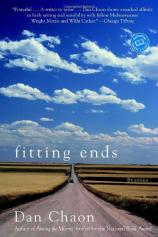
Fitting Ends
by Dan Chaon

List Price: $12.95
Pages: 256
Format: Paperback
ISBN: 0345449096
Publisher: Ballantine Books

Click here to buy this book from Amazon.com.
Click here to buy this book from Amazon.ca.


rgg_discuss.gif (1294 bytes)


1. Chaon has professed to being influenced by the well-known old story, "The Lady or the Tiger?" Like that story, many of the stories in Fitting Ends deliberately end on the edge of a moment, leaving the reader to decide what the future holds in store for a character. Do the stories point the reader toward a particular conclusion, or do they leave the unanswered questions entirely to the reader's own view of human nature?

2. In "Presentiment," Rich thinks: "Love didn't have anything to do with the outside world: It just happened. Some mysterious brain chemistry set in, and you couldn't avoid it." Is his love for his autistic son really so mysterious? How does this example of love compare with others in the book? Are some types of love more positive than others?

3. Many of the young characters in Fitting Ends exhibit a great dread of the future. What does their pessimism stem from? Is it a function of psychology? Family and social circumstances? The larger culture? Do you think these young adults will continue to face the world with such trepidation as they get older, or is there hope that they will grow out of it?

4. A review of Fitting Ends in the Chicago Tribune said, "Dan Chaon shows a marked affinity in both setting and sensibility with fellow Midwesterners Wright Morris and Willa Cather." What is a "Midwestern sensibility"? Are there places in these stories that seem to particularly represent such a sensibility? Which aspects of Midwestern life does Chaon seem critical of, and which does he appear to view with affection?

5. In "Thirteen Windows," the narrator admits that sometimes he sees things that aren't there, and many of the other characters in the book struggle with skewed perceptions of the world around them. To what extent are the various characters' problems a result of misinterpretations of reality? To what extent are the characters lying to themselves? Do you see some of the narrators as more clear-sighted and honest than others? Which ones seem most trustworthy?

6. "Chinchilla," "Accidents," and "Going Out" all present children who must cope with a parent's alcoholism or mental illness, but every child responds to his or her situation in a different way. Why? What are the factors that seem to influence each of these children the most?

7. Ghosts and ghostly visions figure prominently in several of the stories. In other stories a memory of a person's past self haunts the present. What do ghosts represent in the world of these stories? What would it take to dispel these ghosts?

8. Several of the characters in the book have made an effort to break loose from their small-town roots, and they are often in conflict with those they have left behind. What are the advantages and disadvantages of setting off on one's own, versus the decision to stay put and remain close to one's origins?

9. In his interview, Chaon talks of being concerned about the order in which the stories appear in Fitting Ends. How did you approach reading the stories in this book? Did you start with the first story and read straight through until the end, or did you skip around here and there? Would the order in which you read the stories change the effect of the book as a whole? Why do you think Chaon chose to place the stories in this particular order?

10. The epigraph of the book evokes Charles Dickens's A Christmas Carol, and Scrooge's desperate question to the Ghost of Christmas Future: "Are these the shadows of things that Will be, or are they the shadows of things that May be, only?" In what ways are these stories about fate, about the "shadows of things that Will be"? Are the characters' futures sealed, or is there hope for them to change? Are their ends really "fitting," or should we to take the title of the collection ironically?

top of the page

Critical Praise

"The best of these stories . . . possess a rare, disorienting force. When you look up from them, the quality of light seems a little different. It’s a reminder to those of us who have almost forgotten what literature can sometimes do."
Boston Book Review


"The most honest, observant and timely book written this year about the American generation now approaching thirty . . . Chaon speaks with clarity of feeling, and more than a little oddball wit, about the lives of those left behind the demographic curve of America—men and woman with pointless jobs, doughy faces, soured relationships, bad credit. . . . Each story pulls you into its subtle emotional vortex, largely because of Chaon’s knack for simple but poignant detail."
New York Newsday


"Remarkable . . . Each story is a marvel of complexity, dense with meaning and nuance. . . . Very few first works are as solid, moving, and pitch-perfect as Chaon’s."
The Cleveland Plain Dealer


"[AN] OFTEN PERCEPTIVE, LUCID VOICE."
The New York Times Book Review


"Powerful . . . A writer to savor . . . Dan Chaon shows a marked affinity in both setting and sensibility with fellow Midwesterners Wright Morris and Willa Cather."
Chicago Tribune


Privacy Policy | Contact Us | Advertising | About Us

© Copyright 2001-2010, ReadingGroupGuides.com. All rights reserved.
The Book Report, Inc. • 250 West 57th Street • Suite 1228 • New York, NY • 10107
Ph: 212-246-3100 • Fax: 212-246-4640

Bookreporter.comReadingGroupGuides.comGraphicNovelReporter.comFaithfulReader.com
Teenreads.comKidsreads.comAuthorsOnTheWeb.comAuthorYellowPages.com