Reading Group Guide
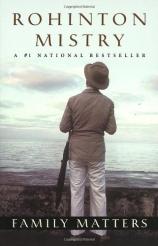
Family Matters
by Rohinton Mistry

List Price: $14.95
Pages: 445
Format: Paperback
ISBN: 037570342X
Publisher: Vintage Books

Click here to buy this book from Amazon.com.
Click here to buy this book from Amazon.ca.


About This Book


When Rohinton Mistry's A Fine Balance was published in 1996, it was greeted with unanimous praise, and, in December 2001, it was selected by Oprah Winfrey for her book club. Now, Mistry gives us a novel that confirms him as a writer whose work is "worthy of the 19th century masters" (Time).

The setting is Bombay, mid-1990s. Nariman Vakeel, suffering from Parkinson's disease, is the elderly patriarch of a small, discordant family. He and his two middle-aged stepchildren—Coomy, bitter and domineering, and her brother Jal, mild-mannered and acquiescent, occupy a once-elegant apartment whose ruin progresses as rapidly as Nariman's disease. When his illness is compounded by a broken ankle, Coomy plots to turn his round-the-clock care over to her younger, sweet-tempered half sister—living with her husband and two sons in an already over-crowded apartment—knowing that Roxana will not refuse. What ensues is a great unraveling, and repair, of the family, and a revelation of its love-torn past.

top of the page


rgg_discuss.gif (1294 bytes)


1. The family's story springs from Nariman's marriage to the widowed mother of Coomy and Jal. We're told, "And he, when he looked back on it all, across the wasteland of their lives, despaired at how he could have been so feeble-minded, so spineless, to have allowed it to happen" (p. 10). He also blames his parents and their friends, "the wilful manufacturers of misery" (p.76). Why did Nariman give in, after his eleven-year love affair with Lucy, to his parents' demand that he marry a Parsi woman? He was forty-two years old at the time. Was his decision an act of weakness?

2. When the medical assistant setting plaster on his broken ankle says to Nariman, "we need a Mahatma these days," Nariman retorts, "All we get instead are micro-mini atmas" (p. 47). What is the novel's perspective on the state of India's politics, compared with the idealism of Mahatma Gandhi? Is Nariman a cynic, a wit, or simply a realist at this stage of his experience?

3. Nariman's memories of the past, including his love affair with Lucy, are presented in italics at intervals throughout the novel. What is the effect of Mistry's revealing the family's tragic history in this intermittent way? How central is the theme of memory to Family Matters?

4. Yezad's friend Vilas writes letters for illiterate workers in Bombay. How does his presence in the novel illuminate the lives of those less privileged, and even more unfortunate, than the Chenoy and Vakeel families?

5. Most of the novel's events take place in two apartments. What perspective do the names of these buildings—Chateau Felicity and Pleasant Villas—cast on the lives lived within them? How are these dwellings described? Coomy asserts that Roxana's flat, though only two rooms is "huge" by Bombay standards: "You know that in chawls and colonies, families of eight, nine, ten live in one room" (see p. 75). Why is it important to our comprehension of Bombay life that we understand just how little space people are living in?

6. In answer to their question about why Yezad moved out of his beloved family home, Roxana tells her sons, "Daddy's three sisters didn't like me" (p. 40). Why does Mistry suggest, as in his Tolstoyan epigraph, that "all unhappy families resemble one another"? To what degree does family unhappiness result from constant togetherness?

7. Does Coomy force the care of Nariman onto Roxana as an act of revenge? Is it understandable that, given her loyalty to her mother's memory, Coomy would resent having to tend her ailing stepfather? Why are the circumstances of Coomy's death particularly ironic?

8. In Family Matters, several characters take steps to alleviate their difficulties. Yezad tries to bring in more money through gambling, and he also makes efforts to change Mr. Kapur's mind about running for office so that he himself will be promoted. Jehangir, as homework monitor, accepts bribes. Coomy and Jal try to delay their stepfather's return by destroying the ceiling of their apartment. Why do these characters' strenuous efforts to arrange the events of their lives come to grief? Does Mistry suggest that fate—rather than desire or will—rules human lives?

9. Why is Roxana so moved by the sight of Jehangir feeding his grandfather, a moment she perceives as "something almost sacred" (p. 98)? Of all the characters in the story, Roxana is the one who understands most fully the weighty responsibilities that come with loving one's family. How does this understanding impinge upon her happiness? Is she too self-sacrificing?

10. How seriously are we to take the ideas of Mr. Kapur, Yezad's employer? Are we to assume that he would not have made a successful politician? Is Mistry using him to represent the best of India's secular and pluralist ideals? What is the meaning of his murder? What sort of person is his widow?

11. Mr. Kapur tells Yezad, "Everyone underestimates their own life. Funny thing is, in the end, all our stories—your life, my life, old Husain's life, they're the same. In fact, no matter where you go in the world, there is only one important story: of youth, and loss, and yearning for redemption. So we tell the same story, over and over. Just the details are different" (p. 197). How does Kapur's insight address the need for empathy, a theme that is underscored at various times throughout the novel?

12. What place does the Hindu extremist party Shiv Sena have in the novel's political background? Should Yezad feel partly responsible for the death of Mr. Kapur? How does Mistry use the murder and its aftermath to reflect the complexity and danger of life in contemporary Bombay?

13. Yezad's return to religion is presented in terms of timelessness, peace and comfort; he perceives his Zoroastrianism as "encoded in blood and bone" (p. 297) Yet the novel makes readers all too aware of the destructive aspects of religious belief as well. How does Yezad's spiritual life change as the novel proceeds? What effect does his embrace of orthodoxy have on his family? How does the description of Yezad five years later (p. 403), point to what has become most important for him?

14. The Parsis, followers of an ancient Persian religion, were in colonial days an influential and highly respected minority in India. Family Matters addresses the dwindling of their cultural dominance despite the efforts of people like Nariman's father who refuse to let their children intermarry. How does Mistry express his ambivalence about the Parsis? What are the positive and negative aspects of their tradition and their exclusivity?

15. Mistry's descriptions of Nariman's faltering mind and body are sobering, not least for the impact his failing health has on those around him. Coomy and Jal "were bewildered, and indignant, that a human creature of blood and bone, so efficient in good health, could suddenly become so messy.… Sometimes they took it personally, as though their stepfather had reduced himself to this state to harass them" (p. 68). Roxana, on the other hand, quotes Gandhi's injunction "that there was nothing nobler than the service of the weak, the old, the unfortunate" (p. 248). How do such realizations about loving service, as well as the awareness of mortality, affect the ethical thinking of Mistry's characters?

16. The novel's epilogue is presented by Jehangir, now fourteen. Why has Mistry chosen to make Jehangir a central consciousness in the novel? What are we to make of Jehangir's final words?

17. Mistry's realism and his broad social canvas reflect the influence nineteenth-century fiction. How is his approach like or unlike other novels you may have read that address the conditions of a society through one family?

top of the page

Critical Praise

"Mistry harks back to the 19th-century novelists. . . . The reader is moved, even to tears."
—John Updike, The New Yorker


"[Mistry] needs no infusion of magical realism to vivify the real. The real world, through his eyes, is magical."
The New York Times


"Mistry . . . solidifies his standing as one of the world's finest authors. . . Come to [this book] with the anticipation or foreboding you'd bring to a letter from home. You'll be rewarded luxuriously."
The Seattle Times


"Mistry [is] a giant of a writer. . . . [an] almost perfect example of the storyteller's art."
Chicago Tribune


"Mistry writes with a patient attention to language, structure, and detail reminiscent of. . . .Tolstoy and Tagore… His greatest strength lies in depicting the human heart, in all its longing and imperfection, with unsentimental tenderness."
San Francisco Chronicle


"Worthy of the 19th-century masters."
Time


"Subtle and true . . . His evocation of the streets and sounds of jostling Bombay is almost painfully alive."
New York Review of Books


"Rohinton Mistry is not a household name, but it should be. . . . he ought to be considered simply one of the best writers, Indian or otherwise, now alive. . . . Major writers differ from minor ones. . . in their ability to handle the big questions: death, family, the passing of time, the inevitability of loss, God or the corresponding God-shaped hole. Mistry handles all of them in an accomplished style entirely his own."
The Atlantic


"Mistry's prose is expansive, generous to its characters and ample in story. . . . Frequently clear-eyed, courageous and deeply entertaining."
The Oregonian


"As much a tribute to the spirit of Bombay as it is a portrait of domestic life in modern India. . . . Mistry's quiet sense of humor enlivens the story and makes it a delight to follow."
Baltimore Sun


"Imagine a 19th-century realist sensibility probing the abiding mysteries of India in our time. Leo Tolstoy meets R. K. Narayan. . . . Mistry's compassion for [his] people is boundless."
Newsday


"A wonderfully perceptive and sometimes hilarious exploration of the complexities of family life. . . . A novel of great wisdom, beauty and power–a book to be treasured."
Buffalo News


"Almost Tolstoyan in registry and range . . . To say Mistry captures the textures of India well and creates larger-than-life characters is to note the least of his achievements."
The Observer (London)


"As compelling and rich as either of Mistry's other novels . . . the world in a two-room flat. . . . Mistry depicts the sort of family love that grounds us in the world."
Globe & Mail


"Stealthily, even movingly, Mistry reveals small triumphs of humanity over distaste, minute shifts that signal leaps of compassion."
The Guardian (UK)


"Mistry has created a meticulously evoked, deliberately paced portrait of decay and ruin. . . . It is not a pretty picture, but Mistry makes it warmhearted and stirring all the same."
Time Out New York

 
Back to top.   


Privacy Policy | Contact Us | Advertising | About Us

© Copyright 2001-2008, ReadingGroupGuides.com. All rights reserved.