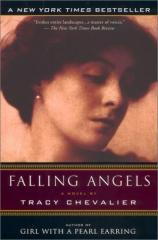
Falling Angels


Review
Falling Angels




FALLING ANGELS is Tracy Chevalier's long-awaited follow-up to her international bestseller GIRL WITH A PEARL EARRING. However, this new title is far from a companion piece to her beloved debut.
FALLING ANGELS begins January 1901, the morning after Queen Victoria's death, the morning that her son, the dandy King Edward VII becomes monarch. This is a telling date to begin a novel with, and Chevalier doesn't waste any time setting up her main character, Kitty Coleman, as the archetype of the new Edwardian age. Kitty is an upstanding London lady --- beautiful, refined and very, very smart. She has a handsome husband, a plain but intelligent daughter, and a beautiful home, complete with cook and maid. From all appearances, she is completely and utterly successful and socially accepted. But those standards are Victorian to the extreme, and Kitty is a modern woman. She is bored with her family and her life and longs to be back at home with her nurturing father and brother so she can be free to study, to make art, to do whatever.
Kitty's diametrical opposite is Gertrude Waterhouse. Gertrude longs to be more than she is --- in short, the proper Victorian lady. She follows manners books, wears all the right things and instructs her two precocious daughters on how to be gentlewomen. Kitty and Gertrude (and their families) are brought together in a chance meeting in a graveyard. The families have abutting plots, and their marked social and cultural differences are immediately recognizable: the Waterhouse's gravestone features a large, romantic, old-fashioned angel, which the Coleman's want removed.
The families become further embroiled when the Waterhouses, in an effort to keep up with society, move to a more posh, more acceptable house. This house (of course) happens to be right next to the Coleman's own. Maude, Kitty's daughter, and Livy, Gertrude's oldest, join forces in friendship as the families' lives get increasingly complicated. Unfortunately for the reader, these interworkings occur at the time when the plot completely falls apart. The first misstep Chevalier makes is to have the two girls become confidantes with a gravedigger's son named Simon. While it is plausible that Livy and Maude would become friends due to their class and age, it is utterly unthinkable that parents would allow their little girls to play with an older boy who curses, is far too cheeky and is frankly way below them in class status --- especially parents with pretensions to gentility like the Waterhouses. To put it in American terms, this friendship is akin to a white Savannah family allowing their five year old daughter to play with the teenage son of their black garbage man in the 1950s.
Even putting this implausible relationship aside, the children themselves leave a lot to be desired. They are precocious to the extreme and, even allowing for the fact that children in turn-of-the-century times spoke in a way that is unfamiliar to modern ears, their dialogue is stilted and unbelievable. And in Livy, Chevalier has created a real little monster --- a spoiled drama-queen who uses all her powers of manipulation against her family, Simon, and the Colemans. Not to say there aren't children like her in the world, but why should we want to read about them?
The fact that she includes the interclass friendship is very surprising since, in every other case, Chevalier's characters are utter stereotypes of the upper-class in Victorian and Edwardian Britain. Gertrude is a two dimensional cutout whose every word seems ripped from one of the manners manuals of the time, the men come across as bumbling bureaucrats who know nothing of their families, and the servants are all crass and interested solely in clandestine sex. Prime example: Richard Coleman, Kitty's husband, begins the novel as a freethinking scientist, a man who loves but does not understand his wife. He even goes so far as to try "swinging" to get her interested in him again. By the middle of the novel, however, he has become enemy number one, the man who is keeping Kitty down, though we're left with the sense that if she just told him her desires, Richard would build her a room of her own.
One would think that Chevalier, who went to so many pains to show how smart her main character, Kitty, was, would then allow Kitty to act smart. But no. Instead, Kitty falls into the same traps and tropes that have felled female heroines since time immemorial. Kitty commits adultery, falls under the spell of a radical feminist, even has an abortion at a time when, frankly, having a back-alley abortion would have killed her. Chevalier is also heavy-handed when she discusses Kitty's zeal for feminism. After her affair has left her feeling even more alone and confused, Kitty turns her attention wholeheartedly to the woman's suffrage movement. It is obvious that going to meetings and rallies, organizing and just talking to these intelligent women gives Kitty some of the mental nourishment she needs. Chevalier, however, again falls into cliche, making these women shallow and bored upper-class housewives who either care little for the cause and all for the publicity, or who are blindly following Caroline Black, their charismatic leader. Here again, Chevalier falls short. She had the chance to further explore these women and their lives but instead she fell back on assumptions and stereotypes, making them out to be radicals at best and fools at worst.
Chevalier is at her best when she is describing the Victorian fetishism of death, funerals, and graveyards. She obviously did her research, and some of the material is fascinating, but readers who know little of the time period will be at a loss. FALLING ANGELS itself is a tad death-obsessed. As the title portends, the characters in FALLING ANGELS do not come to happy ends. Instead, through a series of coincidences and tumults, two of the main characters are dead at the end of the book. Chevalier has written a potboiler, not unlike the Victorian penny novels. FALLING ANGELS is an interesting attempt, but will leave fans of GIRL WITH A PEARL EARRING perplexed and disappointed.
Reviewed by Jennifer Abbots on January 24, 2011


Falling Angels
- Publication Date: September 24, 2002
- Genres: Fiction
- Paperback: 336 pages
- Publisher: Plume
- ISBN-10: 0452283205
- ISBN-13: 9780452283206