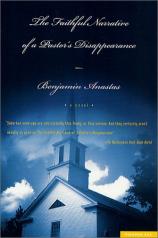
The Faithful Narrative of a Pastor's Disappearance
by Benjamin Anastas
List Price: $13.00
Pages: 288
Format: Paperback
ISBN: 0312420684
Publisher: Picador USA
In the small, mainly white well-to-do Boston suburb of W_____ during the mid-1990s, the young, charismatic black pastor of the Pilgrims' Congregational Church suddenly vanishes. Why? Where did he go? Who saw him last? What would have, or who could have, caused him to leave? When will he return? Or will he, ever? The Faithful Narrative of a Pastor's Disappearance, the title of which deftly and deliberately nods to a famous Jonathan Edwards sermon of 1737, is a perceptive, compelling, and often laugh-out-loud novel of the many paradoxes of today's New England: new cultural values and old religious traditions, liberalism and provincialism, acceptance and prejudice. With a richly varied and wholly representative cast of characters-the parishioners who, each and all, discover, are affected by, and finally must surmount the pastor's absence-this is a blistering yet insightful satire of religion and real estate, suburbs and sex-drives, adultery and the American Dream. Benjamin Anastas offers a novel that, as Newsday observed, "is a mighty good read. The characters and their social milieu are wonderfully drawn, and the writing is sardonic and memorable."
top of the page

1. With page after page of suburban boredom, consumer-culture excess, marital disillusion, psychological medication, drug and alcohol dependency, and unfulfilling careers in meaningless jobs, this novel paints an ugly picture of contemporary American society. Begin your discussion by addressing the purposes and targets of the satire in these pages.
2. Chapter One of The Faithful Narrative of a Pastor's Disappearance is actually one long sentence. What does this feat of grammar as well as gossip reveal about the book's structure, narrator, plot, setting, and/or characters?
3. Examine the tone of the omniscient narrator of this "faithful narrative." Also, describe the attitudes or impressions Benjamin Anastas seems to have regarding his characters, their priorities, and their predicaments? What do you make of the language used by this author to tell his tale? And what about the title? Does it seem ironic to you? Explain why or why not. Also, discuss the italicizing of certain words throughout the story. Based on the language of this novel, how would you characterize the narrator's-and the author's-feelings about religion, faith, churchgoing, and the like.
4. Although the Rev. Thomas Mosher is "missing" over the whole course of the novel, and is thus described and encountered only through flashbacks, we learn a lot about his personal background and private identity. Describe his personality, secrets, likes and dislikes, and general disposition. What do certain members of his congregation admire about him? What do other members find lacking in him? Look back to the scene in Chapter Four where the pastor sits alone in a pew at the back of the church and stares at the stained-glass windows on either side of him. Which particular window reminds Thomas of himself, and why? And why is he able to see "himself in both halves of the picture"?
5. Discuss how race, class, gender, identity politics, individual spirituality, and political correctness are addressed in this narrative. How do the main characters -especially Thomas Mosher, Kate Moore, Artemesia Angelis, Margaret Howard, the Caruso family, and the Swedish nanny Ulla-think and feel about these issues? If and when these issues are treated satirically in the novel, to what end-or for what larger purpose or reason-is such satire proffered? Identify any social and political points made in the text of The Faithful Narrative.
6. Explore this novel's many suspenseful elements. In what ways does the story fully rely on matters of suspense and perplexity? Also, consider the pastor's disappearance as a literary mystery, a whodunit, providing as many clues, red herrings, motives, and suspects as you can. Moreover, consider the book's depiction of the mystery of faith itself-both that of the Holy Trinity and that of how people can have, find, develop, or seek out faith in the first place. What are the key puzzles or mysteries in this story? How, if at all, are they answered? Which questions remain unanswered?
7. Ultimately, The Faithful Narrative is as much about the disillusion and near-breakdown of a beautiful yet deeply depressed working mother in suburban Massachusetts as it is about a melancholy pastor who suddenly turns up missing. Identify the crises afflicting Bethany Caruso as the novel begins, as well as the problems she encounters as the story develops. What are the personal crises that she is running from? And which problems is she finally willing to face? What important decisions does Bethany make for herself at the end of Chapter Nine?
8. Describe the love affair between Thomas and Bethany. What does each individual find in the other, especially at the outset of their affair? As the affair continues, when do the two of them seem closest, most joyful, most at peace? And when do they come off as aimless, agitated, unsure of their prospects as lovers? And why does Bethany, in the final chapter, decide to visit the address (in a neighboring town) listed for Thomas's mother? Were you surprised by this? Explain why or why not.
9. Throughout the narrative, much thought is given by the various characters to the last sermon that Thomas delivered before he disappeared. How do they regard the pastor's de facto parting remarks? Or do they even comprehend them? What was the title of this sermon, and what was it about? Explain the relationship between the sermon and the larger themes of the novel.
10. Reread the epigraph that begins The Faithful Narrative, a quotation from Jonathan Edwards, the 18th-century Puritan minister (whose thoughts and writings are often echoed by those of Thomas Mosher). What connections can you identify between the meaning of this quotation and the meaning(s), in your own estimation, of the novel itself?
top of the page

"Surprisingly seductive. . . . An extended, sometimes hilarious double take on American culture. . . . You can find yourself reading this book for pleasures more often associated with a think piece than a story. . . . Every word communicates a kind of fearful joy. . . . [The book is] graceful and slyly comic about religious matters."
The New York Times Book Review
"Suburban send-ups aren't usually this funny, or this serious. And they certainly aren't usually as good as The Faithful Narrative of a Pastor's Disappearance."
The Washington Post Book
World
"Artful. . . . Through it all, one happy constant is the author's gimlet prose. In just his second novel, Anastas shows a rare ability to empathize with his main character, sympathize with a large but never unwieldy cast of minor ones, and nail the walk-ons in a sentence."
San Francisco
Chronicle
"Recognizing the contrast between old New England and contemporary New England, the clash between spirituality and materialism, Anastas skillfully weaves old with new in both language and culture. . . . The carefully constructed sentences carry the reader irretrievably forward, immersing him or her deeply in the outcome. . . . Anastas's gifts for description and characterization make this work a literary as well as a satirical masterpiece."
The Desert News (Salt
Lake City)