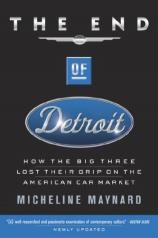
The End of Detroit: How the Big Three Lost Their Grip on the American Car Market


Review
The End of Detroit: How the Big Three Lost Their Grip on the American Car Market




Take a drive on most U.S. highways and even consumers wholly uninterested in the auto industry would have to agree with New York Times automotive writer Micheline Maynard --- the Big Three's dominance of the American car market is over.
Imports dominate California's car-clogged roads. In Texas, once dominated by domestic truck brands Chevrolet and Ford, imports are increasingly popular with younger, more affluent consumers. Even in the Big Three's home state, Michigan, import brands have built some of the biggest and most extravagant dealerships in the country to serve a growing number of customers.
In August 2003, cold hard facts began piling up alongside such anecdotal evidence. For the first time ever, Toyota outsold Chrysler, now owned by the German-American company DaimlerChrysler. It was a seminal point for the domestic carmakers that had tried everything short of giving away cars to shore up their faltering market share in the past two years. By September, the Big Three's market share hit 57 percent, a historic low.
How and why Toyota surged to this position and how once-dominant brands of Ford, General Motors and Chrysler let it happen is at the heart of THE END OF DETROIT.
Ms. Maynard deconstructs how imports from Korea, Japan and Germany systematically have eaten away at the market share of U.S. car brands. Through detailed and engaging reporting, she shows how these companies consistently offered consumers higher quality, cheaper prices or more dramatic styling and performance. She also talks about why the U.S. companies have failed to stop the imports in their tracks.
Ms. Maynard does a superb job of offering insight and evidence as to how Toyota and Honda grew from offering cheap energy efficient cars in the 1970s to full-line auto makers with trucks and sport utility vehicles that rival the power and performance of the domestic makers.
She dives into the differences between Honda and Toyota, explaining how divergent these two Japanese companies really are, despite the fact that they are often "mentioned in the same breath --- Toyota-and-Honda, all run together --- as if they were one big company instead of two." Ms. Maynard, however, rightly points out that the two companies are following very different corporate paths to win consumers. Both corporate strategies spell trouble for the domestic automakers.
Toyota has plans to be the world's No. 1 automaker, overtaking General Motors by the beginning of the next decade. Ms. Maynard believes Toyota's domination is inevitable; she even writes a fictional news story in which Toyota announces this fact. While it is hard to argue with Toyota's superiority, Ms. Maynard doesn't discuss in detail whether Toyota could fall prey to the same problems as the domestic makers while it pushes for world domination.
By contrast, Honda is content to build vehicles for its small but zealous customer base, Ms. Maynard says. Sometimes, ironically, those zealous customers are in fact its biggest competitors. General Motors now buys Honda engines for use in its vehicles.
She also outlines the comebacks of upstart brands such as Korea's Hyundai and Japan's Nissan. Hyundai dominates the low-end of the market with its inexpensive sedans and small sport utilities. Nissan is pulling a flanking position by offering flashy, high performance products like the 350Z and even a sexy minivan called Quest.
But when Ms. Maynard turns her attention to the U.S. automakers, it is with less of the fine detail with which she brought the imports' story to life. Her broad brush of the U.S. industry may leave readers wanting more stories and details on how the Big Three lost their grip. Instead, her re-telling of how Ford neglected the Taurus family sedan and lost its No. 1 ranking to the Camry has an outsiders' feel, which contrasts to the insider's feel of her reporting on Toyota and Honda.
Despite this, her conclusions about how the Big Three lost control of an industry they once dominated are in depth enough for executives in any industry to learn from. Ms. Maynard writes that the Big Three continued to produce inconsistent, poor quality cars that didn't meet consumers' changing needs, even as a growing list of competitors upped the ante. Worse yet, the Big Three blamed everyone but themselves for the problems besetting them. And finally they suffered from a major case of hubris, believing that their consumers would keep coming back if they added enough macho sizzle to cars.
A telling anecdote in that regard comes in one of the book's final chapters. Over lunch Ms. Maynard asks Robert Lutz, a former Chrysler executive that GM hired to bring passion back to its cars, which automobile he wanted buyers to think about when they thought GM. She writes, "Lutz unhesitatingly chose the Chevrolet Corvette." Low slung V-8 sports cars popular with retirees aren't likely to help GM beat Toyota and other imports in the coming years.
Ms. Maynard predicts that by 2010 the U.S. carmakers will account for just 50% market share, a slide of nearly 40% since the 1960s. She predicts that by 2010 the Big Three (if all of them survive) will compete in a market more akin to Europe's, where a dozen strong competitors compete to control smaller slices of market share.
If this could happen to the once mighty Detroit, readers will take pause and think about what industries could fall next.
Reviewed by Fara Warner on January 21, 2011


The End of Detroit: How the Big Three Lost Their Grip on the American Car Market
- Publication Date: September 21, 2004
- Genres: Business, Nonfiction
- Paperback: 368 pages
- Publisher: Crown Business
- ISBN-10: 0385507704
- ISBN-13: 9780385507707