IndieBound Independent Bookstores

Barnes & Noble

Loading
Reading Group Guide
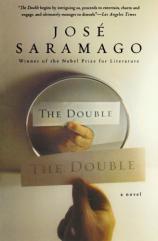
The Double
by José Saramago

List Price: $25.00
Pages: 336
Format: Hardcover
ISBN: 0151010404
Publisher: Harcourt Trade Publishers

Click here to buy this book from Amazon.com.
Click here to buy this book from Amazon.ca.


About This Book


Tertuliano Máximo Afonso is a history teacher in a secondary school. He is divorced, involved in a rather one-sided relationship with a bank clerk, and he is depressed. To lift his depression, a colleague suggests he rent a certain video. Tertuliano watches the film and is unimpressed. During the night, noises in his apartment wake him. He goes into the living room to find that the VCR is replaying the video, and as he watches in astonishment he sees a man who looks exactly like him-or, more specifically, exactly like the man he was five years before, mustachioed and fuller in the face. He sleeps badly.

Against his own better judgment, Tertuliano decides to pursue his double. As he establishes the man's identity, what begins as a whimsical story becomes a dark meditation on identity and, perhaps, on the crass assumption behind cloning-that we are merely our outward appearance rather than the sum of our experiences.

top of the page


rgg_discuss.gif (1294 bytes)


1. This novel is first and foremost an existential meditation on the self. Begin your discussion of The Double by exploring how the book addresses such enemies of selfhood as obsession, fear, and mortality. To what extent, in your view, is Saramago asserting that the self is defined by such enemies? To what extent is he asserting that the self is imprisoned by them? Are the self and the other ultimately one and the same--united in their aversion to such enemies? Or are the self and the other enemies themselves, forever separate and opposed?

2. Saramago's writing style is at once unique and unorthodox, engrossing and off-beat. As one reviewer put it, this author writes at a "stream-of-consciousness pace [while employing] few paragraph breaks, no quotation break-outs, and with sentences mostly comma-ed off." Explain why this style might be especially fitting for the narrative of The Double. When crafting your answer, recall, for example, how the dialogue in this novel unfolds on the printed page.

3. Tertuliano is described as suffering from a "temporary weakness of spirit ordinarily known as depression"-a description that prompted a reviewer to write "Saramago has an arch way with the received notions of our modern society." What do you think the reviewer meant by this? (Or, to put it another way, how does Saramago seem to regard "depression" in the above-cited passage?) Would you agree with this reviewer's take on Saramago? Why or why not?

4. Discuss the role that dreams play in this story. Refer to various dream scenarios in the novel to examine how dreams can tellingly reflect--or tellingly refract--the identity of the dreamer.

5. Describe the character called "Common Sense." Why does Common Sense only talk to, or appear to, Tertuliano? What purpose does Common Sense serve in The Double?

6. "Chaos is merely order waiting to be deciphered." This phrase appears as one of the novel's two epigraphs, and is also presented later in the book as a profound yet off-the-cuff remark made by Maria da Paz to her boyfriend. What does this phrase mean to you, in general and in terms of this novel specifically?

7. One of the two twins in this novel is a history teacher; the other is a movie actor. What might each profession symbolize in Saramago's novel? Also, along those same lines, what do you make of the fact that a math teacher makes the suggestion that sets this entire plot in motion?

8. When António Claro and Tertuliano Máximo Afonso finally meet face to face, António remarks to Tertuliano: "This is like a science fiction film written, directed, and acted by clones under orders from a mad philosopher." Who is the "mad philosopher" of The Double? The author? The narrator? Fate? God? Modern society? Science itself? The reader?

9. Discuss how women are portrayed in this novel: Tertuliano's girlfriend, António Claro's wife, Tertuliano's mother, etc. Does the author seem to regard women in a manner different from men? Defend your view by citing passages from the text. Who is Cassandra?

10. What's the difference, by Tertuliano's logic, between teaching history from back to front and teaching it from front to back? Which does he consider better--more fruitful, more correct? Also, what metaphorical points might be extracted from Tertuliano's ideas about history and the study of history?

11. Several different conversations in the book address the subject of words. What did this novel teach you about the limits, traps, paradoxes, quirks, and misunderstandings implicit in all languages?

12. Discuss a few of the many proverbs--both genuine and invented, both real and fanciful--that are recited throughout this novel by the narrator and main characters. Which fares better over the course of The Double: wisdom or intellect?

13. A British review of this book pointed out that: "Old as our fears, the familiar figure of the double haunts the literatures of every country. It comes in all shapes and sizes, [and] is one of the most complex, most retold, and richest of our fables . . . Since the immutable laws of nature insist that something cannot exist in two places at the same time, a man and his double cannot both remain alive: one of the two must vanish for the order of the universe to be respected." How does Saramago's version of the "double" myth/legend/archetype compare and contrast with other stories you have heard, read, or seen in this vein?

14. When accepting the Nobel Prize in Literature, Saramago began his speech thus: "The fictional character is the master, the writer his apprentice." Explain how this idea is--or is not--echoed in The Double.

15. Revisit the brief final chapter that concludes The Double. Were you surprised, upset, challenged, perplexed, or gratified by it? Explain. Did the ending change your view of the novel overall? If so, how?

top of the page

Critical Praise

"xxxxxxxxxxxxx"
XXXX


"xxxxxxxxxxxxx"
XXXX


"xxxxxxxxxxxxx"
XXXX


"xxxxxxxxxxxxx"
XXXX

 
Facebook Fan Page  Follow us on Twitter


Add Your Guide to ReadingGroupGuides.com!

Bookreporter.com Bets On...: Books We're Betting You'll Love


Privacy Policy | Contact Us | Advertising | About Us

© Copyright 2001-2012, ReadingGroupGuides.com. All rights reserved.
The Book Report, Inc. • 250 West 57th Street • Suite 1228 • New York, NY • 10107
Ph: 212-246-3100 • Fax: 212-246-4640

Bookreporter.comReadingGroupGuides.comGraphicNovelReporter.comFaithfulReader.com
Teenreads.comKidsreads.comAuthorsOnTheWeb.com