IndieBound Independent Bookstores

Barnes & Noble

Loading
Reading Group Guide
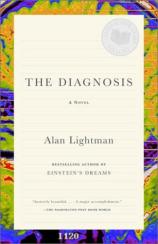
The Diagnosis
by Alan Lightman

List Price: $14.00
Pages: 384
Format: Paperback
ISBN: 0375725504
Publisher: Vintage

Click here to buy this book from Amazon.com.
Click here to buy this book from Amazon.ca.


About This Book


The acclaimed, bestselling author of Einstein's Dreams presents another startling meditation on science and life–the harrowing tale of one man's struggle to cope in a wired world as his own biological wiring short-circuits.

As Bill Chalmers shuttles to work, an extraordinary thing happens. Suddenly, he can't remember who he is or where he works. All he can recall is the corporate motto: the maximum information in the minimum time. Bill’s memory returns, but a pronounced numbness encroaches his body. He grows increasingly isolated at work, his doctors are unable to diagnose his condition, and his wife and son are more interested in technology than they are in him. The result is a startling arraignment of a world driven by speed, information, and the bottom line.

top of the page


rgg_discuss.gif (1294 bytes)


1. Why does the novel begin on the subway? What are the mythological or metaphoric implications of Bill losing his way on an underground journey?

2. How do Bill's encounters with the homeless woman [p. 4] and with his neighbor [p. 7] reveal what kind of man he is? How do the descriptions of the station and the train ride establish the atmosphere for the rest of the novel?

3. As his panic mounts, Bill reflects on what is happening to him [p. 15]. Why can he recall the times of his appointments but not the first name of his coworker, Jenkins? What does the order in which he forgets things reveal about modern society?

4. In his attempt to rediscover his identity, Bill escapes from the hospital, wanders through Boston neighborhoods, and eventually ends up in a church. Why does his search follow this particular path? Both hospitals and churches are commonly thought of as sanctuaries. To what extent, if any, do they serve this purpose for Bill?

5. One of the most bizarre events of the evening is Bill's confinement in the cash booth [p. 61]. What images, metaphors, and even individual words give this scene its power and resonance? Why does it mark the turning point for Bill?

6. When Bill returns home, why is he so secretive about what happened to him? What does his reluctance to admit his memory loss reflect about his relationships with his family and coworkers? About how he perceives himself? Are his actions understandable? In light of their initial reactions, do you think Melissa and/or Alex could have provided an emotional anchor for him? If he had confided in them immediately, would it have changed the course of events? What other opportunities does Bill have to reconnect with his emotions throughout the course of the novel? Why doesn't he take advantage of them?

7. Alex greets his father "outfitted in a steel-mesh face mask, white jacket, white glove, and white shoes . . . and he brandished a foil" [p. 72]. Why is the reunion between father and son portrayed in this way? How does Alex's interest in fencing, a fairly esoteric activity, add another dimension to the story? In what ways is it linked to his subsequent fascination with PLATO ONLINEª?

8. Why does Lightman give so much space to the e-mail messages circulated among the characters? Beyond a convenient (and often amusing) way of recording events, what purpose do they serve?

9. What does the relationship between Anytus and his son, Prodicus, have in common with the relationship between Bill and Alex? In what ways do the sons challenge their fathers' beliefs about life, either implicitly or explicitly? Is alienation between fathers and sons an inevitable part of life, or are Anytus and Bill "bad fathers," guilty of abnegating their moral responsibilities to their sons?

10. In brooding about his situation, Bill thinks, "Of one thing he was certain: that he had been afflicted far beyond what he deserved. . . . He, who played by the rules, who was more intelligent and able than most, who wanted only a nice house in the suburbs with a family who loved him, an adequate income, an eventual senior partnership and position where he could hold his place in the world" [p. 149]. Do you think this passage describes what most of us are looking for in life? What elements are missing?

11. Why does Melissa say, "I've caused everything. I'll never forgive myself" [p. 365]? Is this an expression of the guilt she feels about her online relationship with the professor and her failure to support Bill emotionally? Is it possible that she is actually in some way responsible for Bill's illness?

12. In the "Anytus Dialogue," Prodicus says, "Sokrates has drawn what he is too modest to speak. He has revealed his true self and the selves of us all" [p. 95]. How do the images Socrates draws relate to the themes of the book? What do the drawings Bill scrawls across his bedroom reveal, perhaps inadvertently, about his true self and the selves in all of us? If you are familiar with Plato's Republic, how can the "Allegory of the Cave" be used as a key to understanding the underlying meaning and message of The Diagnosis?

13. Lightman juxtaposes the stories of Socrates and Bill Chalmers without drawing explicit comparisons between them. In what ways are the two stories parallel? How does Bill's eventual acceptance of his fate echoe the attitudes Socrates expresses to Anytus in talking about his imminent execution?

14. The Diagnosis can be seen as a "dystopian" novel, a portrait of a society that has distorted the most basic principles and values of humankind. What elements does it share with George Orwell's 1984, Margaret Atwood's The Handmaid's Tale, Alan Nourse's Bladerunner, and other visions of dystopia presented in literature and film? What aspects of the novel are the most disturbing?

top of the page

Critical Praise

"Original and grimly unsentimental…. A major accomplishment, written in austerely beautiful prose."
The Washington Post Book World


"A funny, troubling story about our culture's devotion to technology at the expense of humanity…. Clever and wise, a rare combination."
San Francisco Chronicle


"Although the world around Bill 'is diminished to the most feeble red light,' the novel, at last, burns brightly."
The New Yorker

 
Facebook Fan Page  Follow us on Twitter


Add Your Guide to ReadingGroupGuides.com!

Bookreporter.com Bets On...: Books We're Betting You'll Love


Privacy Policy | Contact Us | Advertising | About Us

© Copyright 2001-2012, ReadingGroupGuides.com. All rights reserved.
The Book Report, Inc. • 250 West 57th Street • Suite 1228 • New York, NY • 10107
Ph: 212-246-3100 • Fax: 212-246-4640

Bookreporter.comReadingGroupGuides.comGraphicNovelReporter.comFaithfulReader.com
Teenreads.comKidsreads.comAuthorsOnTheWeb.com