Reading Group Guide
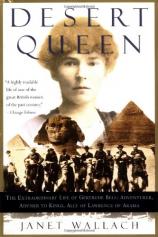
Desert Queen
The Extraordinary Life of Gertrude Bell: Adventurer, Adviser to Kings, Ally of Lawrence of Arabia
by Janet Wallach

List Price: $15.95
Pages: 464
Format: Paperback
ISBN: 0385495757
Publisher: Anchor

Click here to buy this book from Amazon.com.
Click here to buy this book from Amazon.ca.


About This Book


Turning her back on her privileged life in Victorian England, Gertrude Bell (1868-1926), fired by her innate curiosity, journeyed the world and became fascinated with all things Arab. Traveling the length and breadth of the Arab region, armed with a love for its language and its people, she not only produced several enormously popular books based on her experiences but became instrumental to the British foreign office. When World War I erupted, and the British needed the loyalty of the Arab leaders, it was Gertrude Bell's work and connections that helped provided the brain for T. E. Lawrence's military brawn. After the war she participated in both the Paris and Cairo conferences, played a major role in creating the modern Middle East, and was generally considered the most powerful woman in the British Empire.

In this incident-packed biography, Janet Wallach reveals a woman whose achievements and independent spirit were especially remarkable for her times, and who brought the same passion and intensity to her explorations as she did to her rich romantic life. Too long eclipsed by Lawrence's fame, Gertrude Bell emerges in this first major biography as a woman whose accomplishments rank as crucial to world history (especially in light of the continuing geopolitical importance of the Middle East) and whose life was a grand adventure.

top of the page


rgg_discuss.gif (1294 bytes)


1. Gertrude Bell was born in 1868 at the height of the British Empire, when the British navy ruled the seas and British merchants supplied food and clothing to half the world's population. The Bell family lived in northern England and employed 40,000 workers in their coal and iron works. In addition to running their prosperous business, Gertrude's father Hugh Bell and her grandfather Lowthian Bell were well-educated, intellectually curious, adventurous, and politically engaged. Hugh Bell's motto was "obstacles are made to be overcome." How did Gertrude Bell's upbringing shape her? How did she apply her father's philosophy to her life?

2. Gertrude Bell was a difficult child: precocious, stubborn, and naughty enough to discourage her nannies from staying on the job. She prided herself on being better than the others around her, and as she grew up, her best friends were her brother Maurice and her cousin Billy Lascelles. In her adolescent years, she always seemed at odds with her stepmother; the one woman she seemed to care for was her aunt Florence, whose husband was the British ambassador to Bucharest and Tehran. What were Gertrude Bell's relationships like with other females? Why did she have such disdain for the British wives in Baghdad? Were there any women she admired? Did her attitude toward women change over the years? If so, how did it manifest itself?

3. Like most young women of her time, Gertrude Bell was expected to marry by the age of twenty. Although she was intellectually outstanding, from a marital point of view she was a failure, having found neither husband nor a fiancé. She was sent abroad to give her some sophistication and to prevent her from becoming a bluestocking. Yet when she fell in love with Henry Cadogan, her father told her he would not give her permission to marry. Why did her father object to the match? Why did she obey his wishes? Gertrude seemed unusually close to her father and continued to ask for his advice even after she became an important official. How would you characterize their relationship? How did it influence her relationships with other men?

4. Although women were often treated as second-class citizens, Gertrude Bell received the finest education and was given many of the privileges of a man. She was sent to college in London, and then was able to attend Oxford University. She was given freedom to travel around the world, was a published writer while still in her twenties, and often discussed politics with members of Parliament and British diplomats. In light of this, how did she respond to the women's suffrage movement? Why did she feel this way?

5. The bedouins gave Gertrude Bell the complimentary title of "an honorary male." When she was in the desert, she was able to march into the tents of the sheikhs. The tribal leaders often hosted her for one or two nights, sharing their best food and enjoying conversations with her that ranged from local gossip to world politics. Yet in their own world, the Arabs kept their women in separate quarters, did not allow them to take their meals with the men, and had little regard for the women's opinions. Why did the sheikhs accept Gertrude Bell as an equal and even treat her as a dignitary? How similar were the attitudes of the Arab notables and the British male officers and officials?

6. During World War I there were three different agreements that the British made concerning the future of the Arab lands after the breakup of the Ottoman Empire. When they were revealed, these agreements created anger and confusion among all three groups. What were the promises and to whom were they made? What impact did they have on the Middle East?

7. When the British decided on the emir Faisal to lead the new state of Iraq, they knew they would have problems. Faisal came from an important Sunni family yet he had never set foot in Mesopotamia. Why were they determined to put him on the throne? What were the political reasons? What sort of person was he? Why did the British believe he would be accepted by the Shiites? What was his role in the Arab revolt against the Turks? Gertrude Bell knew that the Arabs in Mesopotamia had a long, rich history. How did she teach Faisal this history? Faisal had to be approved by a referendum, yet he knew no one when he arrived in Iraq. What did Gertrude Bell do to make sure Faisal would be approved in a referendum?

8. When the British entered Baghdad after the defeat of the Turks, they declared themselves liberators and received a warm welcome from the Arabs. Shortly afterwards, attitudes changed, and the British were considered the enemy. What happened to change opinions? How did the British treat the Arab unrest? What was British opinion at home concerning Mesopotamia? Why did England turn to the League of Nations? What was Winston Churchill's role?

9. Today, it is often questioned why Iraq looks the way it does geographically and demographically. How were its borders decided? What was Gertrude Bell's role? Did the British know there was oil, and if so, was it the only consideration? Why are the Kurds included in the population? Why were the Sunnis given control?

10. The Baghdad Museum has recently been in the news because of the destruction and theft of many of its antiquities. What was Gertrude Bell's connection to this museum? Why was she interested in it? How did she become interested in archaeology? What discoveries did she make in her earlier travels? What did she do to prevent foreign archaeologists from removing antiquities from the country?

11. In some ways, Gertrude Bell's experiences paralleled that of Victorian England. In what ways did they reflect the fortunes of the British Empire? At the end of her life, she took an overdose of sleeping pills. How did the end of her life reflect the decline of the empire?

top of the page

 
Back to top.   


Privacy Policy | Contact Us | Advertising | About Us

© Copyright 2001-2008, ReadingGroupGuides.com. All rights reserved.