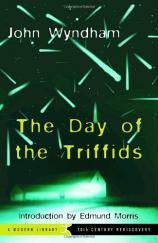
The Day of the Triffids
by John Wyndham
List Price: $11.95
Pages: 256
Format: Paperback
ISBN: 0812967127
Publisher: Modern Library
In 1951 John Wyndham published his novel The Day of the Triffids to moderate acclaim. Fifty-two years later, this horrifying story is a science fiction classic, touted by The Times (London) as having "all the reality of a vividly realized nightmare."
Bill Masen, bandages over his wounded eyes, misses the most spectacular meteorite shower England has ever seen. Removing his bandages the next morning, he finds masses of sightless people wandering the city. He soon meets Josella, another lucky person who has retained her sight, and together they leave the city, aware that the safe, familiar world they knew a mere twenty-four hours before is gone forever.
But to survive in this post-apocalyptic world, one must survive the Triffids, strange plants that years before began appearing all over the world. The Triffids can grow to over seven feet tall, pull their roots from the ground to walk, and kill a man with one quick lash of their poisonous stingers. With society in shambles, they are now poised to prey on humankind. Wyndham chillingly anticipates bio-warfare and mass destruction, fifty years before their realization, in this prescient account of Cold War paranoia.
top of the page

1. Some critics of The Day of the Triffids believe the novel is devoid of ideas and was written merely to please a destruction-hungry audience. However, there are many instances in the novel where morale, literature, and law and order are discussed and debated. Do you think this is a technique to simply further the action of the story or was Wyndham inserting political views?
2. Bill and Josella encounter a handful of new societies in their apocalyptic world. What are the social theories behind each? Why did they fail or succeed? If they did fail, could anything have been done to help the societies succeed? If any of these societies were formed in the present day, would they survive?
3. Which society would you yourself join and why?
4. Bill witnesses many suicides without interfering, and even helps three people kill themselves, actions that in the 1950s were against the law. How can he, from his own accounts a decent, law-abiding citizen, move so easily into depravity? Why, after we witness this depravity, do we still sympathize with him? Is Wyndham commenting on his country's laws and culture?
5. The Day of the Triffids's main characters are all decidedly bourgeois, as are the casts of many other sci-fi novels. How does this affect the themes and action of the story?
6. Do you appreciate the love story between Bill and Josella? Did Wyndham intend it to play a role in the action or was he simply inserting some human interest into the plot?
7. The literary theory Marxism states a piece of literature cannot be critiqued without studying the politics, economics, and culture of the time period it was written in. Hence, no text is universal or forever timely. Do you agree with this theory? Is The Day of the Triffids universal or timely? If yes, is this inherent in the actual text or our present-day culture?
8. Some critics feel Wyndham's ultimate message is one of doom; humans are forced to live on a small island with no relief or chance for re-populating the earth. Other critics feel Wyndham meant his book to be hopeful; society's ills, including those which produced the triffids and mass-destruction weapons, are wiped out and society can start afresh. What view do you hold?
9. Many critics have compared Wyndham to H.G. Wells, who was actually one of Wyndham's favorite writers. Do you consider the two writers on the same level, both in their imagination and their writing talents?
top of the page