Reading Group Guide
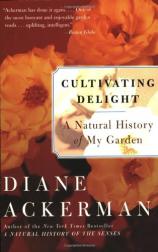
Cultivating Delight
A Natural History History of My Garden
by Diane Ackerman

List Price: $13.95
Pages: 272
Format: Paperback
ISBN: 0060505362
Publisher: Perennial

Click here to buy this book from Amazon.com.
Click here to buy this book from Amazon.ca.


About This Book


In Cultivating Delight, naturalist, poet, and author of the widely-beloved and bestselling A Natural History of the Senses, Diane Ackerman shares with her readers the delight, joy, and pathos she experiences in the life of her garden and its myriad inhabitants. Here, Ackerman explores the living world outside the human element. It is through the ever-changing life and lives of and in her garden that Ackerman juxtaposes that which we attempt to control as humans whose natural inclination is for the imposition of order against that which is natural and therefore uncontrollable, and steeped in the always chaotic change of the seasons and the passage of time.

Whether Ackerman is deadheading flowers, or glorying in the profusion of more than 100 rose bushes and perennials; providing a regular meal of sugar water for the frenetic, frazzled and short life of the hummingbird; offering an off-season treat of peaches to the most dreaded, scavenging, and beautiful of garden pests, the deer; or even studying the slug, the author welcomes the unexpected drama and extravagance, as well as the sanctuary the garden provides not only to her, but to its other inhabitants as well. It is through her garden that Ackerman offers her readers the firsthand experience of the beauty of impermanence, with which the passage of time comes not only death in the garden, but life as well.

top of the page


rgg_discuss.gif (1294 bytes)


1. In Cultivating Delight, the author refers to patience and persistence, fondness for ordeal, and a fascination with new customs and ideas as being the necessary calling cards of the true gardener. Why do you think this is the case, and is it true among all gardeners? What are some of the instances that occurred in the life of the author's garden where she needed to rally all of her patience, her fondness for ordeal, and her fascination with new customs?

2. Does the author ever manage to allow her human desire for order to overtake her love of the natural? If so, when? Do you think that the author feels it's possible to be a dedicated gardener and not impose order, or is order itself a necessary by-product of being human?

3. One would assume that with gardens as large and beloved as Ackerman's, that one would be dedicated to ridding it of the pests that threaten to devour it. Why is it then that Ackerman has such a high tolerance -- almost a love -- for what gardeners traditionally consider to be dangerous pests: deer, rabbits, raccoons, slugs, and weeds? Why would she consider planting an entire lawn of weeds?

4. What was Ackerman's most helpful piece of advice to you as a gardener? Has she changed the way you look at your garden, or the way you work in your garden? If so, how?

5. Ackerman frequently humanizes her garden: she speaks of its accomplishments, its "mood-swings" and chemical fluctuations, its teasing sexual habits and functions. Do you think that the humanizing of the garden will help or hinder you as a gardener vis a vis its maintenance or care? Does this humanizing negatively or positively affect the gardener's ability to perform certain tasks in the garden, for example, spreading "weed killer"? Will her humanization of the garden challenge you to think and perform differently as a gardener?

top of the page

Critical Praise

"An enchanting intellectual sensualist … Ackerman buzzes productively from idea to revelation to insight … [with] breezy philosophical lyricism."
Publishers Weekly (* Starred Review *)


"The joy of reading Diane Ackerman comes form the sheer beauty of her language … [it] inspires us to recognize the importance of cultivating delight."
Christian Science Monitor


"Lyrical, knowledgeable and imaginative."
Booklist


"A fascinating tour of plant mythology and fact …[Ackerman] plays both sleuth and poet."
People


"Diane Ackerman takes us down the garden path with a renewed sense of awe …[and] enlightened eyes."
Los Angeles Times


"Ackerman’s rich prose is a bridge to a world of discovery."
Nature


"Ackerman’s joy is palpable and persuasive when she turns her gaze outward, lost in the diffuse surmise of compassion, spiked through with awe, filled with admiration for the growth that passes through her hands and before her eyes."
Washington Post Book World

 
Back to top.   


Privacy Policy | Contact Us | Advertising | About Us

© Copyright 2001-2009, ReadingGroupGuides.com. All rights reserved.
The Book Report, Inc. • 250 West 57th Street • Suite 1228 • New York, NY • 10107
Ph: 212-246-3100 • Fax: 212-246-4640

Bookreporter.comReadingGroupGuides.comGraphicNovelReporter.comFaithfulReader.com
Teenreads.comKidsreads.comAuthorsOnTheWeb.comAuthorYellowPages.com