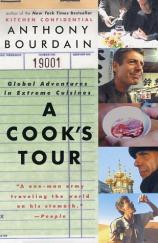
A Cook's Tour
Global Adventures in Extreme Cuisines
by Anthony Bourdain
List Price: $14.95
Pages: 288
Format: Paperback
ISBN: 0060012781
Publisher: Ecco
The only thing "gonzo gastronome" and internationally bestselling author Anthony Bourdain loves as much as cooking is traveling. Inspired by the question, "What would be the perfect meal?," Tony sets out on a quest for his culinary holy grail, and in the process turns the notion of "perfection" inside out. From California to Cambodia, A Cooks' Tour chronicles the unpredictable adventures of America's boldest and bravest chef.
top of the page

1. Bourdain tastes some pretty exotic dishes in A Cook's Tour -- Tête de veau (calf's face), snake wine, and sheep testicles, to name a few. What is the wildest thing you've ever eaten? What is the thing you've always wanted to try? What is the thing you'd never try no matter what?
2. When you travel to other places, how important is trying the cuisine of the region to you? Do you make a point of sampling as much regional food as possible or do you tend to stick to the tried and true, eating at McDonald's more often than not? Where that you've visited has had the best food and why?
3. After reading A Cook's Tour -- and from your own personal experience -- what are some basic differences Americans have in their attitude towards food, meals, and eating, compared to people in other countries?
4. Is A Cook's Tour more of a travel book, more of a food book, or equal parts both? If you could, would you want to embark upon a globe-trotting adventure similar to Bourdain's? What seemed most appealing and most unappealing about his trip?
5. How did the fact that Bourdain is a professional chef affect his account? Would it have been better or worse if he was an "ordinary" person? Did his background make him more willing to try different things or more of a "food snob" about what he ate?
6. What do you think the food of a country says about the politics, customs, people, and general way of life of that culture? Compare, for instance, the food/cultures of Japan, Cambodia, and Portugal.
7. Bourdain makes many of his descriptions of eating good food sound almost like a religious experience. Do you agree that good food can have this affect -- or is it, in the end, just sustenance? If not food, what in your life do you feel this passionately about?
8. In both of his books, Bourdain discusses the phenomenon of the celebrity chef. How does he use his celebrity? How does he compare to other well-known chefs in terms of his appeal, his honesty, and his style?
top of the page

"If you’re looking for a camel ride and an amiable companion, you could do a lot worse."
Washington Post
"Vintage Bourdain."
Dallas Morning News
"Brilliant. A chain-smoking, hard-drinking, cut-to-the-chase guy’s guy, ready to try anything new and different."
Minneapolis Star Tribune
"Bourdain’s mission is to show the cool, un-Martha side of the culinary world."
Time magazine
"Food Writer of the Year"
Bon Appétit
"[Bourdain] is a one-man army traveling the world on his stomach--and his droll wit."
People
"None of your limp-wristed, pinch-mouthed, hoity-toity delicacies for this guy."
Elle
"Mighty engaging.... [Bourdain’s] snappy, full-bore writing style--whether being sarcastic, passionate, or descriptive--is good entertainment."
Kirkus Reviews
"Adventurous and opinionated, [Bourdain] is very good company."
Milwaukee Journal Sentinel
"Some fine food adventure reading…. Bourdain offers excellent insight into real food."
San Francisco Chronicle