Reading Group Guide
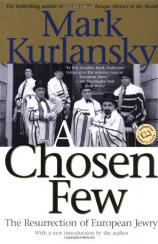
A Chosen Few
The Resurrection of European Jewry
by Mark Kurlansky

List Price: $15.00
Pages: 432
Format: Paperback
ISBN: 0345448146
Publisher: Ballantine Books

Click here to buy this book from Amazon.com.
Click here to buy this book from Amazon.ca.


About This Book


A Powerful, Deeply Moving Narrative of Hope Reborn in the Shadow of Despair

Fifty years after it was bombed to rubble, Berlin is once again a city in which Jews gather for the Passover seder. Paris and Antwerp have recently emerged as important new centers of Jewish culture. Small but proud Jewish communities are revitalizing the ancient centers of Budapest, Prague, and Amsterdam. These brave, determined Jewish men and women have chosen to settle–or remain–in Europe after the devastation of the Holocaust, but they have paid a price. Among the unexpected dangers, they have had to cope with an alarming resurgence of Nazism in Europe, the spread of Arab terrorism, and the impact of the Jewish state on European life.

Delving into the intimate stories of European Jews from all walks of life, Kurlansky weaves together a vivid tapestry of individuals sustaining their traditions, and flourishing, in the shadow of history. An inspiring story of a tenacious people who have rebuilt their lives in the face of incomprehensible horror, A Chosen Few is a testament to cultural survival and a celebration of the deep bonds that endure between Jews and European civilization.

top of the page


rgg_discuss.gif (1294 bytes)


1. The book both opens and closes with Passover. What is the significance of this holiday to this story?

2. What has been the impact of the Holocaust on subsequent generations of European Jews? How does this differ from the impact on subsequent generations of American Jews?

3. Was it reasonable for Jews to return after the war to the countries where they had been betrayed?

4. After the fall of Communism, very few Jews were left in Eastern Europe who had any experience with the practice of the religion. What does it mean to rebuild a Jewish community with secular Jews?

5. Explain the difference in motivation between those Jews who returned to East Germany and those who returned to West Germany after the war.

6. Should the Zionists who returned to postwar Europe have gone to Israel instead?

7. Would it have been easier to rebuild a religious community or an assimilated community in postwar Europe?

8. Has European Jewry since 1945 undergone a resurrection, as implied in the subtitle of this book, or is it something less than that?

9. What impact has the state of Israel had on European Jews?

10. What does it mean for American Jews that these communities in Europe still exist?

11. Throughout European history, France was always thought of as a haven for Jews, until the twentieth century. As the country with the largest Jewish population in Europe, will it be a haven or a dangerous place for Jews going forward into the twenty-first century?

12. Why is the survival of European Jewry so crucial to the Jewish people throughout the rest of the world?

13. In countries with some of the worst records of treatment of Jews, it has become fashionable to embrace everything Jewish. Is this philo-Semitism another form of anti-Semitism, and is it dangerous?

14. Three million Polish Jews were killed in the Holocaust, and most of those who returned were subsequently driven out. In the current political climate of Poland, is there a future for Jews, and are there enough to build a real community?

15. Why do survivors in Holland appear to be in more pain than in most other countries? Is it because Holland never came to terms with its war history? Is it that as a society, Holland is more open to discussing psychological problems than other countries in Europe?

16. What has the impact of terrorism been on Jewish communities in Europe?

17. Russian Jews have been immigrating to Western Europe, especially Germany, most of them with very little knowledge of Judaism. What will be their impact?

18. What has been the role of the Hasidic movement in modern European Judaism?

19. Following the Six-Day War, the Soviet Union, Eastern Europe, and even deGaulleÕs France shifted their policies toward Israel. What was the impact on European Jewry?

20. Are the communities described in this book merely vestigial or is there a future for Jewry in Europe?

top of the page

Critical Praise

"In this valuable book, Kurlansky brings alive the missing years of European Jewry."
The Washington Post Book World


"Consistently absorbing . . . A Chosen Few investigates the relatively uncharted territory of an encouraging phenomenon."
Los Angeles Times


"I can think of no book that portrays with such intelligence, historical understanding, and journalistic flair what life has been like for Jews determined to build lives in Europe."
—SUSAN MIRON, Forward


"This book is a fascinating review of the changing life of Jews and Judaism and Europeans in general since the Second World War."
Rocky Mountain News


"Kurlansky does an astonishingly informative job here, covering a vast array of individuals and communities throughout Europe, chronicling the economic, political, and cultural trends that reshaped and often played havoc with their lives and destinies. His descriptions of life in Antwerp, Paris, Budapest, and Amsterdam are superb, while his chapters on Poland are among the best I’ve read."
—SUSAN MIRON, Forward
"A richly descriptive and insightful survey of post-Holocaust European Jewry . . . With a novelist’s eye for irony and description, [Kurlansky] offers many moments of transcendence and humor; entertaining culture clashes between communists and capitalists, religious and secular, Zionists and diasporists. . . . A lively, penetrating follow-up to Holocaust readings that speaks volumes about the resiliency of the Jewish people."
Kirkus Reviews


"Kurlansky’s collection of case histories unfolds like a novel."
The Jewish Advocate

 
Back to top.   


Privacy Policy | Contact Us | Advertising | About Us

© Copyright 2001-2008, ReadingGroupGuides.com. All rights reserved.