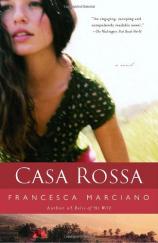
Casa Rossa
by Francesca Marciano
List Price: $14.00
Pages: 352
Format: Paperback
ISBN: 0375726373
Publisher: Vintage Books
Set against the political turmoil of the twentieth century, it portrays the fantasies and the hopes, true and false, that the women carry with them as they journey from the starkly beautiful landscape of southern Italy to the glamorous, trend-setting Rome of the 1950s and '60s, to New York City's art world in the 1970s and '80s.
The story begins with the marriage of Lorenzo Strada, an artist, and Renée, the beautiful Tunisian woman he meets on the Riviera in the 1920s. They winter in Paris and spend summers in a farmhouse in Puglia lovingly restored by Lorenzo. For Renée, the house comes to symbolize Lorenzo's determination to control and isolate her, and on the brink of World War II, she leaves him and their five-year-old daughter, Alba, and moves to Germany with her lover. Raised in Puglia by Lorenzo and a colorless, conventional step-mother, Alba makes her way to Rome after the war, where she marries Oliviero, an up-and-coming screenwriter, and is swept into the wild, promiscuous world of Italy's booming film industry. When Oliviero dies under mysterious circumstances, Alba's daughters, Alina and Isabella, face a future tainted by rumors of betrayal and unanswered questions that reach deep into the family's history. Each seeks escape, Alina by fleeing her homeland for New York City, Isabella, by joining the Italian terrorist movement.
Francesca Marciano's evocative portraits of rural Italy, Rome, and New York City create a vivid backdrop for the novel. Specific in detail, universal in its import, Casa Rossa is a profoundly moving exploration of the willful manipulation of personal and historical memory.
top of the page

1. How do Marciano's initial descriptions of Casa Rossa and the surrounding countryside [pp. 13, 15] create an emotional backdrop for the story that is about to unfold? What particular images or passages underscore the significance of the house in defining the relationships in the Strada family? How do the depictions of Stellario and the other villagers help to establish the family's cultural and social values?
2. Is Lorenzo's "indecent" fresco of Renée [p. 22] more than a reflection of his fury at her betrayal and departure? What does it reveal about his character and his beliefs about the roles of men and women in a marriage? To what extent does Renée share his attitudes? What marks the turning point in their relationship?
3. Why does Lorenzo describe Jeanne's insistence on painting the house red as "Jeanne drowning Renée in a bloodbath" [p. 27]? What other interpretations of the name "Casa Rossa" emerge over the course of the novel?
4. When she is a little girl, Alba first hears the rumors that her mother worked for the Germans [p. 40-41]. Why does she ask Jeanne, rather than her father, about the stories? How does the language Jeanne uses to describe Renée"nobody knew the story of your mother, where she came from, what her real name was [p. 42]"convey the way the family has chosen to view Renée and her place in the family history?
5. How does the relationship between Alba and Oliviero mirror the relationship between Lorenzo and Renée? Compare, for example, the descriptions of the first meetings of each couple [pp. 10-13, 45] What is the significance of the men's professionsa painter and a man who "makes stories" for a livingin attracting the women?
6. Why does Alina decide to move to New York City? What does America represent to her?
7. At the beginning of Casa Rossa, Alina says, "There is something that has been handed down from woman to woman in my family. I don't know how to call it. A secret, an unspoken legacyit needs to remain concealed, it's something to be ashamed of" [p.14]. How does Alba choose to deal with the family's secret shame? How does her choice affect her own life and happiness? What impact does it have on her daughters? Does Alina understand and accept the legacy by the end of the novel?
8. The manipulation of memory and reconstruction of the past is a major theme of Casa Rossa. What parallels are there between the stories the Strada family constructs and the historical record the Italians have constructed about their participation in World War II and about the domestic terrorism that explodes in the 1980s?
9. Is it essential for people to recognize and face up to mistakes and misdeeds committed by previous generations? Can denialeither personal or communalserve a positive purpose?
top of the page

"An engaging, sweeping and compulsively readable novel." The Washington Post Book World
"An enthralling tour de force
The gritty details of modern Italian life make Casa Rossa impossible to put down." USA Today
"[Marciano] amps up the glamour and mystery in her sophisticated novel about Italian sisters who clash over family, politics and men. Think La Dolce Vita turned topical tale." Glamour
"Elegant, eloquent prose . . . Casa Rossa is notable for its rueful understanding of the volatile mix of emotions that binds us to those we love." Los Angeles Times
"[A]ffecting, beautifully told. . . [R]ich and resonant. . .Marciano is a natural-born storyteller." The New York Times
"Beautifully told . . . rich and resonant. . . . Marciano is a natural-born storyteller."" The New York Times Book Review
"A family epic [that] revolves around three generations of extraordinary women
Fans of Marciano's first novel will once again embrace her sensual descriptions of exotic lands." San Francisco Chronicle
"Marciano brings Southern Italy as boldly to life as she did Kenya in Rules of the Wild. . . . imperturbably weav[ing] intricate complications together into a glamorous, romantic whole." Publishers Weekly
"Lyrical. . . . Romantic. . . . The story of a family whose secrets collide with history." Desert News
"Marciano. . .casts a sharp eye on the society that surrounds the family of the Casa Rossa. Her Italy is full of lies. . .But the search for truth takes courage, and the lesson learned in her novel is that the violence of the anni di piombo achieved nothing." The Economist
"Lyrical. . . . spiced with those special Italian flavors: beauty, melodrama, andof coursemurder. . . . Thank heaven for life's little pleasures." Daily Candy NYC
"Marciano effectively intermingles family secrets, Italian history, and the loves and lives of her characters. A good read." Library Journal
"Tells the mesmerizing story of three generations of a twentieth century Italian family . . . with . . . passion and fervor. . . . Enthralling." Italian Tribune
"We are made to reevaluate history and to look at the human cost both of ideals and failures in ideals. . .The period [Marciano] describes may have been given a stylish apotheosis by the early Fellini, but it can survive now only in elegies which, like this one, are really indictments." Times Literary Supplement