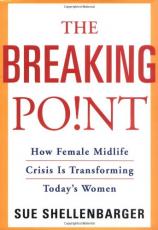
The Breaking Point
How Female Midlife Crisis is Transforming Today's Women
by Sue Shellenbarger
List Price: $25.00
Pages: 288
Format: Hardcover
ISBN: 0805077111
Publisher: Henry Holt and Co.
In the tradition of The Second Shift, a groundbreaking work that identifies and explains the phenomenon poised to redefine our culture.
When Sue Shellenbarger wrote about her midlife crises in her award-winning Wall Street Journal Work & Family column, the volume and emotional intensity of the responses from her readers was stunning. As she heard story after story of middle-aged women radically changing course in search of greater fulfillment, a trend began to emerge: an entire generation of women was experiencing the tumultuous transition of midlife in ways not seen before.
To capture this paradigm shift, Shellenbarger combines original research data and interviews with more than fifty women who've navigated their own midlife crisis. Long stereotyped as the province of men, today the midlife crisis is reported with greater frequency by women than men. Emboldened by the financial independence to act upon midlife desires, exhausted by decades of playing supermom and repressing the feminine sides of themselves to succeed at work, women are shedding the age roles of the past in favor of new pursuits in adventure, sports, sex, romance, education, and spirituality. And in the process they are rewriting all the rules.
Beyond defining a new phenomenon, The Breaking Point shows how various options women use to cope with the turmoil of midlife-from playing it safe to dynamiting their lives-have a profound impact on their families, careers, and our culture at large. Provocative, insightful, and resonant, The Breaking Point is sure to be one of the most controversial and talked-about publications of 2005.
top of the page

1. Joseph Campbell said: "Midlife is when you reach the top of the ladder and find that it was against the wrong wall." Give examples of how this might pertain to your own life.
2. Female midlife crisis is not necessarily brought on by the fear of death (which is more common in men), but by major life transitions or events. Evidence suggests that women go through bigger upheavals than men but deal with midlife turbulence better, why?
3. Why is there more potential for crisis for women who are successful? Why do some women continue smoothly through middle life, and others experience complete upheavals?
4. How can the fear of losing your ability to attract men and to be thought of as attractive facilitate a crisis?
5. Compare the cultural effects of baby boom women's midlife crises to their predecessors in the 60s and 70s.
6. Discuss which one of the archetypes best fits your personality. (Adventurer, Lover, Leader, Artist, Gardener, Seeker.)
7. "Growth hurts," says a Cornell University researcher. Discuss ways to deal with the surprise of pain at such a mature stage of life.
8. Which mode of midlife crisis describes your experience and why: Sonic Boom, Moderate, Slow Burn, Flameout, Meltdown, Non-Starter.
9. How does making a choice for yourself make others in your life happier? How can you tell whether the risks involved in shaking up your life are worth the outcome? Is it necessary to take a leap of faith to push yourself through a midlife crisis?
10. Discuss ways in which the archetype of the Seeker can help women reconnect to themselves and to the things that have meaning in their lives.
11. One of the main lessons of midlife crisis is that you cannot be afraid to be alone, or alone with your thoughts. How can you rebuild a relationship with yourself? What are some of the things you can learn from midlife crisis?
12. How can women avoid the isolation that many feel at this stage of life? What are some of the ways in which women can share their stories and experiences to help themselves and others?
top of the page

"Every once in a while you read a book that transforms you. Like the shift of a kaleidoscope, it reconfigures your view of life's journey. This is such a book. It may stimulate you to change directions, perhaps even enable you to find life's greatest joy: fulfillment. An invigorating read."
Helen Fisher, Author of Why We Love