Reading Group Guide
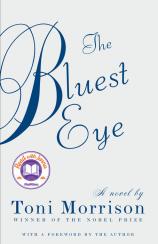
The Bluest Eye
by Toni Morrison

List Price: $15.00
Pages: 224
Format: Hardcover
ISBN: 0375411550
Publisher: Knopf

Click here to buy this book from Amazon.com.
Click here to buy this book from Amazon.ca.


About This Book


Oprah's Book Club® May 2000 selection!

The Bluest Eye, published in 1970, is the first novel written by Toni Morrison, winner of the 1993 Nobel Prize in Literature.

It is the story of eleven-year-old Pecola Breedlove--a black girl in an America whose love for its blond, blue-eyed children can devastate all others--who prays for her eyes to turn blue: so that she will be beautiful, so that people will look at her, so that her world will be different. This is the story of the nightmare at the heart of her yearning and the tragedy of its fulfillment.

top of the page


rgg_discuss.gif (1294 bytes)


1. The novel opens with an excerpt from an old-fashioned reading primer. The lines begin to blur and run together—as they do at the beginning of select chapters. What social commentary is implicit in Morrison's superimposing these bland banalities describing a white family and its activities upon the tragic story of the destruction of a young black girl? How does Morrison's powerful language—both highly specific and lyrical—comment on the inadequacy of "correct" English and the way in which it masks and negates entire worlds of beauty and pain?

2. "Quiet as it's kept, there were no marigolds in the fall of 1941. We thought, at the time, that it was because Pecola was having her father's baby that the marigolds did not grow." With these lines Morrison's child narrator, Claudia MacTeer, invites the reader into a troubling community secret: the incestuous rape of her 11-year-old friend Pecola Breedlove. What are the advantages of telling Pecola's story from a child's point of view? Claudia would appear to connect the barrenness of the land to Pecola's tragedy. In what ways does Morrison show how Pecola's environment—and American society as a whole—are hostile to her very existence?

3. The title of the novel refers to Pecola Breedlove's intense desire for blue eyes. She believes herself ugly and unworthy of love and respect, but is convinced that her life would be magically transformed if she possessed blue eyes. How does racial self-loathing corrode the lives of Pecola and her parents, Cholly and Pauline Breedlove? How does racial self-hatred manifest itself in characters like Maureen Peal, Geraldine, and Soaphead Church?

4. At a certain point in the novel, Morrison, through her narrator, states that romantic love and physical beauty are "probably the most destructive ideas in the history of human thought." How do the lives of individual characters bear out that statement? To what degree are these two concepts generated from within or imposed on us by society? Where do the characters first encounter ideas of romantic love and beauty—ideas which will eventually torture and exclude them? What positive visions of beauty and love does the novel offer?

5. What role does social class play in the novel? Pecola first comes to stay with the MacTeers because her family has been put "outdoors" owing to her father's drunken violence and carelessness. The threat of "outdoors" focuses families like the MacTeers on upward mobility. "Being a minority in both caste and class we moved about anyway on the hem of life, struggling to consolidate our weaknesses and hang on, or to creep singly up into the folds of the garment." Is divisiveness one result of this upward striving Morrison describes? What are others?

6. The novel is set in a Midwestern industrial town, Lorain, Ohio, Morrison's own birthplace. Pauline and Cholly Breedlove are transplanted Southerners and several key scenes in the novel are set in the South. How does Morrison set up comparisons between a Northern black community and the Southern black way of life? What values have been lost in the migration north?

7. Consider Morrison's characterization of Cholly Breedlove. While she clearly condemns his actions, she resists dehumanizing him. If rape of one's daughter is an "unimaginable" crime, can one at least trace the events (and resulting emotions) that made it possible for Cholly to commit this brutal act? Is there a connection between the white hunters' "rape" of Cholly and the sexual aggression he eventually turned on his daughter?

8. The Bluest Eye was published in 1970. At the time Morrison was writing the novel, the racist society that condemned Pecola Breedlove was still very much in place and Morrison took great risks—both within the black community and American society as a whole—to tell this important story. While advances in civil rights and racial attitudes have been made in the intervening years, it is arguable that many of the core issues so vividly evoked in the novel remain. What evidence is there that racial self-hatred continues to ruin lives? What present-day cultural factors could contribute to tragedies like Pecola's?

© Copyright 2003 by Toni Morrison. Reprinted with permission by Penguin Group (USA). All rights reserved.

top of the page

 
Back to top.   


Privacy Policy | Contact Us | Advertising | About Us

© Copyright 2001-2008, ReadingGroupGuides.com. All rights reserved.