|
|
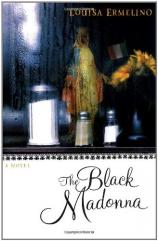
The Black Madonna
by Louisa Ermelino
List Price: $23.00
Pages: 256
Format: Hardcover
ISBN: 0684871661
Publisher: Simon & Schuster
The Black Madonna has long protected her mountain villagers in southern Italy, and some say she followed her people to America. What else explains the magic and miracles on Spring Street in Little Italy over the decades?
Teresa, whose son Nicky should never have walked again after his four-story fall, keeps a holy card of the Black Madonna hidden beneath her underwear. Magdalena, beautiful and mysterious, can make any man fall in love with her, including her stepson Salvatore, by praying secretly to an image of the Black Madonna in her attic. And Antoinette, after giving birth to five girls, had Jumbo, the biggest baby Spring Street ever saw -- once she had the Black Madonna's portrait in her kitchen.
Vibrant, dark-souled creatures who get their way, control their lives, and pass on arcane knowledge like family heirlooms from generation to generation, Teresa, Magdalena, and Antoinette, with their intersecting lives, take center stage in The Black Madonna. This is an exploration of how each woman, and her beloved son, is forever changed by the Madonna of Viggiano. Louisa Ermelino's wonderful novel reveals a delicious truth: that it is the Italian-American women who hold the secrets -- and the power -- from the "other side," and that they know how to use them.
A celebration of mother love and magic, The Black Madonna is filled with the sights, sounds, smells, and taste of Little Italy. Ultimately, it is a vibrant and life-affirming saga that all Americans will want to embrace as their own.
top of the page

1. The novel is divided into three sections, by its three central female characters (Teresa, Magdalena, and Antoinette) and by year (1948, 1936, and 1968). How do your perceptions of these women change over the course of your reading? What does the author achieve by structuring the novel this way, as opposed to using a more linear structure? Are some of the story's elements made more mysterious and suspenseful?
2. Most of the novel takes place in New York's Little Italy. How does the author use descriptions of local streets, shops, and businesses to enrich her descriptions of each era, and of the neighborhood's character? How does the author use dialogue to convey a sense of time and place?
3. Does the fact of the author's background (as an Italian-American herself) affect your response to the story? How does her ethnicity lend "authenticity" to the story being told? When thinking about your response to the novel, is her background irrelevant?
4. Consider the extent to which your notions of Italian-Americans have been informed by the media (e.g. The Godfather,' HBO's Sopranos series, etc.). How does the author overturn stereotypes in this novel? What were some of the surprising things you learned about Italian families from this novel?
5. Is the community portrayed in this novel male-dominated, or do women actually hold more power in the neighborhood?
6. The theme of faith is present throughout the novel. What role does it play in the daily lives of the novel's characters, particularly for the women? How does it sustain them?
7. Why does The Black Madonna hold such power over Teresa, Magdalena, and Antoinette, as well as Zia Guinetta? Why do they never lose faith in her?
8. How does Amadeo's marriage to Magdalena affect his relationship with Teresa? In what ways does the marriage cause a shift in Teresa's relationship with her own son, Nicky?
9. Consider the boys central to this novel: Nicky, Jumbo, and Salvatore. What brings them together as friends? In what ways are they alike? How do they differ?
10. Among the Italian families described in the novel, it is a tradition that when the children become adults, they will still care for their parents. The children in this novel feel a strong sense of responsibility toward their families. How do each of the boysNicky, Salvatore, and Jumborespond to this tradition? To what extent does it affect the paths they choose for themselves in life?
11. One of the themes the novel deals with--often through the use of humor--is assimilation. Why do you think the families of this New York neighborhood are so resistant to, and suspicious of, the customs of their adopted country? Why does assimilation have a slightly negative connotation for them? Is their resistance a means of maintaining their heritage? Over the course of the novel, certain characters such as Amadeo and Salvatore assimilate to American ways more than others: Are they viewed as success stories, traitors to their roots, or a little of both?
12. Why does Teresa choose to stay married to Angelo, a man who has not been around for years? Consider the time and setting in which the story takes place. How does the gossip of the neighborhood women affect her pride?
13. One of Teresa's neighbors remarks one day that if things had gone differently, Teresa would be living in Amadeo's house instead of Magdalena. Why didn't Teresa pursue a relationship with Amadeo?
14. What does it mean for a woman to mother someone else's child, as Teresa does for Amadeo after his wife's death? Is this healthy for a woman to do--does it adversely affect the child at all? Is it brave for Teresa to do this, despite what others in the neighborhood may say about her?
15. After Nicky's accident, Teresa tells him that "as long as no one saw him wheeling himself around like a circus freak, it was not a bad thing" (p. 35). Why does she care so much about the neighbors seeing Nicky like this? Why does she feel ashamed?
16. Why are marriage and childbirth so significant to each of the characters in this novel?
17. In what ways does the author undermine conventional notions of Italian machismo?
18. From the start of the novel, there is tension between Antoinette and Teresa. What is the source of their tension? How does it affect their children? Is Antoinette a sympathetic character? In what ways does she potentially antagonize the reader? How does Antoinette's character evolve over the course of the novel? Do you have a different opinion of her at the conclusion of the story?
19. Discuss the author's detailed descriptions of food throughoutand the importance of cooking, and of family dinner gatherings, in the novel. How does food signify a close family? How does it make a woman such as Antoinette Mangiacarne feel needed by her children?
20. How does the novel depict relationships between mothers and their sons? Fathers and their sons?
21. The mothers in this novel are determined to protect their beloved sons from harm. In what ways does their determination prove to be problematic to their sons? Nicky reflects after his divorce that "his mother was more important and any woman who got involved with him now would have to know that from the beginning." [p. 172]
22. How does having an exceedingly overprotective mother cause a crippling effect, particularly for Jumbo? (At one point Salvatore teases Jumbo, saying that his mother wanted him to be her husband; Antoinette herself says that as long as Jumbo ended up "in his bed and her kitchen she could forgive him anything." How does this dynamic infantilize Jumbo, and hinder his ability to succeed as an adult? How might it affect his role as husband to Judy and father to Baby Sol?
23. How does the section that takes place in Castelfondo reinforce the powerful familial bonds portrayed in the novel, the connection between those left in the "old country" and those who had emigrated to America?
24. What are the Black Madonna's gifts to each of these women: Teresa, Magdalena, Antoinette, and Zia Guinetta?
25. What role does honor play in the novel? Think about Jumbo's dealings with Fat Eddie Fingers, and his handling of Judy's pregnancy; and Amadeo's accepting Magdalena as his wife.
26. Does Magdalena do anything to encourage her neighbors' notions of her as a mysterious seductress? Why do they think this about her? Even as an adult, Salvatore thinks that Magdalena "unsettled him. She was still seductive, powerful." [p. 198]
27. Along with most of the characters in this novel, Teresa is a deeply superstitious woman: "When she heard Jumbo or his mother leave the house, she sprinkled the holy water onto the landing and down the stairwell" (p. 29). She goes to see "the woman on Bedford Street who had the power" after Nicky's accident (p. 31). Zia Guinetta, Amadeo's aunt, considers herself a witch, and says that she learned "the arts" from her mother. Amadeo considers buying a Cadillac but is afraid of "tempting fate." Think about how superstition shapes certain decisions made by these characters, and how it may affect the way they lead their lives, their relationships with each other.
28. Initially, there is mutual antipathy between Antoinette and Judy's parents, who are Jewish and live on Long Island, yet the two families have a great deal in common. (Even Sylvia acknowledges that both Italians and Jews were "family people.") What are some of the similarities between the Catholic Italian-American families portrayed in the novel, and Judy's Jewish family? How does the family dynamic differ between the two?
29. Consider Antoinette's relationship with Jumbo and Sylvia's relationship to her daughter. Antoinette is proud of the fact that her son is the biggest baby ever born in the neighborhood, and says at one point that even her son's many missteps give her pleasure, "because they tied him to her all the more tightly." [p. 188] Sylvia, however, watches her daughter get out of the car one day and remarks to herself that Judy may have gained some weight--"this was the first disappointment." [p. 194] How do their attitudes toward their children affect how Antoinette and Sylvia relate to each other?
30. The novel ends in 1968. Do the characters' lives turn out as you expected? Whose is most surprising to you? How do you imagine the lives of these characters to be a decade later? Twenty years later? What do you think has become of them? Are they living in the neighborhood they grew up in? How would gentrification have altered their community?
top of the page

"The Black Madonna is fast-paced and delightful, one of those books you can't put down until you've devoured every last word."
The New York Post
"A zesty debut
the warmth and humor of this slice-of-lives storytelling are seductive. This engaging first novel has TV sitcom potential."
Publishers Weekly
"Ermelino's frisky, old-fashioned storytelling possesses timeless appeal."
Entertainment Weekly
"An Italian version of The Joy Luck Club."
People
"Refreshing
What makes this book good is the author's truth of observation, her ear for speech and her humor, not to mention an ability to tell a sprawling story in a few words."
The San Francisco Chronicle
"Bad boys and good mothers -- or good boys and bad mothers? In The Black Madonna, Louisa Ermelino shows us three exasperating but lovable Italian mamas, and their equally exasperating but lovable sons. It's a festa worthy of the best held on Spring Street!"
Rita Ciresi, author of Sometimes I Dream in Italian
"Wise, witty, warm -- all the expected things, but tough too, and literary. Ermelino is a first-division writer -- graceful and witty in her use of language, loyal to the truth, passionate and proud. If Scorsese was a woman and a novelist, one would expect no less from him."
Fay Weldon, author of Affliction and A Hard Time to Be a Father
"The Black Madonna is a big-hearted, wise, and wonderfully observed novel about mothers and sons. Louisa Ermelino gives the reader all the life and glorious color of her characters and of New York's Little Italy."
Susan Isaacs, author of Almost Paradise and Shining Through
"Moving gracefully across decades and continents, The Black Madonna recounts marvelous tales of love, friendship, jealousy, and magic. With apparent effortlessness, Louisa Ermelino creates a world full of larger-than-life characters that is at once both ordinary and miraculous."
Tom Perrotta, author of Joe College and Election
"An endearing portrayal of working-class Italian-American women, their sons, their families, their lives, their loves, and their dreams in New York's Little Italy. Ermelino writes with sensitivity and compassion and a signature earthy charm."
Louise DeSalvo, author of Adultery
"The Black Madonna is an exquisite read. Teresa, Antoinette, and Magdalena, what a trio! These are not ladies who lunch, these are ladies that sit on tenement stoops, but they are just as lethal. The scenes at the Bronx hospital and in Italy are comically priceless. As has been said, Italiani, brava gente, but it is clear from these pages that "la femmina" rule the roost."
Edwin Torres, author of Q&A and Carlito's Way
"Louisa Ermelino is America's counterpart to Fellini and DeSica. She practices storytelling at its best. Lower Manhattan's Italian-American community has never been portrayed with more humor and love than in The Black Madonna."
Vincent Patrick, author of The Pope of Greenwich Village
|
|
|