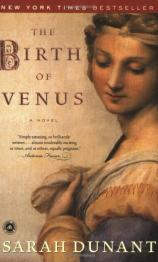
The Birth of Venus


Review
The Birth of Venus




Florence, Italy. 1492.
"The night the painter arrived is sharp as an etching in my memory…"
Like Botticelli's famous painting, from which this historical novel takes its title, THE BIRTH OF VENUS tells its story through layers of color and texture. Unlike other recent novels, it does not recreate the story behind the painting. Instead, the reference to Botticelli's masterpiece --- commissioned by Lorenzo de' Medici and depicting the mythological story of Venus being born from the sea --- is meant to symbolize the vibrancy of Renaissance Florence.
In the late fifteenth-century, Florence is thriving under the rule of the Medici, a family well known for its love of luxury and the arts. Symbols of the city's wealth and beauty are everywhere --- luxurious clothing, sumptuous feasts and glorious works of literature, art and architecture crafted by the likes of Dante, Botticelli and Brunelleschi.
For fourteen-year-old Alessandra Cecchi, the daughter of a prosperous cloth merchant, the gilt trappings only intensify her feelings of helplessness at the limitations imposed on women's freedom. She rebels against these restrictions in the only ways she can --- soaking up knowledge in the schoolroom, using her sharp wit to deter the cruelty of her older brothers, and drawing in secret.
When her father arrives home on a winter night in 1492 with a painter from the north, Alessandra's life will change in ways she never imagined. The painter has been brought into their household to work his magic on the chapel in the family's palazzo --- creating the altar frescoes and bringing honor and glory to the Cecchi name with each stroke of his paintbrush.
Intrigued as much by the young painter as by his talent, Alessandra seeks his help in furthering her own artistic ability. Their burgeoning relationship is cut short when Alessandra --- aware that, for her, an arranged marriage is inevitable --- weds an older nobleman she believes respects her intelligence and shares her love of art.
As Alessandra's life changes, so too does the city of Florence. The death of Lorenzo de' Medici paves the way for the Dominican friar Girolamo Savonarola to wield his religious fanaticism and plunge the city into its darkest days. Women are further oppressed, a serial killer walks the streets delivering his own cruel brand of justice and even within the Cecchi family it is impossible to distinguish friend from foe. And in her marriage, Alessandra finds devastating --- and potentially dangerous --- secrets, along with the surprising freedom to pursue her art and her attraction to the painter.
THE BIRTH OF VENUS breathes life into the history of Florence --- its art, philosophy, religion and politics --- but it is clearly Alessandra's story. The character of Alessandra was born when Sarah Dunant, who owns a home in Florence, discovered a lack of records about women artists during the fifteenth century. Was the desire there, she wondered, to play a part in the city's art movement but not the means to express it?
As the narrator of the tale, Alessandra takes up a pen during her final days to recount the events that have shaped her life. This vantage point allows Dunant to pique the reader's interest by foreshadowing pivotal events. It also makes for a richer story by giving Alessandra a perspective that would have eluded her had the story been told as a chronological narrative.
THE BIRTH OF VENUS is by turns mesmerizing and thought provoking, seductive and poignant. By the time you reach the last page, you'll feel much as Alessandra does when she realizes that, despite her talent never fully flourishing, she had the courage to add her voice to the greater chorus and "to have been a part of it at all" was reward enough.
Reviewed by Shannon McKenna on January 21, 2011


The Birth of Venus
- Publication Date: November 30, 2004
- Genres: Fiction, Historical Fiction
- Paperback: 448 pages
- Publisher: Random House Trade Paperbacks
- ISBN-10: 0812968972
- ISBN-13: 9780812968972