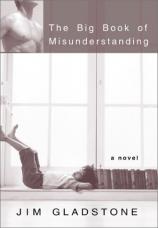
The Big Book of Misunderstanding


Review
The Big Book of Misunderstanding



Sooner or later everyone has to grow up…right?
That's the major thematic inquiry that hangs over each page of Jim Gladstone's THE BIG BOOK OF MISUNDERSTANDING.
In the third sentence of the book, the narrator, 20-something Josh Royalton, poses the ominous question: Did I have to end my life to end my childhood? And then, in a sometimes caustic but mostly humorous fashion, he tells us his entire life story. The tales seem archetypal at first: there are stuffed animals that come alive at night to frighten him; wrestling sessions with his more agile, stronger sibling, Lew; and goodnight rituals with his mom and dad, Becca and Harris Royalton. Some of Gladstone's most touching passages are in these early pages, when Joseph looks back with delight on being a middle-class child in a suburb of Philadelphia. The reminiscences are recognizable to anyone who grew up in middle-class America. In fact, they are almost universally recognizable. However, don't get too comfortable --- all is not Norman Rockwell in the Royalton abode.
The oldest of two sons, living in a household with an ever present sexually-charged parental energy that would make any child uncomfortable, Josh is four when we first meet him and his sense of humor. But Gladstone's real comedic genius lies in Josh's high school and college recollections and observations --- a few true, a few constructed, and most told in brief passages that each pack the punch of some of today's best short stories. (Think David Sedaris.)
A budding homosexual, Josh tries to convince himself that it's only natural to have fantasies about his male playmates, after all, he reasons and desires, they're having the same dreams about him, aren't they? He gets his adolescent, horny hands on a copy of EVERYTHING YOU ALWAYS WANTED TO KNOW ABOUT SEX and finds the chapter on masturbation provides "enormous relief." Once, he recalls, he wrote a horrendous poem entitled "Ode to An Everything Pizza" for Mother's Day, which he promptly read on a radio call-in show, followed by several calls praising the poem using different voices and made up names. These personas --- and the many he devises later --- lead to a teenage career in local theatre, where he finds his true passion. Later he elevates lying to an art form in college when he entertains his friends with family fictions. (Although, honestly, he could have told them some of the "real" stories and received the same kudos for his cleverness.) The minor characters Josh and the Royaltons interact with --- roommates, a girlfriend (yes, a girlfriend), boyfriends, and neighbors --- are richly drawn, quirky folks who could have been just as much the product of Josh's imagination as Gladstone's.
Josh's family --- the fodder for his mischievous tales --- is both bandage and underlying wound. Josh feels himself at once repulsed and attracted to home and to his family; the young adult Josh abhors their cloying connection as much as the child in him requires it. This is a struggling-with-coming-of-age tale, and not just for Josh. Through Josh's eyes, we watch his brother distance himself from what he calls an unhealthy family dependency, only to come full circle and unknowingly repeat the same relationship later in his own life. In an extremely painful but expertly written series of passages we see the senior Royaltons grappling with their own maturation; Gladstone unveils the elderly but immature bride and groom and finds that a relationship once frozen in time has started to thaw. Growing up. Eventually it happens to everyone…right?
The title may be THE BIG BOOK OF MISUNDERSTANDING, but Gladstone's sparkling debut book shares rare insights and exhibits a candid and profound (and funny!) understanding of what it means to grow up (or not grow up), at any age.
Reviewed by Roberta O'Hara on January 1, 2002


The Big Book of Misunderstanding
- Publication Date: January 1, 2002
- Genres: Fiction
- Paperback: 242 pages
- Publisher: Haworth Press
- ISBN-10: 1560233826
- ISBN-13: 9781560233824