Reading Group Guide
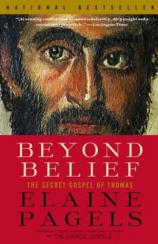
Beyond Belief
The Secret Gospel of Thomas
by Elaine Pagels

List Price: $13.00
Pages: 272
Format: Paperback
ISBN: 0375703160
Publisher: Vintage

Click here to buy this book from Amazon.com.
Click here to buy this book from Amazon.ca.


About This Book


In Beyond Belief, renowned religion scholar Elaine Pagels continues her groundbreaking examination of the earliest Christian texts, arguing for an ongoing assessment of faith and a questioning of religious orthodoxy.

Spurred on by personal tragedy and new scholarship from an international group of researchers, Pagels returns to her investigation of the "secret" Gospel of Thomas, and breathes new life into writings once thought heretical. As she arrives at an ever-deeper conviction in her own faith, Pagels reveals how faith allows for a diversity of interpretations, and that the "rogue" voices of Christianity encourage and sustain "the recognition of the light within us all."

top of the page


rgg_discuss.gif (1294 bytes)


1. Why has Elaine Pagels chosen Beyond Belief as her title? How can the title be interpreted?

2. Pagels begins each chapter with a personal reflection. What do these passages add to the book? What do they reveal about Pagels's own struggles with some aspects of traditional Christian beliefs? For what is she searching, as both a scholar and a Christian?

3. Pagels argues that those who "enshrined the Gospel of John within the New Testament and denounced Thomas's Gospel as 'heresy' decisively shaped --- and inevitably limited --- what would become Western Christianity" [p. 29]. In what ways has the triumph of John over Thomas shaped and limited Western Christianity? How might Christianity be different today if Thomas had been included in the New Testament?

4. Pagels says, "Thomas's Gospel encourages the hearer not so much to believe in Jesus, as John requires, as to seek to know God through one's own, divinely given capacity, since all are created in the image of God" [p. 34]. Why is this distinction so important? Why were Thomas's ideas considered heretical?

5. Why did Irenaeus and other early Christian theologians feel it was essential to unify Christian beliefs into a canon of orthodox teachings that all Christians must accept? What political pressures influenced their decisions?

6. What are the dangers of spiritual intuitions, visions, divine revelations, and other intensely subjective religious experiences? What are some of their destructive consequences? What positive value is there in such experiences? Should the Church encourage or discourage Christians from seeking or relying on these methods of access to a direct knowledge of God?

7. How do the Nag Hammadi texts alter our view of early Christianity? Do they, as Pagels suggests, offer a more open, diverse, and less doctrinal version of Christianity? Can they coexist with canonical texts? Should they be embraced by Christians? Why were they suppressed?

8. In the Gospel of Thomas, Jesus tells his disciples, when they ask about the resurrection, "What you look forward to has already come, but you do not recognize it," and says that "the kingdom of the Father is spread out upon the earth, and people do not see it" [p. 50]. What are the implications of these statements? How do they differ from more traditional ideas of the resurrection and the kingdom of God?

9. Pagels discusses several highly symbolic or metaphorical readings of the Bible, such as The Secret Book of John, in which Eve is interpreted as an embodiment of "epinoia --- a 'creative' or 'inventive' consciousness," and the apple as a symbol of higher spiritual knowledge [pp. 164–67]. How convincing is this reading? What does it offer that more conventional readings do not? Why did Irenaeus want to prohibit such interpretations?

10. At the beginning of Chapter 5, Pagels asks herself "Why not just leave Christianity --- and religion --- behind, as so many others have done?" [p. 143] Why is she tempted to abandon the church? What is it about Christianity that she still finds compelling? Does her situation seem representative of the ambivalence that many Christians feel today?

11. Based on your reading of Beyond Belief, how should religious tradition and innovation be balanced? How can the Church maintain its traditions without suppressing the imaginative involvement of creative individuals?

12. Pagels ends by saying that "the wealth and diversity of our religious traditions" encourages "those who endeavor, in Jesus' words, to 'seek, and you shall find'" [p. 185]. Why does she end her book in this way? What aspect of Christianity is she underscoring?

top of the page

Critical Praise

"Lucid . . . a spiritual as well as an intellectual exercise. . . . [Pagels] seems to rejoice that in the earliest years of Christianity there existed these strange, dissident doctrines."
--- The New York Times Book Review


"With the winning combination of sound scholarship, deep insight and a crystal clear prose style . . . [Beyond Belief] portrays the rich and beautiful heritage that was lost when champions of religious orthodoxy turned on many of their fellow Christians and declared them 'heretics'."
--- Los Angeles Times


"Majestic. . . . Exhilarating reading, Pagel's book offers a model of careful and thoughtful scholarship in the lively and exciting prose of a mystery writer."
--- Publishers Weekly


"Brilliantly lucid, elegantly written . . . [Pagels'] book is so readable you can't put it down."
--- Providence Journal-Bulletin

 
Back to top.   


Privacy Policy | Contact Us | Advertising | About Us

© Copyright 2001-2008, ReadingGroupGuides.com. All rights reserved.