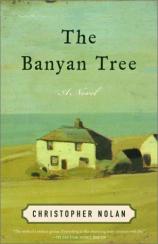
The Banyan Tree
by Christopher Nolan
List Price: $13.00
Pages: 384
Format: Paperback
ISBN: 0385720688
Publisher: Anchor Books
Covering the eighty-plus years of the life of Minnie O'Brien, The Banyan Tree is
a rich saga of rural Ireland in the twentieth century. In distinctly layered prose that
has been compared to that of James Joyce, William Butler Yeats, and Dylan Thomas, Nolan
lovingly details the life and times, the triumphs and tragedies, of this spirited woman,
who struggles to keep her body and soul, as well as her modest hopes, alive. Married in
1922 to Peter O'Brien, a good and decent man who nonetheless harbors a terrible secret,
Minnie bears him three children: Brendan, who joins the Church, rises to become a bishop,
and is quietly drinking himself to death in New York; Sheila, who marries above herself to
a wealthy but nasty Dublin businessman; and Francis, the youngest, who leaves home at age
seventeen to wander the world in search of fame and fortune. It is for him--Minnie's
favorite, the prodigal son--that she struggles to keep the five fields willed to her by
her husband from the clutches of her ambitious and unscrupulous neighbor Jude Fortune.
For, she is sure, one day soon Frankie will put an end to his wanderlust and come home to
claim what is rightfully his. Ostensibly bucolic, The Banyan Tree--feisty and
colorful, filled with humor and love--also demonstrates forcibly that the gentle world of
Minnie's youth is gone forever.
top of the page

1. The novel's opening chapter is a narration of Minnie at work on her weekly butter
churning. How does this chapter introduce the reader to the mind of Minnie O'Brien, to the
story's main concerns, and to the author's idiosyncratic prose style? What is the
significance of ordinary domestic detail in this novel?
2.It has been said of Christopher Nolan that "he plummeted into language like an
avalanche, as if it were his one escape route from death--which, of course, it was. He had
been locked for years in the coffin of his body, unable to utter. When he found words he
played rapturously with them, making them riot and lark about, echoing, alliterating and
falling over one another. . . . Nolan constantly subverted and remade idiom" (John
Carey, Preface to Under the Eye of the Clock, New York: St. Martin's Press 1987, p. ix).
What pleasures and difficulties does Nolan's unique use of language present to the reader?
What is unusual about his verb usage? What are the other notable elements of his writing
style?
3. According to Merriam-Webster's Collegiate Dictionary, a banyan tree is an East Indian
fig tree whose branches send out shoots that grow down to the soil and root to form
secondary trunks. Why has Nolan chosen this image for the book's title? To what does the
metaphor of The Banyan Tree refer? How is it being used in the following quotation:
"She thought as she chewed and chewed as she thought, and every time she swallowed
her banyan tree grew in desperation. . . . As she savoured it The Banyan Tree sent
down more roots and the moment they hit the floor up sprang three children, her three
children, playing a game of snap-apple this Hallowe'en in September" [p. 145]?
4. In Irish fiction the Catholic Church has traditionally played a large and sometimes
cruelly repressive role. How important is the church in Minnie's life? What effect, if
any, does religion have upon her sexuality? How does she feel when her eldest son decides
to become a priest?
5. Carried across the threshold by Peter, Minnie is described as a new bride, "hunted
down by nature" [p. 65]. At Sheila's birth, the narrator tells us that the new baby
"curled her toes in readiness for a life of only second-class importance" [p.
122]. Do these examples imply that being born female in Minnie's world limits a woman's
potential for happiness and self-realization? Does the fact that Minnie's neighbor Jude
Fortune, an example of an ambitious rather than a passive female, comes to such an unhappy
end support that theory?
6. Jude Fortune plays a powerful role in the story as the antagonist of Minnie's deepest
wish--to retain ownership of the five fields for Frankie's return. What sort of a woman is
Jude, and how are her values set in opposition to Minnie's? We're told, "The widow
Fortune thought like a farmer but grafted like a whore" [p. 172] and "To her
there was no such thing as love" [p. 171]. Is Jude's love of money and Minnie's love
of the land used to draw attention to two very different spiritual conditions in these
women?
7. Many important plot details in The Banyan Tree are only hinted at within the
text. We're told that Jude Fortune's father, "the bluebottle of her childhood, had
infested her every struggling dream. . . . Jude's reality lay somewhere between a father's
commerce and a husband's love" [p. 171]. Is this hint meant to supply an explanation
for Jude's behavior as an adult? Later in the story, Peter O'Brien's grandson reveals that
he is Nuala Lynam's grandson. Earlier, we are told that Nuala had put her baby up for
adoption at his birth. Is it correct to assume that the young man knows who his
grandfather is, and who Minnie is? Why is the author vague in these descriptions?
8. Why does Minnie fix her hopes on Frankie's return? What effect does his late arrival
have on her? Is he an admirable character? Does it appear that Minnie doesn't love her
other two children as much as she loves Frankie? Do the circumstances of Frankie's
conception make him an especially beloved child?
9. Near the end of her life, Minnie reflects on her children: "One set out as a priest
and came home an old man, one set out as a boy and never came back at all, and his girl
set out to nurse and now she's her own best patient" [p. 329]. Does Minnie have a
happier disposition than any of her children? Is she more at peace with the choices she
has made?
10. Minnie's two sons leave home early in life, but while Brendan sends letters and money,
Frankie cuts his ties more ruthlessly. What motivates their actions and their seeming
desire to stay away from Ireland? Are they trying to escape their family, or is it the
farm and its responsibilities that are too much of a burden? Could the novel be an
exploration of a generation's abandonment of rural life?
11. Thinking of Peter, Minnie says, "Aye indeed the mousetrap caught me a good man, a
good honest man" [p. 17]. Is Peter as honest as Minnie thinks he is? What are Peter's
best qualities? Why does he keep the knowledge of his heart disease from his wife and
family? When Minnie finds a picture entitled "your baby boy Peter" in his coat
pocket years after his death [p. 326], does she realize Peter's dishonesty? Does she
connect the visit of Nuala Lynam's grandson, who is "the livin' image" [p. 335]
of her son Frankie, with Peter's secret?
12. Much of Minnie's emotional life is lived waiting for the postman and for Frankie's
return: "This game of waiting was murder on the heart and tinder-boxed the
brain" [p. 329]. Sheila also waits, in thrall to her rich and wandering husband Luke
Green. Does this theme of waiting point to a problem of passivity, or of disappointed
love, in the lives of these women?
13. Looking at the generation of exiles from Ireland--the alcoholic priests Brendan O'Brien
and Harry Hope, the rootless Frankie, the Irish-speaking Pat from Donegal, who seems to be
dying of AIDS, the prostitute who enlists Frankie's help with Pat--does it appear that
these characters are living hopelessly unhappy lives, or merely normal ones? Is their
discontent directly related to their exiled condition? How does their discontent differ
from Minnie's? Are all hopes doomed to fail, for the rooted and wandering alike?
14. Christopher Nolan has been disabled from birth, and in his memoir Under the Eye of the
Clock, he refers to himself as "birth brain-damaged, but curiously, though seldom
recognized, intellectually normal" [p. 4]. How might such a disability affect an
author's point of view, the things he notices and cares about with greatest intensity?
Does the physical world perceived by the five senses appear with greater emphasis in
Nolan's writing? Does the fact that he typed out the book with his "unicorn
stick" seem to have affected the book's style or structure?
15. The story of The Banyan Tree is a simple one, focused as it is upon the memories
and experiences of a single character. How does Nolan's exuberant use of language
transform the apparent simplicity of the story? If you have read James Joyce's Ulysses,
which follows the thoughts and experiences of three characters throughout the course of
one day, would you consider The Banyan Tree similar in its basic premise?
top of the page

"Richly–even baroquely–told…. Nolan writes with verve."
The New York Times Book Review
"Nolan’s soaring language and lilting, alliterative style suffuse…the book with a sense of the miraculous."
The Philadelphia Inquirer
"A work of genius. Everything in this charming story simmers with life…. Unflaggingly engaging."
The Christian Science Monitor
"Nolan…makes the ordinary extraordinary. In his hands, a simple tale of a countrywoman’s steadfast strength becomes an elegiac, enthralling epic; funny, poignant, and as earthy as the Irish sod it’s set on."
BookPage
"Nolan is a stunning writer."
The New York Review of Books