Reading Group Guide
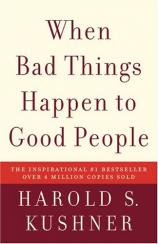
When Bad Things Happen to Good People
by Harold S. Kushner

List Price: $9.95
Pages: 176
Format: Paperback
ISBN: 1400034728
Publisher: Anchor

Click here to buy this book from Amazon.com.
Click here to buy this book from Amazon.ca.


About This Book


When Harold Kushner's three-year-old son was diagnosed with a degenerative disease and that he would only live until his early teens, he was faced with one of life's most difficult questions: Why, God? Years later, Rabbi Kushner wrote this straightforward, elegant contemplation of the doubts and fears that arise when tragedy strikes. Kushner shares his wisdom as a rabbi, a parent, a reader, and a human being. Often imitated but never superseded, When Bad Things Happen to Good People is a classic that offers clear thinking and consolation in times of sorrow.

Since its original publication in 1981, When Bad Things Happen to Good People has brought solace and hope to millions of readers and its author has become a nationally known spiritual leader.

top of the page


rgg_discuss.gif (1294 bytes)


1. What is wrong, according to Kushner, with the quotations from the Bible on page 12? Such teachings tell us that God is in control and makes things happen for a reason; why does Kushner disagree with the perspective they express?

2. What does Kushner mean when he says, "Chaos is evil" [p. 61]?

3. Throughout the book, Kushner emphasizes the role of community in bringing people through their worst pain and grief. He mentions Jewish traditions like the meal of replenishment and the recitation of the Mourner's Kaddish [p. 133], which shift the focus away from grief and death and back to life. Why is this idea so important, and why is it so often overlooked by people who are suffering from a loss?

4. What is the main message of the prayer written by Jack Riemer [pp. 130–31]? How does it differ from the kinds of prayers people often pray, like asking God for acceptance to a certain college or asking for a relative to get well? How is it similar to or different from the prayer of Jacob, discussed on pages 136–37?

5. Do the ideas expressed in When Bad Things Happen to Good People apply equally well to private and public tragedy --- say, one person's death from cancer as opposed to the massive loss of life that took place on September 11, 2001, or the devastation of the 2003 earthquake in Iran? How might these ideas affect a reader's moral understanding of history's worst events?

6. Why is the story of Job so important to this book? What insight does Kushner bring to the story?

7. Kushner writes, "I no longer hold God responsible for illnesses, accidents, and natural disasters, because I realize that I gain little and I lose so much when I blame God for those things" [p. 147]. Does it make sense that God is not an active agent in human misfortune? Why do most people think that God is responsible for the bad things that happen to us?

8. The idea that suffering has no meaning is "the most significant challenge that can be offered to the point of view I have been advocating in this book" [p. 148]. How does Kushner come to terms with this problem?

9. What is the wisdom in Kushner's suggestion that we should always focus on looking forward, asking ourselves, "Now that this has happened to me, what am I going to do about it?" [p. 149]

10. Kushner writes, "There is a crucial difference between denying the tragedy, insisting that everything is for the best, and seeing the tragedy in the context of a whole life, keeping one's eye and mind on what has enriched you and not only on what you have lost" [p. 153]. Why is this shift in perspective so important?

11. "The facts of life and death are neutral. We, by our responses, give suffering either a positive or a negative meaning" [p. 151]. How central is this statement to the book's overall argument?

12. Kushner says that he would give up all of the wisdom and sensitivity that he gained through his own suffering in order to be "the father of a bright, happy boy" [p. 147]. If Kushner's son had lived, it is unlikely he would have written this book. Kushner argues that suffering is not ennobling, yet his readers might argue that in his case it was. What is the creative potential of tragic experience?

13. If you could summarize in a sentence or two how this book has changed your perspective on the most difficult problems you face, what would you say? What inspiration does the book offer for you?

top of the page

Critical Praise

"Whether religious or not, this book will speak because it touches–profoundly, but simply–on questions no parent and no person can avoid."
Harvey Cox, Harvard Divinity School


"When Bad Things Happen to Good People offers a moving and humane approach to understanding life's windstorms."
Elisabeth K˙bler-Ross


"A touching, heartwarming book for those of us who must contend with suffering, and that, of course, is all of us."
Andrew M. Greeley


"This is a book all humanity needs. It will help you understand the painful vicissitudes of this life and enable you to stand up to them creatively."
Norman Vincent Peale

 
Back to top.   


Privacy Policy | Contact Us | Advertising | About Us

© Copyright 2001-2009, ReadingGroupGuides.com. All rights reserved.
The Book Report, Inc. • 250 West 57th Street • Suite 1228 • New York, NY • 10107
Ph: 212-246-3100 • Fax: 212-246-4640

Bookreporter.comReadingGroupGuides.comGraphicNovelReporter.comFaithfulReader.com
Teenreads.comKidsreads.comAuthorsOnTheWeb.comAuthorYellowPages.com