IndieBound Independent Bookstores

Barnes & Noble

Loading
Reading Group Guide
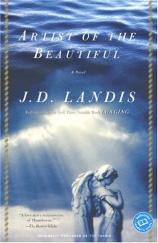
Artist of the Beautiful
A Novel
by J.D. Landis

List Price: $14.95
Pages: 416
Format: Paperback
ISBN: 0345450078
Publisher: Ballantine Books

Click here to buy this book from Amazon.com.
Click here to buy this book from Amazon.ca.


About This Book


In his critically acclaimed novel, Longing, J.D. Landis explored the volatile nature of passion as he brought to life the extraordinary marriage of Robert and Clara Schumann. It was a fervent love story that unfolded against the lavish backdrop of the Romantic Age. Now Landis tells a haunting story set amid a sylvan cluster of towns, villages, and graveyards in New England --- nestled in a valley that would be purposely flooded in the late 1930s to create the Quabbin Reservoir. Communities would be destroyed, lives uprooted, connections to places of birth severed, and the dead would be exhumed and reburied.

The fate of Swift River Valley holds a strange fascination for seventeen-year-old Sarianna Renway, a wayward student obsessed with the life and work of poet Emily Dickinson. Sarianna finds herself drawn to this little world whose end is predetermined and whose time is drawing near. In the small hamlet of Greenwich Village --- abandoned, beautiful, doomed --- Sarianna takes a job tutoring a minister's son.

A man of deep faith, Jeremy Treat strives to instill hope into a town destined to be taken and lost forever. He vows to be the last one in the valley to ensure his remaining flock leaves safely. Eleven-year-old Jimmy, "the perfect representation of God on earth," is a curious and compassionate child prodigy. The matriarch of the household is twenty-six-year-old Una, a voluptuous eccentric who embraces scandal --- and pines for the one true love who disappeared almost twelve years ago on the day she became Jeremy's wife. When the mysterious Ethan Vear resurfaces, none will emerge unchanged --- especially Sarianna, who finds herself ensnared in a triangle of shifting identities and warring passions.

In lush, evocative prose, J.D. Landis takes these vivid characters --- their secrets, their temptations, their desires --- and creates a stunning New England gothic novel of sexual awakening, profound loss, and thwarted love.

top of the page


rgg_discuss.gif (1294 bytes)


1. The title of this novel has been changed from its original, The Taking, to Artist of the Beautiful, which is taken from the title of a Nathaniel Hawthorne short story.Why do you think the title was changed? Which title: a) do you prefer, and b) do you think more appropriate?

2. In previous drafts of Artist of the Beautiful, some characters had different names: Sarianna was Susannah; Jeremy Treat was Darius Scadding; Una Treat was Alma Scadding; Simeon was Jairus. Why do you think these individual names might have been changed? Discuss how important you think characters' names are in this or any novel.

3. In what ways does the author "see --- New Englandly?" Consider not only landscape and history but also temperament.

4. What might the author mean when he says in the preceding interview, "We become those we love, and those we kill"? How does this relate to Artist of the Beautiful?

5. The lyrics of all but one of the songs and hymns in this novel were written by the author. Which one was not? (Hint: It was translated from the Italian.)

6. Describe Sarianna Renway's physical appearance. Why do you think her image sometimes fails to appear in mirrors and never appears in photographs? Discuss the use of both mirrors and photographs in this novel.

7. How many times in her life does Sarianna have sex? The author describes her as "asexual." Sarianna says early in the novel (p. 16) that she feels privileged to have been freed of desire before she was "lashed" by it. Discuss the use of the word "lashed" in two of its meanings: to be "bound" and to be "whipped." What does Sarianna mean when she says, "Without an object, desire is not only aimless but incongruous"? What happens to Sarianna when she encounters people she does desire? How does she function in an atmosphere so sexually charged?

8. When Sarianna finds on a Mount Holyoke College bulletin board the advertisement for the tutoring job in the Swift River Valley, she tears it down "so no one else might see it." How much of a schemer is Sarianna? How much of a coquette? Discuss what she learns about herself in the course of this one summer, keeping in mind that she is looking back upon this time from over fifty years later.

9. Do you think that Ethan is frozen in time, or is time frozen in Ethan? Why does Ethan's hair suddenly begin to grow after more than ten years?

10. What does Una mean when she says, "There is no now"? Is there indeed such a thing as the present moment? How does Una's statement relate to this novel, particularly to the revelation in the epilogue when Ethan's coffin is opened? What happens in the novel that makes Sarianna contradict Una's pronouncement?

11. Emily Dickinson wrote that Jesus was "too trackless for a tomb." How might this relate to the discovery of Ethan and Una, together and young, at the end of the book?

12. Jeremy Treat "wrestled not with the triviality of God but with the enormity of man." Sarianna has come to believe, through the example of Emily Dickinson, "If God made man, He was imperfect; if man made God, he was divine." A sign in the novel states, "God has no religion." Discuss these statements and this novel as a religious novel. Do you think God has, or favors, a particular religion? Do you think God ever intervenes in human affairs? Discuss the notion of "free will" in the novel (see p. 122), particularly as it relates to that of God's will.

13. Is any book in which there are characters who believe in God a book that therefore deals in the supernatural?

14. In what ways is Jimmy "the perfect representation of God on earth"? What does Jeremy Treat mean when he says, "If God were an artist, my son is what He'd make"?

15. Who is the "artist of the beautiful"? Ethan? Jimmy? Sarianna? Emily Dickinson? God? Any and all of us?

16. As a person and/or artist, would you rather be renowned when alive and forgotten when dead or unknown when alive and immortal when dead?

top of the page

Critical Praise

"Richly conveys both the joy and the sorrow of [an] extraordinary love story . . . In a lush, sinuous style . . . Landis draws us into a world at once turbulent and dazzling."
Los Angeles Times


"Witty, precise, rich in historical detail . . . No couple better sums up the brilliance and intensity of the Romantic Age than Robert and Clara Schumann. . . . Landis has a wonderful capacity for writing dialogue that sounds as if it's coming off the top of the characters' heads."
The Philadelphia Inquirer


"Penetrating. . . Landis has seamlessly interwoven his text with ideas (about language and music, genius, imagination and the nature of human devotion) that are very much his own. . . . It is almost as if Landis himself were conducting a score, with the two characters his human instruments."
The New York Times Book Review

 
Facebook Fan Page  Follow us on Twitter


Add Your Guide to ReadingGroupGuides.com!

Bookreporter.com Bets On...: Books We're Betting You'll Love


Privacy Policy | Contact Us | Advertising | About Us

© Copyright 2001-2012, ReadingGroupGuides.com. All rights reserved.
The Book Report, Inc. • 250 West 57th Street • Suite 1228 • New York, NY • 10107
Ph: 212-246-3100 • Fax: 212-246-4640

Bookreporter.comReadingGroupGuides.comGraphicNovelReporter.comFaithfulReader.com
Teenreads.comKidsreads.comAuthorsOnTheWeb.com