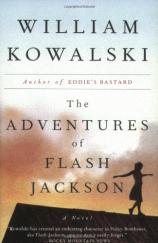
The Adventures of Flash Jackson
A Novel
by William Kowalski
List Price: $13.95
Pages: 336
Format: Paperback
ISBN: 006093624X
Publisher: Perennial
Haley Bombauer, aka Flash Jackson, confronts the summer of her seventeenth year with glorious anticipation. She envisions herself roaming the hillsides and forests on her beloved horse, venturing farther and farther away from her sleepy hometown and her overprotective mother.
But when Haley falls through the rotted roof of the barn, she is destined to spend the summer in a thigh-high cast, stuck at home with her mother, enduring visits from her spooky grandmother, and pondering the error of her impulsive ways. The year that follows will, in fact, transform not only her life but also the lives of those around her.
Set in Mannville, New York, William Kowalski's signature town, here is the story of one young woman's emergence into a world that, in her words, "was not designed with girls in mind" and her efforts to find a way to fit in without giving up her independence.
top of the page

1. Do you agree with Haley that "Life as a girl is pretty bad, all things considered. Seems like you can't just do what you want -- you have to do what other folks want you to do, or they might think ill of you"? (p. 13) How does the older Haley change her assessment of girlhood?
2. Haley has three role models: her mother, Miss Powell, and her Grandmother. What does each of these women do for Haley? Have you ever had a role model who changed your life in some significant way?
3. "Fear is a useless emotion," says Miss Powell, "One that will map your life out for you if you let it." Do you agree with this?
4. Haley thinks of her grandmother as someone who, like Thoreau, lives deliberately, or as Haley puts it, "Living like you meant it, doing everything yourself and not relying on anybody else to help you." (p. 20) How might the meaning of that term changed for Haley by the end of the novel?
5. When Haley's grandmother looks into the bowl to determine Haley's future, she utters two statements. Pay attention and Don't break rules. Does this turn about to be good advice for Haley? Is it good advice in general?
6. Before she meets Miss Powell, Haley thinks of her alter ego, Flash Jackson, as a kind of superhero, a "stuntman trapped in a female body." How does her image of Flash Jackson change over the course of the novel? Is Flash still a superhero?
7. Why do you think Frankie is so important to Haley? What does he represent to her?
8. During one of his "episodes," Frankie tells Haley about his plans for a theater. "People from the whole world can come right here," he tells her, "And they can get on stage and tell everyone their story, and then things will be okay again. People will understand each other." Why is this idea so appealing to Haley? How would you envision such a theater? Which of the novel's characters would benefit from the chance to tell his or her story?
9. Although Haley's grandmother rarely speaks to her, Haley learns to decipher the wisdom that the old woman is passing on to her. One of the most striking lessons is that "there was no secret; there was no hidden meaning. There was only what was right in front of your nose." (178) How would you apply this wisdom to Haley's experiences in the woods? How might you apply it to your own life?
10. What did you think of Haley and Adam's encounter in the woods? Do you think Haley's first sexual experience was a positive one?
11. In the woods, Haley comes as close to living like an animal as any human can. What does she learn about the difference between humans and animals? What kinds of relationships does she form with the other living things in the woods, especially Bear? How does her pregnancy affect her experience in the woods?
top of the page

"This ...is a tight book with a plot that arches where it's supposed to, characters that sing with life, dialogue that is lovely and real and images that resonate."
Globe and Mail (Toronto)
"An appealing and original story."
Kirkus Reviews
"A coming-of-gender story."
Library Journal