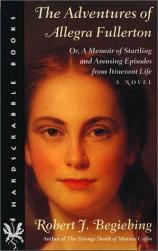
The Adventures of Allegra Fullerton
Or, A Memoir of Startling and Amusing Episodes from Itinerant Life-A Novel
by Robert J. Begiebing
List Price: $15.95
Pages: 326
Format: Paperback
ISBN: 158465211X
Publisher: University Press of New England
A picaresque novel of the remarkable life of a liberated 19th-century woman.
Robert J. Begiebing's first novel, The Strange Death of Mistress Coffin, was hailed by Annie Proulx in the New York Times Book Review as "a striking and original work by a gifted writer with an extraordinary feeling for the past." Begiebing delivers on the promise of that first book with his new novel, a lively, colorful, and exciting "portrait of the artist as a young woman" set in the early years of the republic.
In The Adventures of Allegra Fullerton, Begiebing masterfully conjures the voice and perspective of a young widow in the early 19th century, struggling toward independence and artistic fulfillment in a society unprepared to grant either to a woman. From her "stalking" by a powerful and dissolute young industrialist to her friendship with Transcendentalist Margaret Fuller, another independent-minded woman; from her artistic awakening in Italy, influenced by, among others, a young John Ruskin, to her re-awakened passion as a woman, Allegra Fullerton narrates her story in a voice that is wry, wise, but eternally optimistic.
Begiebing once again demonstrates his masterful command of historical fiction, vividly re-creating another century on the page. The daily life of New England and Italy in the 1830s and 1840s -- especially the circumstances of an itinerant portrait painter and struggling artist -- is rendered in rich and authentic detail. And Allegra's own consciousness is very much the product of her era, even as she struggles constantly to transcend the limited role that society offers her. Infused with picaresque humor and adventure, with meditations on art and freedom, and with the captivating, intelligent voice of Allegra herself, The Adventures of Allegra Fullerton is an enjoyable, engrossing novel.
top of the page

1. Like Hawthorne's The Scarlet Letter, The Adventures of Allegra Fullerton is presented to the reader as a "found" manuscript. How does this notion, introduced at the outset, affect your reading of the book? Why might the author create this "frame" for the book, rather than diving directly into Allegra's story?
2. The preface refers to the narrative both as a "novel" and a "memoir." Though the overall work is clearly fiction, why might the author introduce such an ambiguity into the frame story? How does this ambiguity affect your reading of the novel?
3. The preface makes reference to "the metallic -- dare I say lifeless? -- brilliancy of so many of our own contemporary authors." What sort of argument (if any) do you think Begiebing is making about contemporary literature, not just in the preface but in the form and nature of the entire novel?
4. Allegra's own story begins, not with the start of her travels, but later, as she is held captive by Joseph Dudley. Why might the author chose to start the story at this point? What sort of shape does this device give to the overall narrative arc?
5. The novel introduces historical figures such as Richard Henry Dana, John Ruskin and, especially, Margaret Fuller as characters. How does the presence of historical figures affect your experience of the story? Does the technique contribute to the authenticity of an historical novel? What knowledge of these figures did you bring to the novel, and how did that affect your reading?
6. Although Allegra Fullerton is set in the nineteenth-century, it is, inevitably, also a contemporary novel, inasmuch as it is written by an author who lives in our time and who has been shaped by the same social dynamics. How does this tension between the contemporary and the historical inform the novel and your response to it? Why might an author choose an historical setting for a novel?
7. One of the pleasures of historical fiction is the opportunity to learn detailed information about the culture and practices of earlier eras, especially such lost traditions as itinerant portrait painting. How well does the novel succeed on this level? At the same time, contemporary readers bring some knowledge of the era and its social dynamics to such a book. How did your previous knowledge of nineteenth century New England shape your response to the book?
8. The nature and role of art is an important topic for the characters in the story, and indeed, the preface refers to the story as a kuntslerroman, or artist novel. What sort of expectations do you bring to a work of this type? In what ways does this particular novel fulfill or decline to fulfill those expectations?
9. The role of women in society is another topic of concern to many of these characters, and at the same time, it is a subject on which society's consensus has changed a great deal from the period in which the novel is set. To what extent does the novel reflect the conventions of its time period, and to what extent does it reflect contemporary concerns and opinions?
10. A minor character in the novel remarks, "Life passes us by, you know, if we do not seize upon it and live honestly with those whom we love." In what ways are Allegra Fullerton's efforts to live honestly complicated by her ambitions as an artist and her status as a woman?
top of the page

"The 'recovered' memoir is fascinating . . . Allegra describes her transformation from 'mere traveling face maker' to sophisticated associate of Margaret Fuller and John Ruskin. She travels to Florence in the 1840s, where she contemplates her complicated relationship to the world as a young widowed female painter and engages in discussions about the nature of art . . . Allegra's insightful ruminations on the artistic life make up the lively heart of this book."
New York Times Book Review
"Art, philosophy, religion, slavery, sexual propriety, suffrage -- all are addressed with candid clarity. Although the language of the era is sometimes difficult for modern readers, the effort it takes is ultimately rewarded. Highly recommended."
Library Journal(starred review)
"Scholarly research and an imaginative plot are the linchpins of Begiebing's beguiling second novel . . . Begiebing presents Allegra's memoirs in formal, lustrous period language, and his meticulously evoked settings, dialogue and characters provide a seamlessly authentic entry into the era . . . Saturated with vivid period detail, sprinkled with rousing feminist sentiments . . . the novel will keep readers engrossed in its intelligent heroine's adventures. Reproductions of 19th-century portraits provide a visual supplement to this first-rate tale."
Publishers Weekly
"Two qualities set Allegra apart from a damsel-in-distress story: the richness of the historical detail and Begiebing's uncanny ability to see through the eyes of his main character. It's almost weird how convincing her voice is; one thinks of possession or reincarnation . . . Fictionally, Allegra is more accomplished and engaging [than The Strange Death of Mistress Coffin]. Begiebing, like Allegra, has studied and practiced his craft; his maturity shows in the depth of his main character . . . A delightful and surprising book."
Portsmouth (NH) Herald
"Begiebing . . . captur[es] the very essence of history and lifestyles of nineteenth century New England and Europe . . . thoroughly engrossing . . . It is quite obvious . . . that Begiebing has spent a significant amount of time in careful research on the nineteenth century, including studies in the artistic, social, economic, geographical, philosophical and political realms. All of which has imbued this work with detailed descriptions as to bring Allegra Fullerton's fictional story -- along with her beliefs and passions -- to life."
ForeWord Magazine
"Begiebing weaves research and plot in the style of 19th century prose, with long, lyrical sentences and thoughtful descriptions . . . The result is a captivating tale that rings historically true, and one that will particularly appeal to those who love art and history."
Foster's Daily Citizen (NH)