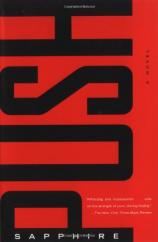
Push
by Sapphire
List Price: $11.00
Pages: 192
Format: Paperback
ISBN: 0679766758
Publisher: Vintage
The questions, discussion topics, and author biography that follow are
intended to enhance your group's reading of Sapphire's Push.
We hope they will aid your understanding of this vibrant and powerful
first novel by one of America's most controversial poets.
"Don't nobody want me. Don't nobody need me. I know who I am...ugly black grease to be wipe away, punish,
kilt, changed, finded a job for"[p. 33]. This is the voice of Precious
Jones, a viciously abused Harlem girl. At sixteen, Precious is pregnant-for
the second time-with her own father's child, and regularly beaten and
ordered around by her jealous, reclusive mother. Though she sits dutifully
in class every day-"I always did like school, jus' seem school never did
like me"[p. 38]-she has remained completely illiterate. Her life seems
set to repeat the self-destructive pattern of her mother's, until her
principal sends her to an alternative reading class where, with the help
of a dedicated teacher and fellow students who have undergone experiences
as harrowing as her own, she begins an intoxicating discovery of words,
friendship, and, in the process, herself.
Precious's voice-stark and crude yet filled with raw intelligence and even humor-demands to be heard
and, once heard, will prove unforgettable.
top of the page

1. What does this story tell us about the inadequacy of ordinary schools to deal with students' problems
and with their resulting learning handicaps? "I got A in English and
never say nuffin', do nuffin'"[p. 51], Precious says. Precious's principal
in effect tells her teacher to give up on her, saying "Focus on the
ones who can learn"[p. 39]. Is this an understandable or forgivable
attitude? How would you describe Mr. Wicher and his teaching methods?
Is he merely a coward or is he trying his best?
2. "The tesses paint a picture of me wif no brain,"says Precious. "The tesses paint a picture of me
an' my muver-my whole family, we more than dumb, we invisible"[p. 33].
In what way are Precious and her family members invisible to the larger
world? If you have read Ralph Ellison's Invisible Man, can you compare the way the
two authors use the metaphor of invisibility for their characters?
3. During the course of the story, Precious is obliged to confront her own prejudices and modify
or reject them. Her experience with the Hispanic EMS man makes her look
at Hispanics for the first time as human beings like herself; her friendship
with Ms. Rain and Jermaine makes her reexamine her knee-jerk homophobia.
Early in the novel she says, "I hate crack addicts. They give the race
a bad name"[p. 14], but later she questions that uncompromising position.
In an interview, Sapphire said of Precious that "she doesn't
know that hating gay people or hating Jews or hating foreigners is detrimental
to her" (Interview magazine, June 1996). Why is it detrimental
to her? Why is it imperative that she lose her prejudices before she,
herself, can be helped?
4. How would you describe Precious's self-image at the beginning of the book, and how would you describe
it at the end? How have her friends and supporters succeeded in helping
to alter her view of herself?
5. What is Precious's attitude toward Louis Farrakhan and his movement at the beginning of the story?
How does this attitude change during the course of her education? Why
have Farrakhan and his opinions become such a vital part of her world
view? What do you deduce the author's attitude toward him to be?
6. A famous-or perhaps infamous-Labor Department study, the Moynihan Report, blamed the absence of fathers
and the dominance of women (rather than economic and racial inequality)
for the problems confronting the African American family. Many black
scholars and activists have argued against the report's conclusions.
Which side of the argument do you believe Push to support?
7. Push presents what one reviewer called "one of the most disturbing portraits of motherhood
ever published" (City Paper, November 1996). How would you explain
or interpret Precious's mother's behavior?
8. "Miz Rain say we is a nation of raped children, that the black man in America today is the product
of rape"[p. 70Ð71]. What does Ms. Rain mean by this metaphor, and does
it strike you as an accurate one?
9. Precious tells Ms. Rain that the welfare helps her mother, to which Ms. Rain responds, "When
you get home from the hospital look and see how much welfare has helped
your mother"[p. 75]. What does this novel indicate about abuses and
inadequacies in the system? How might an ideal system be constructed?
10. Precious's file reflects the government "workfare" point of view, that Precious should already
be earning her own living, possibly as a home attendant. Precious objects
violently to this idea. Can you understand the social worker's point
of view? Have Precious's and Jermaine's arguments [pp. 123-125] changed
any opinions you previously held on this subject?
11. "Miz Rain say value. Values determine how we live much as money do. I say Miz Rain stupid there.
All I can think she don't know to have NOTHIN'"[p. 66]. Which opinion
do you agree with, or is there something to be said for both? What answer,
if any, does the novel offer?
12. "One of the myths we've been taught," Sapphire has said, "is that oppression creates
moral superiority. I'm here to tell you that the more oppressed a person
is, the more oppressive they will be" (Bomb, Fall 1996). How does the
novel illustrate the concept of the cycle of abuse? How does Precious
break that cycle, and what aspects of her own character enable her to
do so?
13. Push has been called a Dickensian novel, to which Sapphire has responded, "Part of
what's so wrong in this story is that we're not in a Dickensian era.
Those things shouldn't be happening in a post-industrial society" (Bomb,
Fall 1996). She sees the novel as "an indictment of American culture,
which is both black and white" (ibid). What aspects of our culture have
enabled the inequities described in the novel to develop? Would you
say that contemporary American cities consist, as Dickens's London was
said to, of two entirely different cultures, the rich one and the poor?
14. Why do you think Sapphire has chosen to end the story where she does? Does the book end on a sad
or hopeful note? What sort of future do you envision for Precious?
15. What is the significance of the novel's title, Push? At what points in her life is Precious
enjoined to "push"? What is meant by this word, and how does Precious
respond to the injunctions?
top of the page