IndieBound Independent Bookstores BRC Facebook Fan Page
Reading Group Guide
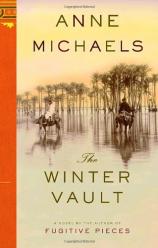
The Winter Vault
by Anne Michaels

List Price: $25.00
Pages: 352
Format: Hardcover
ISBN: 9780307270825
Publisher: Knopf

Click here to buy this book from Amazon.com.
Click here to buy this book from Amazon.ca.


About This Book


Award-winning poet and novelist Anne Michaels gives us a love story of extraordinary depth and complexity, a mesmerizing tale that juxtaposes historical events with the most intimate moments of individual lives.

In 1964, a newly married Canadian couple settles into a Nile River houseboat moored below the towering figures of Abu Simbel. Avery is one of the engineers responsible for the dismantling and reconstruction of the temple as it’s rescued from the rising waters of the Aswan Dam. He is a “machine-worshipper,” yet exquisitely sensitive to the dichotomy of creation and destruction of which machines are capable. Jean is a botanist by avocation and passion, interested in everything that grows. They had met on the banks of the St. Lawrence River and watched together as the construction of the seaway changed the course of the river and swallowed towns, homes, lives. Now, at the edge of another world about to be lost forever, Avery and Jean create their own world, exchanging the “moments that are the mortar of our days, innocent memories we don’t know we hold until given the gift of the eagerness of another.”

But that gift will not be enough to bind them when tragedy strikes, and they will go back to separate lives in Toronto. Avery returns to school to study architecture, and Jean enters the life of Lucjan, a Polish émigré artist. Lucjan’s haunting stories of occupied Warsaw draw Jean further and further away from Avery. But, in time, he will also offer her the chance for forgiveness, consolation, and, finally, her own, most essential life.

Stunning in its explorations of both the physical and emotional worlds of its characters, intensely moving and lyrical, The Winter Vault is a radiant work of fiction.

top of the page


rgg_discuss.gif (1294 bytes)


1. Discuss the metaphor of the title, The Winter Vault.

2. Have you read Michaels’s first novel, Fugitive Pieces? What parallels do you see between that novel and her new novel?

3. Reread the two passages at the very beginning. Now that you’ve read the entire book, what do the phrases “No image forgets this origin” and “No word forgets this origin” mean to you?

4. The book opens with Avery painting Jean’s back, and closes with her painting his. What is the significance of this act?

5. Throughout the novel, themes of human destruction and rebuilding play out. What do you think Michaels is trying to say? Can you think of any destruction in the novel that’s not human in origin?

6. How does Jean’s botany connect to Avery’s work?

7. What is the purpose of the Belzoni flashback on pages 30–32?

8. Why does Georgina Foyle affect Avery so strongly?

9. Words carry a lot of weight with the characters, especially through their storytelling. How do Avery, Jean, and Lucjan use words to achieve --- or avoid --- intimacy?

10. On page 93, Marina says, “Love must wait for wounds to heal.” Whose wounds is she talking about? How does this notion resonate throughout the novel?

11. Avery longs to save something, rather than destroy things. How does he finally do this?

12. Discuss the idea of home. How does it differ for the Nubians, the Poles, Avery, Jean, Lucjan?

13. On page 140, Jean talks about virtually indestructible seeds, which can lay dormant for centuries before sprouting. What is she really talking about?

14. “I want to build the room where I wish I’d been born,” Avery says on page 158. What does he mean by that?

15. How does Jean’s dream (pages 166–7) relate to her pregnancy? How does it change her?

16. What is the connection between Jean’s after-hours gardening and Lucjan’s “Caveman” paintings?

17. On pages 202–3, Jean realizes Lucjan’s painting “was not about Lascaux but about exile and the seizing of joy that will not come of its own accord.” Who else tries to seize joy, and how do they do it?

18. Reread the paragraph on page 214 that begins, “Cities, like people, are born with a soul. . .” Could you say the same about the Nubian countryside and the small towns along the St. Lawrence?

19. Daub writes to Jean (page 249): “Perhaps there is a collective dead. But there is no such thing as a collective death. Each death, each birth, a single death, a single birth.” What does this mean for Jean, for Lucjan, for the post-Holocaust world?

20. How does the jazz group the Stray Dogs fit into the larger story?

21. Reread and discuss Ranger’s rant on pages 266–7.

22. Several times in the novel, Lucjan tells Jean that we only get one chance to be happy in life, and if something goes wrong, that chance is lost forever. Where do you think that turning point is for him? For Jean? And Avery? Do you agree with this theory?

23. “Regret is not the end of the story; it is the middle of the story”(page 336). The novel closes with this thought. What does it mean?

top of the page

Critical Praise

"Has it been worth the wait [sinceFugitive Pieces]? It has . . . Anne Michaels, in short, is back . . . Think of The Arabian Nights, or the Odyssey, where characters incessantly tell stories about themselves and others; these are texts that carry whole cultures within themselves, and Michaels achieves something similar here . . . This is a book that proposes great themes: a critique of progress, an exploration of the nature of human suffering, an interrogation of the relationship between past and present. And yet, for all of that, it remains at bottom a deeply affecting love story . . . Beautifully written."
— Steven Hayward, Globe and Mail


"A deeply felt novel of ideas that explores loss, displacement, human connection and the ‘one or two organizing principles’ that inform an individual life . . . Michaels brings lost worlds to life [in] painfully beautiful prose."
Kirkus Reviews


"A tender love story set against an intriguing bit of history is handled with uncommon skill . . . Michaels is especially impressive at making a rundown of construction materials or the contents of a market as evocative as the shared moments between two young lovers . . . An exquisite second novel."
Publishers Weekly, Starred Review

 
Back to top.   


Privacy Policy | Contact Us | Advertising | About Us

© Copyright 2001-2009, ReadingGroupGuides.com. All rights reserved.
The Book Report, Inc. • 250 West 57th Street • Suite 1228 • New York, NY • 10107
Ph: 212-246-3100 • Fax: 212-246-4640

Bookreporter.comReadingGroupGuides.comGraphicNovelReporter.comFaithfulReader.com
Teenreads.comKidsreads.comAuthorsOnTheWeb.comAuthorYellowPages.com