IndieBound Independent Bookstores BRC Facebook Fan Page
Reading Group Guide
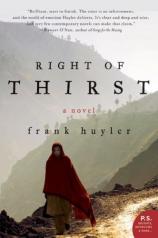
Right of Thirst
by Frank Huyler

List Price: $14.99
Pages: 384
Format: Paperback
ISBN: 9780061687549
Publisher: Harper Perennial

Click here to buy this book from Amazon.com.
Click here to buy this book from Amazon.ca.


About This Book

Shattered by his wife's death, and by his own role in it, successful cardiologist Charles Anderson volunteers to assist with earthquake relief in an impoverished Islamic country in a constant state of conflict with its neighbor. But when the refugees he's come to help do not appear and artillery begins to fall in the distance along the border, the story takes an unexpected turn.

This haunting, resonant tour de force about one man's desire to live a moral life offers a moving exploration of the tensions between poverty and wealth, the ethics of intervention, the deep cultural differences that divide the world, and the essential human similarities that unite it.

-Click here to read an excerpt from Right of Thirst.

top of the page


rgg_discuss.gif (1294 bytes)

1. The protagonist, Charles Anderson, travels to an unnamed Islamic country on what he believes will be a redeeming humanitarian mission. Why do you think the country is unnamed? Why is Anderson's hometown similarly not identified? Why are specific geographical details withheld throughout the novel?

2. Is Anderson a good man? Are his intentions noble? Are they selfish? Does he himself know or fully understand the difference?

3. What is the relevance of the story to recent world events?

4. What is the relevance of the story to the American Dream? How have Anderson's values changed since he was a young man at the dinner party on the shore of Lake Michigan? Has experience brought him wisdom, and, if so, what has he learned?

5. One of the subtexts of the novel is that of genetics—Elise's study, or Anderson's reflection on the film about the ant burrows. What is the relevance of this theme to the larger events of the story? Is the author implying that we are at the mercy of our genes, that free will is impossible? Or, is he implying the opposite, that we are capable of rising above our basic natures when necessary?

6. Scott Coles is an admirable person on the one hand, and a flawed, foolish narcissist on the other. Is Charles Anderson any different? How much does self-knowledge matter in the end?

7. How is Sanjit Rai like Charles Anderson and/or Scott Coles? How do they differ? Why is Elise studying only the Y (male) chromosome, and what relevance does this fact have to the story? What do you think the author is saying about the world of men?

8. With the noteworthy exception of Homa's mother, the most honest characters in the story are women. What is the role of women and girls in the story? How do they differ from the male characters in the book?

9. Eric, Anderson's son, is an actor. What roles do each of the various main characters—Anderson, Rai, Coles, General Said—play throughout the story? How do these roles differ from their true selves?

10. There are many journeys in this story, some real, some allegorical. What larger purpose does the metaphor of the journey serve?

11. What does the novel seem to be saying about cultural differences? That we are essentially the same, or that there are profound, irreconcilable differences between us that will never be bridged?

12. Why does Anderson give Rai the money at the end? Who is he doing this for? What does this act say about Anderson, and about charity in general? Is it possible to be charitable and selfish at the same time?

top of the page

Critical Praise

"One of the finest novels I’ve read in years... A timely, powerful exploration into the uses and limits of benevolence . . . the limits of what’s good and decent in the American character."
— Ben Fountain, author of Brief Encounters with Che Guevara


"Resonant... vivid and compassionate... A timely, disquieting reflection on mortality, war and the startling dichotomy between the affluent West and the impoverished Third World."
Kirkus Reviews


"A book to treasure. It is a riveting tale of our time, at once haunting and inspiring, provocative and insightful. It will stay with me for a long time."
— Tom Brokaw


"Lyrical, moving, gripping… A dark, compelling story about moral ambition and its pitfalls-a necessary book for this moment in America’s imperial history."
— Andrew Solomon, author of the National Book Award-winning The Noonday Demon

 
Back to top.   


Privacy Policy | Contact Us | Advertising | About Us

© Copyright 2001-2009, ReadingGroupGuides.com. All rights reserved.
The Book Report, Inc. • 250 West 57th Street • Suite 1228 • New York, NY • 10107
Ph: 212-246-3100 • Fax: 212-246-4640

Bookreporter.comReadingGroupGuides.comGraphicNovelReporter.comFaithfulReader.com
Teenreads.comKidsreads.comAuthorsOnTheWeb.comAuthorYellowPages.com