IndieBound Independent Bookstores BRC Facebook Fan Page
Coming Soon
Reading Group Guide
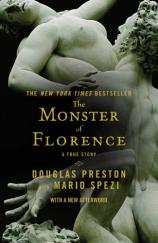
The Monster of Florence
by Douglas Preston and Mario Spezi

List Price: $14.99
Pages: 368
Format: Paperback
ISBN: 9780446581271
Publisher: Grand Central Publishing

Click here to buy this book from Amazon.com.
Click here to buy this book from Amazon.ca.


About This Book

In the tradition of John Berendt's Midnight in the Garden of Good and Evil and Erik Larson's The Devil in the White City, Douglas Preston weaves a captivating account of crime and punishment in the lush hills of Florence, Italy.

Douglas Preston fulfilled a lifelong dream when he moved with his family to a villa in Florence. Upon meeting celebrated journalist Mario Spezi, Preston was stunned to learn that the olive grove next to his home had been the scene of a horrific double murder committed by one of the most infamous figures in Italian history. A serial killer who ritually murdered fourteen young lovers, he has never been caught. He is known as the Monster of Florence.

Fascinated by the tale, Preston began to work with Spezi on the case. Here is the true story of their search to uncover and confront the man they believe is the Monster. In an ironic twist of fate that echoes the dark traditions of the city's bloody history, Preston and Spezi themselves became targets of a bizarre police investigation.

With the gripping suspense of Preston's bestselling novels, The Monster of Florence tells a remarkable and harrowing chronicle of murder, mutilation, suicide, and vengeance --- with Preston and Spezi caught in the middle.

top of the page


rgg_discuss.gif (1294 bytes)


1. Pietro Pacciani was convicted of being the Monster of Florence after an exhaustive investigation. Later he was acquitted. On p. 157, a highly placed carabinieri officer shared a theory of criminal justice with Mario Spezi. He said, “Have you ever considered that [Pietro] Pacciani’s trial might be nothing more than a case of the acquisition and management of power?” What did he mean by that statement? Who acquired and managed power in the course of this case? How did that power serve them?

2. Douglas Preston and Mario Spezi make a compelling case that Antonio Vinci could be the Monster of Florence. Do you agree with their assessment? Many in the Italian establishment have asserted that a satanic cult (or their hired help) committed the murders. Preston and Spezi disagree with that theory. What do you think? Based on what you have read, can you envision any other, different theory that would fit the facts? If you could question any suspect on the list, whom would you want to interrogate? What would you want to know?

3. How important is “journalistic privilege”? Why do you think journalists wish to keep their sources and research secret? In 2005 when Valerie Plame was exposed as a covert CIA officer in the news, a grand jury was convened to investigate how information about Plame was leaked to journalists. Subsequently, Judith Miller, a reporter for the New York Times, was jailed for contempt of court when she refused to reveal her source. Miller was quoted as saying, “If journalists cannot be trusted to guarantee confidentiality, then journalists cannot function and there cannot be a free press.” Do you agree with this statement? Do you think there are times when a journalist should reveal his or her information? When and why? Do you think Preston should have asserted journalistic privilege in his interrogation?

4. Preston was interrogated and accused of several crimes associated with the Monster case while Spezi was jailed and accused of being the Monster himself. Chart the path of their relationship. What actions did they take that led to their harassment by the Italian judicial system? What mistakes did they make?

5. On p. 141, Spezi describes how he went to meet with Arturo Minoliti to ask the caribinieri marshal about his doubts regarding the investigation against Pacciani. Spezi was wearing recording equipment underneath his clothes for this meeting, even though he “always had deep misgivings about this type of journalism and he had often sworn he would never do it. It was dirty, it was shaking down someone for a scoop.” Do you agree that it is dirty? How far do you think a journalist should go for the sake of information? Can you think of examples where journalists did not go far enough? What about examples where journalists went too far? At what point does the quest for the truth become unethical and turn foul?

6. Ruggero Perugini is accused by carabinieri marshal Arturo Minoliti of planting evidence in the garden of Pietro Pacciani—a bullet cartridge casing—that implicated Pacciani in the murder. Why do you think an officer like Perugini would choose to plant evidence, if he in fact did so?

7. Preston and Spezi have spoken of feeling obsessed with the case. They went to great lengths, at high personal risk and expense, to investigate the evidence and see the Monster exposed and caught. Do you think there is a point where such obsession can become negative? Preston and Spezi were so determined to find the killer that they followed up dubious reports that the killer had hidden evidence in locked iron boxes—and this led them into a disastrous entanglement with the police. Chart the progression of their investigation. Do you think their pursuit of the iron boxes was a reasonable quest? Or do you think that their obsession made them vulnerable to believing a false story? Have you ever believed this passionately in a truth that others did not see? How far would you go to achieve your goals?

8. How much, if anything, did you know about the case of the Monster of Florence before reading Preston and Spezi’s book? A number of cities in the United States have suffered from the crimes of serial killers. What did you feel when you read about a case that was so famous in Italy, but had little coverage in the United States until recently? What does it mean to you to imagine a serial killer plaguing countries abroad like this?

9. Count Niccolò Capponi explained to Preston the theory of dietrologia, that Italians often think “the obvious thing cannot be the truth.” What role has dietrologia played in the Monster of Florence investigation? Do you think Americans also have a culture of dietrologia?

10. Some reviewers complained that the book lacked a satisfying ending, in that the identity of the Monster of Florence is never definitively established. Do you think this is a flaw in the book? Does a good work of nonfiction have an obligation to provide a neat ending? Is the truth in all its messy incompleteness sufficient?

11. The Monster is a convoluted and tortuous story, spanning more than forty years, involving many investigators, suspects, victims, ancillary characters --- and two narrators. The authors confront this complexity with an unusual literary structure, breaking the book into two parts, the first told largely in the third person, the second largely in the first person. Do you think this structure works? Do you have any thoughts on other ways the book could have been structured?

12. In a recent essay, Preston wrote: “The Monster of Florence is not just a book about a serial killer or a bungled investigation; it is a book about modern Italy itself.” Do you agree? What does the Monster story reveal about the character of modern Italy --- both positive and negative?

top of the page


Privacy Policy | Contact Us | Advertising | About Us

© Copyright 2001-2010, ReadingGroupGuides.com. All rights reserved.
The Book Report, Inc. • 250 West 57th Street • Suite 1228 • New York, NY • 10107
Ph: 212-246-3100 • Fax: 212-246-4640

Bookreporter.comReadingGroupGuides.comGraphicNovelReporter.comFaithfulReader.com
Teenreads.comKidsreads.comAuthorsOnTheWeb.comAuthorYellowPages.com