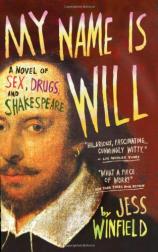
My Name Is Will: A Novel of Sex, Drugs, and Shakespeare


Review
My Name Is Will: A Novel of Sex, Drugs, and Shakespeare




How best to write a contemporary novel about Shakespeare that even Shakespeare would like? Make him a young, sexy and smart ladies man with a cause to suffer and enemies to fight. Give him lots of witty puns to pronounce, a complicated family life and a good group of friends. Finally, compare and contrast him with a graduate student in 1980s California who, also named Shakespeare, is similarly focused on amorous escapades, sidetracked by familial realities and lost in a world of words.
This is Jess Winfield's formula in his debut novel, MY NAME IS WILL.
William Shakespeare is not yet 20 years old. He is a school teacher in his hometown of Stratford who prefers drinking ale with his friends to Latin, and wooing girls to just about everything else. His father is the town drunk, and visitors to the family's home are greeted by a 10-foot garbage pile outside the front door. His mother's family, the Ardens, were once well respected, but since the Queen converted all of England to Protestantism, the Ardens, as Catholics, have begun to fear persecution. All across the country, Catholics, priests and scholars have been arrested, tortured and executed. When William, never one to think too much about religion, learns more about his own family's past and their current struggle to maintain their faith, he must decide where his allegiance lies. Does he risk life and limb for the Roman Church, or does he accept the new faith? His soul-searching is complicated, however, by his libido, which keeps getting him into trouble.
A few hundred years later, Willie Shakespeare Greenberg is struggling with his masters thesis. He has a vague notion that the original Shakespeare was Catholic, but he has very little to go on. His research is complicated not only by his libido but by his preference for getting high over doing any actual work. His father is cutting him off financially, and so he agrees to deliver some drugs to a Renaissance Faire to make some fast cash. But the trip ends up mostly a disaster due to the affections of not two but three women, the DEA and a gigantic magic mushroom.
It’s time for William and Willie to grow up. The one thing it seems that will save them both is theater, if they decide to channel their intellect and energy in that positive direction.
Winfield's tale is funny and interesting. The parallels not only between William and Willie but between 16th century England and 20th century America mostly work. Both eras were ones of rapid social and political change, and both young men embody much of the spirit, and conflict, of their times. William comes across as the far more sympathetic character; he faces real danger and has few options. This is the man long before he was The Bard but was still, according to Winfield, a wise-cracking, rebellious teenager who, deep down, longed to do the right thing. Willie is a bit spoiled and harder to like. But, in his own deep love for the work of Shakespeare (which connects him to his dead mother, who named him with high hopes), Willie finds a path to his true self and readers find a young man with potential for good and for greatness.
In MY NAME IS WILL, Winfield's own love of Shakespeare, love of words and love of theater shine through. He plays with words and captures the feeling of the times and places he is setting the action in, yet the themes remain timeless. Despite a few less than exemplary scenes, it is nicely written, enjoyable and full of references to Shakespearean works that readers in the know will have fun teasing out. In other words, this is a book that even Shakespeare may have enjoyed.
Reviewed by Sarah Rachel Egelman on January 12, 2011


My Name Is Will: A Novel of Sex, Drugs, and Shakespeare
- Publication Date: July 3, 2009
- Genres: Fiction
- Paperback: 320 pages
- Publisher: Twelve
- ISBN-10: 0446508837
- ISBN-13: 9780446508834