IndieBound Independent Bookstores

Barnes & Noble

Loading
Reading Group Guide
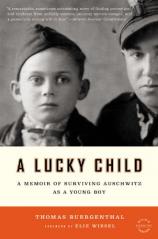
A Lucky Child
A Memoir of Surviving Auschwitz as a Young Boy
by Thomas Buergenthal

List Price: $14.99
Pages: 230
Format: Paperback
ISBN: 9780316043397
Publisher: Back Bay Books

Click here to buy this book from Amazon.com.
Click here to buy this book from Amazon.ca.


About This Book

Thomas Buergenthal, now a Judge in the International Court of Justice in, tells his astonishing experiences as a young boy in his memoir A Lucky Child. He arrived Auschwitzat age 10 after surviving two ghettos and a labor camp. Separated first from his mother and then his father, Buergenthal managed by his wits and some remarkable strokes of luck to survive on his own. Almost two years after his liberation, Buergenthal was miraculously reunited with his mother and in 1951 arrived in the country to start a new life.

Now dedicated to helping those subjected to tyranny throughout the world, Buergenthal writes his story with a simple clarity that highlights the stark details of unimaginable hardship. A Lucky Child is a book that demands to be read by all.

top of the page


rgg_discuss.gif (1294 bytes)

1. Thomas Buergenthal says that he tried to write his story “as I remember living it as the child I was, not as an old man refl ecting on that life” (page xvii). How do you think the effort to achieve this perspective shaped the book? What effect might writing A Lucky Child through the eyes of an adult have had on the narrative? What thoughts, ideas, and emotions are added or taken away when writing about such a defi ning life experience through the eyes of a child?

2. Young Thomas was forced to leave his beloved little red car behind when the Buergenthals’ hotel in Lubochna was occupied by Slovak allies of Nazi Germany --- a heartbreak he never forgot. Were you ever forced to give up something as a child that you could never forget, even if it seemed silly in the face of greater losses?

3. Thomas’s mother insisted for the rest of her life that the fortune- teller was correct in her prediction that her son was “ein Glückskind” --- a lucky child --- and that it was this belief that gave her hope during her time in the camps. Have you, or anyone you know, ever experienced a seemingly baseless faith in something, only to discover later its great importance?

4. The liquidation of the “Arbeitslager” (labor camp), when Ucek and Zarenka are taken from Thomas’s family, is a defi ning moment for Thomas, and one of the few horrors that is never erased from his memory. Before he is taken as well, Thomas declares to the commandant, “Captain, I can work!” Just nine years old at the time, Thomas shows astounding courage. Do you think that in similar circumstances you would have had the fortitude that young Thomas demonstrates so many times? What do you think made him step forward and say this? Was it chance or something more?

5. Upon his arrival in the Auschwitz barracks, Thomas sees the Kapos beat and murder an inmate named Spiegel as payback for his disloyalty to one of them in Kielce. Thomas wonders whether it occurs to the Kapos that they are no different from Spiegel, for as he had denounced one of them to save himself in the ghetto so had they become Kapos to survive in the camps. He writes, “Had they not ended up in the camps, they probably would have remained decent human beings. What is it in the human character that gives some individuals the moral strength not to sacrifice their decency and dignity, regardless of the cost to themselves, whereas others become murderously ruthless in the hope of ensuring their own survival?” How would you answer this question?

6. When Thomas is in the United States, he refl ects: “I doubt that we would have been able to preserve our sanity had we remained consumed by hatred for the rest of our lives.” Do you think you could be as forgiving in such a situation? How do you think Thomas and his mother managed to let go of their anger?

7. A Lucky Child is written with a surprisingly unsentimental tone that Buergenthal attributes to the many years that have passed since he was a child of the camps. This lack of sentimentality is one of the facets of the story that sets it apart from other Holocaust memoirs. Did it unsettle you? Did you fi nd that the tone of Buergenthal’s writing made it easier or somehow more difficult for you to read about the horrors he experienced?

top of the page

 
Facebook Fan Page  Follow us on Twitter


Add Your Guide to ReadingGroupGuides.com!

Bookreporter.com Bets On...: Books We're Betting You'll Love


Privacy Policy | Contact Us | Advertising | About Us

© Copyright 2001-2012, ReadingGroupGuides.com. All rights reserved.
The Book Report, Inc. • 250 West 57th Street • Suite 1228 • New York, NY • 10107
Ph: 212-246-3100 • Fax: 212-246-4640

Bookreporter.comReadingGroupGuides.comGraphicNovelReporter.comFaithfulReader.com
Teenreads.comKidsreads.comAuthorsOnTheWeb.com